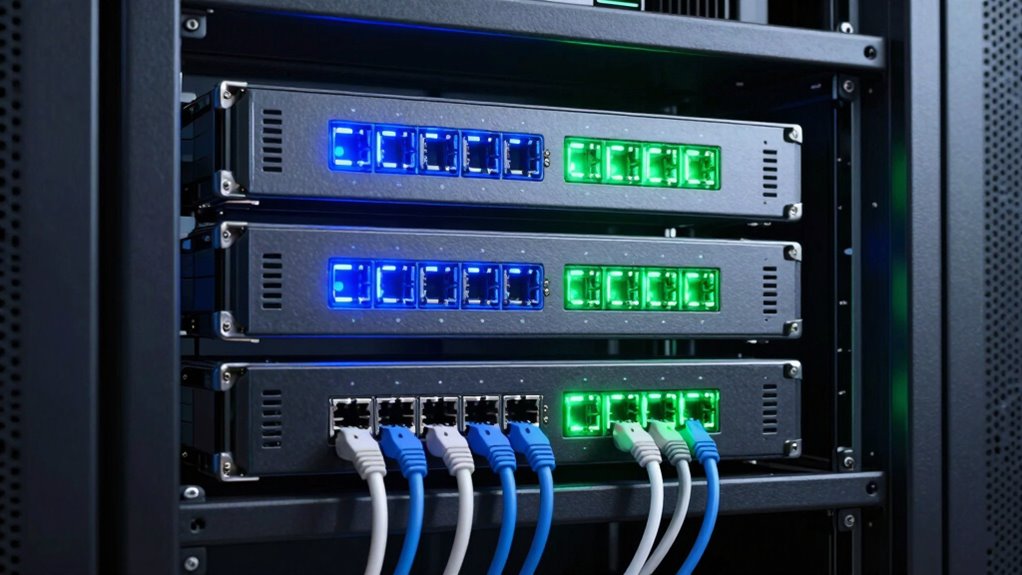
Choosing the right data center switch in 2026 means balancing performance, scalability, and management features. Among the top contenders, the Fortinet FortiSwitch 124F offers a silent, secure option ideal for smaller setups or edge deployments. Cisco N9K-C93180YC-EX stands out for high bandwidth and virtualization support suited for large-scale data centers. For those needing high-speed fiber and redundancy, MikroTik CRS326-24S+2Q+RM provides enterprise-grade throughput. This roundup compares these and other top models, highlighting their strengths and tradeoffs to help you find the best fit for your specific environment.

Get the latest gadgets delivered free — and shop member deals
- Fast, free delivery on millions of items
- Access to Prime Big Deal Days deals on October 6–7
- Prime Video, Amazon Music and more included
Complete the kit



Key Takeaways
- Performance scalability varies significantly, with some models supporting up to 640 Gbps throughput.
- Ease of management ranges from simple, integrated solutions to complex, enterprise-grade configurations.
- High port density and fiber support are crucial for large data centers, but they often come with higher costs.
- Redundancy features like hot-swappable power supplies are common in premium models, enhancing uptime.
- Layer 2 capabilities suffice for basic needs, but advanced features like VXLAN and SDN are reserved for higher-end switches.
| Fortinet FortiSwitch 124F Performance Layer 2 Switch – 24 Gigabit Ethernet Ports, 4 SFP+ Ports, Fanless |  | Best for Silent, Secure Small to Medium Deployments | Model: 124F | Ports: 24 GE, 4 SFP+ | Fanless: Yes | VIEW ON AMAZON | See Our Full Breakdown |
| Cisco N9K-C93180YC-EX 48x 25GB SFP+ 6x 100GB QSFP28 Switch (Renewed) |  | Best for High Bandwidth, Virtualization, and Large-Scale Data Centers | Ports: 48x 10/25-Gbps SFP+, 6x 100-Gbps QSFP28 | Switching Capacity: 3.6 Tbps | Latency: Less than 1 microsecond | VIEW ON AMAZON | See Our Full Breakdown |
| MikroTik CRS326-24S+2Q+RM |  | Best for High-Speed Fiber and Redundancy in Data Centers | Ports: 2x 40 Gbps QSFP+, 24x 10 Gbps SFP+ | Total Throughput: 320 Gbps | Switching Capacity: 640 Gbps | VIEW ON AMAZON | See Our Full Breakdown |
| QNAP QSW-M7230-2X4F24T-US 30-Port Layer 3 Lite Managed Network Switch |  | Best for Scalable, Low-Latency Data Center Networks | Ports: 2×100GbE QSFP28, 4×25GbE SFP28, 24×10GbE | Layer: Layer 3 Lite | Routing Support: IPv4/IPv6 static routing | VIEW ON AMAZON | See Our Full Breakdown |
| Cisco Nexus 9300 Series N9K-C93240YC-FX2 Switch, 48x 25GB SFP, 12x 100GB QSFP28, Dual PSU, Renewed |  | Best for High-Density, Advanced Features, and Enterprise Scalability | Ports: 48× 10/25G SFP+ and 12× 100G QSFP28 | Power supplies: Dual hot-swappable PSU | Form factor: Data center switch | VIEW ON AMAZON | See Our Full Breakdown |
| data center switch | Ports |
|---|---|
| Fortinet FortiSwitch 124F Perf | 24 GE, 4 SFP+ |
| Cisco N9K-C93180YC-EX 48x 25GB | 48x 10/25-Gbps SFP+, 6x 100-Gbps QSFP28 |
| MikroTik CRS326-24S+2Q+RM | 2x 40 Gbps QSFP+, 24x 10 Gbps SFP+ |
| QNAP QSW-M7230-2X4F24T-US 30-P | 2×100GbE QSFP28, 4×25GbE SFP28, 24×10GbE |
| Cisco Nexus 9300 Series N9K-C9 | 48× 10/25G SFP+ and 12× 100G QSFP28 |
More Details on Our Top Picks
Fortinet FortiSwitch 124F Performance Layer 2 Switch – 24 Gigabit Ethernet Ports, 4 SFP+ Ports, Fanless
The Fortinet FortiSwitch 124F specializes in providing a quiet, secure network access point with its fanless design. Its 24 Gigabit Ethernet ports and 4 SFP+ ports support basic high-speed connectivity, making it ideal for edge or branch office environments. Compared with higher-end switches, it lacks Layer 3 features and PoE support, limiting its scalability for larger or more complex data centers. Its integrated management via FortiLink simplifies deployment for users already within the Fortinet ecosystem, but those unfamiliar with Fortinet products might find the setup less intuitive.
Pros:- Fanless operation for silent environments
- Secure, integrated management with FortiLink
- Scalable for various business sizes
Cons:- Limited to Layer 2 capabilities
- No PoE support
- Requires familiarity with Fortinet ecosystem
Best for: Small to medium-sized businesses needing reliable, quiet Layer 2 switching
Not ideal for: Large-scale data centers requiring advanced virtualization or Layer 3 routing
- Model:124F
- Ports:24 GE, 4 SFP+
- Fanless:Yes
Our verdict“A solid choice for environments prioritizing silent operation and security over advanced features.”
Cisco N9K-C93180YC-EX 48x 25GB SFP+ 6x 100GB QSFP28 Switch (Renewed)
The Cisco N9K-C93180YC-EX offers exceptional port flexibility with 48 10/25-Gbps SFP+ ports and 6 100-Gbps QSFP28 ports, making it ideal for high-bandwidth data center environments. Its low latency, support for VXLAN, and high availability features like hot-swappable components make it suitable for demanding deployments. Compared with more straightforward switches, its complex setup requires specialized network knowledge, and the renewed status might limit warranty support. Its size and power consumption are considerations for racks with limited space or power budgets.
Pros:- High bandwidth and port flexibility
- Low latency with cut-through switching
- Supports network virtualization and automation
Cons:- Complex deployment process
- Renewed product may have limited warranty
- Bulkier and more power-hungry
Best for: Large data centers requiring high bandwidth and virtualization support
Not ideal for: Smaller businesses or environments with limited technical staff
- Ports:48x 10/25-Gbps SFP+, 6x 100-Gbps QSFP28
- Switching Capacity:3.6 Tbps
- Latency:Less than 1 microsecond
- Form Factor:1RU rack-mountable
- Operating System:Cisco NX-OS
- Supports:VXLAN, Cisco ACI, Layer 3
Our verdict“This switch is best suited for large, high-performance data centers with skilled network teams.”
MikroTik CRS326-24S+2Q+RM
The MikroTik CRS326-24S+2Q+RM delivers impressive throughput with 2x 40 Gbps QSFP+ ports and 24x 10 Gbps SFP+ ports, supporting nonblocking 320 Gbps throughput. Its dual power supplies provide redundancy, making it reliable for mission-critical applications. Management flexibility with RouterOS and SwOS allows tailored configurations, but the setup can be complex, requiring familiarity with MikroTik’s ecosystem. Its higher price point reflects its enterprise-grade features, making it less suitable for budget-conscious buyers.
Pros:- High-speed fiber ports
- Redundant dual power supplies
- Flexible management options
Cons:- Complex setup process
- Premium price for enterprise features
Best for: Enterprises needing high-speed fiber and redundancy in demanding environments
Not ideal for: Smaller networks or users seeking simple plug-and-play solutions
- Ports:2x 40 Gbps QSFP+, 24x 10 Gbps SFP+
- Total Throughput:320 Gbps
- Switching Capacity:640 Gbps
- Forwarding Rate:252 Mpps
- Management:RouterOS or SwOS
- Power:Dual power supply
Our verdict“A compelling option for high-performance data centers prioritizing fiber connectivity and reliability.”
QNAP QSW-M7230-2X4F24T-US 30-Port Layer 3 Lite Managed Network Switch
The QNAP QSW-M7230-2X4F24T-US stands out with 2×100GbE, 4×25GbE, and 24×10GbE ports, supporting advanced Layer 3 Lite routing. Its design for ToR deployments offers low-latency, lossless transmission with features like PFC and ECN, making it suitable for enterprise and data center environments. While its advanced features require some network expertise, it provides high scalability and reliability for growing infrastructures. Its higher price may deter smaller operations, but its feature set justifies the investment for large-scale setups.
Pros:- High-speed 100GbE and 25GbE ports
- Supports advanced Layer 3 Lite routing
- Designed for low-latency, lossless data transmission
Cons:- Complex setup for non-experts
- Premium pricing for enterprise use
Best for: Enterprise networks needing scalable, low-latency Layer 3 routing
Not ideal for: Small offices or users without network management experience
- Ports:2×100GbE QSFP28, 4×25GbE SFP28, 24×10GbE
- Layer:Layer 3 Lite
- Routing Support:IPv4/IPv6 static routing
- Design:Top-Of-Rack
- Built-in Technologies:PFC, ECN
- Made in:Taiwan
Our verdict“Ideal for large, scalable data centers requiring sophisticated routing and fiber connectivity.”
Cisco Nexus 9300 Series N9K-C93240YC-FX2 Switch, 48x 25GB SFP, 12x 100GB QSFP28, Dual PSU, Renewed
The Cisco Nexus 9300 Series N9K-C93240YC-FX2 offers a dense port mix with 48 10/25G SFP+ and 12 100G QSFP28 ports, making it suitable for demanding cloud and enterprise data centers. Its support for SDN, VXLAN, and EVPN, along with dual hot-swappable PSUs, emphasizes high reliability and feature richness. Its renewed status can impact warranty coverage, and the setup complexity might be overwhelming for those without specialized expertise. However, its energy-efficient design helps reduce operational costs in large deployments.
Pros:- High port density and flexibility
- Supports SDN, VXLAN, EVPN
- Reliability with dual hot-swappable PSUs
Cons:- No included rails kit
- Complex configuration requirements
- Renewed product with limited warranty
Best for: Enterprise and cloud data centers needing dense, feature-rich switches
Not ideal for: Smaller companies or those without technical support resources
- Ports:48× 10/25G SFP+ and 12× 100G QSFP28
- Power supplies:Dual hot-swappable PSU
- Form factor:Data center switch
- Features:VXLAN, EVPN, Layer 2/3, SDN support
Our verdict“A premium choice for large, sophisticated data centers with advanced networking needs.”
How We Picked
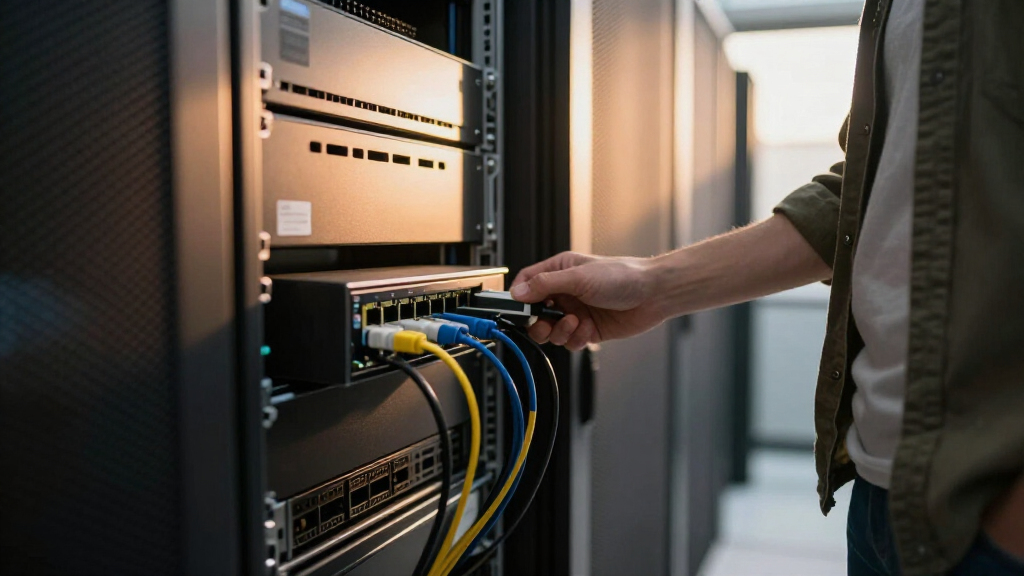
Our selection process focused on switches tailored for data center environments, emphasizing high throughput, advanced management, and scalability. We evaluated products across different tiers—from entry-level to enterprise-grade—considering technical specifications, deployment flexibility, and support features. Price was a factor, but we prioritized value based on performance and feature set. Compatibility with modern data center architectures, such as ToR and spine designs, also influenced our choices. Our goal was to identify options suitable for a range of data center sizes and operational needs, ensuring that each pick offers a distinct role.
Factors to Consider When Choosing Data Center Switch
Selecting the ideal data center switch depends on your specific network size, throughput requirements, management complexity, and future scalability plans. Whether you prioritize simple Layer 2 features or need support for advanced virtualization, each option offers different tradeoffs in price, complexity, and performance. Understanding these differences helps ensure your investment aligns with your operational goals and technical expertise.
Performance and Bandwidth Needs
Assess your current and future bandwidth demands—larger data centers requiring multi-hundred-gigabit throughput will need switches with high port density and support for fiber optics. Some switches, like the MikroTik CRS326-24S+2Q+RM, deliver impressive throughput, but at a premium price. Smaller networks can often suffice with simpler Layer 2 switches, like the Fortinet FortiSwitch 124F, which provides ample performance without unnecessary complexity.
Management and Deployment Complexity
Ease of management varies from plug-and-play solutions to complex, enterprise-grade setups. Switches like the Fortinet FortiSwitch offer integrated management with familiar interfaces, ideal for less technical teams. Conversely, high-end switches such as the Cisco N9K-C93180YC-EX require specialized knowledge but provide automation, virtualization, and advanced routing features that large-scale environments demand.
Scalability and Future Proofing
Consider how your network might grow. Switches supporting 40 Gbps, 100 Gbps, or supporting SDN and VXLAN are better suited for future expansion. The Cisco Nexus 9300 series and MikroTik CRS326 excel in this area, offering modularity and high throughput. For quick deployments with moderate growth, simpler switches may suffice, but they might limit your options down the line.
Cost and Total Cost of Ownership
Price varies widely, with enterprise features commanding premium costs. While initial investment is important, also factor in operational costs, power consumption, and support. More sophisticated switches tend to require more skilled staff and maintenance, which can impact overall TCO. Balancing budget against performance and features is key to making a sustainable choice.
Frequently Asked Questions
What is the main difference between Layer 2 and Layer 3 switches?
Layer 2 switches primarily handle data forwarding within a local network segment based on MAC addresses, making them suitable for simple switching needs. Layer 3 switches add routing capabilities, allowing them to connect multiple networks and support protocols like IP routing. For data centers, Layer 3 features enable more complex network architectures, better scalability, and improved traffic management, which are essential for large or segmented environments.
How important is port speed support like 10G, 25G, or 100G in a data center switch?
The importance of port speed support depends on your data transfer requirements. Higher speeds like 25G or 100G are vital for high-performance applications, large-scale virtualization, and fiber backbone connections. They reduce bottlenecks and enable faster data movement across the network. Conversely, smaller networks or those with less demanding workloads can often operate efficiently with 10G ports, saving costs and power.
What are the advantages of switches with redundant power supplies?
Redundant power supplies significantly enhance network reliability by ensuring continuous operation even if one power source fails. This feature is particularly important in data centers where uptime is critical. It reduces the risk of downtime due to power issues and simplifies maintenance, as a failed power supply can be replaced without shutting down the switch.
Are renewed or refurbished switches a good choice for data centers?
Refurbished or renewed switches, like some Cisco models, can offer cost savings but come with tradeoffs. They may have limited warranties and support, and their lifecycle might be shorter. For mission-critical environments, fully new equipment might provide greater reliability and ongoing support. However, for testing or less critical applications, renewals can be a budget-friendly option if purchased from reputable sources.
What should I consider when choosing a data center switch for future expansion?
When planning for future growth, look for switches supporting high throughput, fiber connectivity, and scalable architectures like SDN or VXLAN. Modular designs and support for higher port densities help accommodate expansion without replacing existing hardware. Additionally, consider management complexity and whether your team has the expertise to handle advanced features that might be necessary as your network evolves.
Conclusion
For small to medium-sized businesses or edge deployments prioritizing silence and ease of use, the Fortinet FortiSwitch 124F offers a reliable Layer 2 solution. Large enterprises or data centers needing high bandwidth, virtualization, and scalability will find the Cisco Nexus 9300 series or MikroTik CRS326 more fitting. Budget-conscious buyers with technical expertise might lean toward MikroTik for its high throughput, while those seeking advanced SDN support should consider the Cisco switches. Ultimately, matching your environment’s size, complexity, and growth plans guides the best choice.
Fall Picks
fall essentials
As an affiliate, we earn on qualifying purchases.