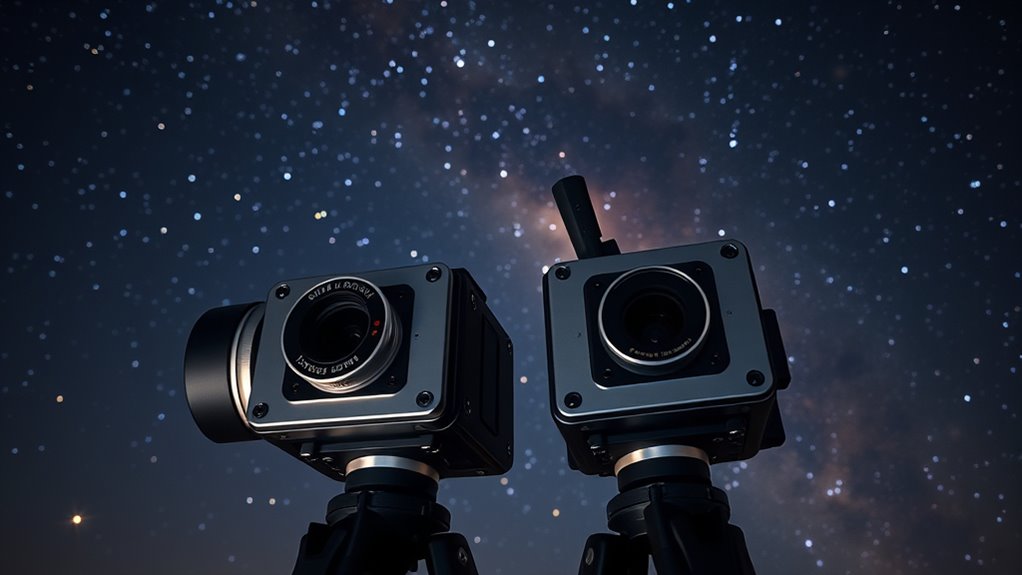

For deep sky astrophotography, choosing the right cooled CMOS camera can make a significant difference in image quality and ease of use. The SVBONY SV405CC stands out with its high sensitivity and fast transfer, making it ideal for capturing faint objects. SVBONY SC571CC offers a high-resolution 26MP sensor and robust cooling, suited for detailed imaging but with a more complex setup. Meanwhile, the SVBONY SV605CC provides a versatile option with a smaller sensor but effective cooling, perfect for those balancing quality and simplicity. Each has distinct strengths and tradeoffs, which I’ll explore to help you find the best fit for your astrophotography goals.

Get the latest gadgets delivered free — and shop member deals
- Fast, free delivery on millions of items
- Access to Prime Big Deal Days deals on October 6–7
- Prime Video, Amazon Music and more included
Complete the kit



Key Takeaways
- High-resolution sensors like the IMX571 excel at capturing detailed deep-sky images but often come with increased complexity and cost.
- Effective cooling systems significantly reduce noise, especially during long exposures, but can add to the setup complexity.
- Compatibility and ease of setup vary widely, with some cameras requiring specific software or stable mounting solutions.
- Sensor size impacts field of view and image detail, with larger sensors ideal for wide-field imaging but often heavier and more demanding to handle.
- Budget considerations influence feature set, with more advanced cameras demanding higher investment but offering superior imaging capabilities.
| SVBONY SV405CC Astrophotography Camera, Cooled Telescope Eyepiece IMX294 |  | Best Overall for Deep Sky Imaging | Sensor: IMX294 | Sensor Size: 4/3″ | Pixel Size: 4.63μm | VIEW ON AMAZON | See Our Full Breakdown |
| SVBONY SC571CC Cooled Color Astronomy Camera, IMX571 CMOS APS-C Sensor |  | Best for High-Resolution Deep Sky Imaging | Sensor: IMX571 CMOS APS-C | Resolution: 26MP | Sensor Size: 23.4×15.7mm | VIEW ON AMAZON | See Our Full Breakdown |
| SVBONY SC571CC APS-C Cooled Camera with SV241 Power Adapter USB Hub |  | Best for Versatile, Multi-Device Setups | Sensor: IMX571 APS-C BSI | Resolution: 26MP | Sensor Size: 23.4×15.7mm | VIEW ON AMAZON | See Our Full Breakdown |
| SVBONY SV605CC Cooled Color Astrophotography Camera, 9MP IMX533 |  | Best for Multi-Purpose Deep Sky and Atmospheric Imaging | Sensor: IMX533 | Resolution: 3008×3008 | Pixel Size: 3.76μm | VIEW ON AMAZON | See Our Full Breakdown |
| cooled cmos astro cameras for deep sky imaging | Sensor | Pixel Size | Resolution | Cooling |
|---|---|---|---|---|
| SVBONY SV405CC Astrophotograph | IMX294 | 4.63μm | 4144×2822 | Two-stage TEC, up to 30°C below ambient |
| SVBONY SC571CC Cooled Color As | IMX571 CMOS APS-C | 3.76 μm | 26MP | Dual-stage TEC, -35°C below ambient |
| SVBONY SC571CC APS-C Cooled Ca | IMX571 APS-C BSI | 3.76 μm | 26MP | Dual-stage TEC, -35°C below ambient |
| SVBONY SV605CC Cooled Color As | IMX533 | 3.76μm | 3008×3008 | TEC secondary refrigeration, cools to 30°C below ambient |
More Details on Our Top Picks
SVBONY SV405CC Astrophotography Camera, Cooled Telescope Eyepiece IMX294
This model is distinguished by its high-sensitivity IMX294 sensor, enabling excellent light collection for faint deep-sky objects. Its two-stage TEC cooling effectively reduces noise during long exposures, a critical factor for astrophotography. Compared with larger sensors, this one strikes a balance between image detail and manageable setup, though it does require compatible software to unlock full functionality. Its fast USB 3.0 interface ensures quick data transfer, making it suitable for experienced users who value reliability and performance.
Pros:- High-sensitivity IMX294 sensor captures faint details
- Effective cooling reduces noise during long exposures
- Fast data transfer via USB 3.0
- Broad software compatibility
Cons:- Requires compatible software for full operation
- Setup can be complex for newcomers
Best for: Intermediate to advanced astrophotographers seeking a high-sensitivity, versatile camera
Not ideal for: Beginners or those seeking a plug-and-play solution without software complexity
- Sensor:IMX294
- Sensor Size:4/3″
- Pixel Size:4.63μm
- Resolution:4144×2822
- Cooling:Two-stage TEC, up to 30°C below ambient
- Interface:USB 3.0
Our verdict“The SVBONY SV405CC offers a compelling mix of sensitivity, cooling, and compatibility, making it the best overall choice for dedicated deep-sky astrophotographers willing to handle some setup complexity.”
SVBONY SC571CC Cooled Color Astronomy Camera, IMX571 CMOS APS-C Sensor
The SVBONY SC571CC caters to those aiming for detailed, high-resolution images with its 26MP IMX571 sensor on an APS-C chip. Its dual-stage TEC cooling keeps noise minimal even in challenging conditions, and the front-window heater prevents dew formation. This camera excels in capturing wide, detailed fields but can be heavy and requires a sturdy mount. Its complexity makes it more suitable for experienced astrophotographers who prioritize image resolution over ease of setup.
Pros:- High-resolution 26MP sensor captures fine details
- Dual-stage TEC cooling reduces noise
- Front-window heater prevents dew
- Reliable USB 3.0 connection
Cons:- Heavy and potentially difficult to mount
- Setup can be complex for newcomers
- May require specific telescope compatibility
Best for: Advanced users seeking maximum detail and resolution in deep sky images
Not ideal for: Beginners or users with limited setup space or less sturdy mounting options
- Sensor:IMX571 CMOS APS-C
- Resolution:26MP
- Sensor Size:23.4×15.7mm
- Pixel Size:3.76 μm
- Cooling:Dual-stage TEC, -35°C below ambient
- Connectivity:USB 3.0
Our verdict“The SC571CC is a powerful, high-resolution camera best suited for astrophotographers who want maximum detail and are prepared for a more involved setup process.”
SVBONY SC571CC APS-C Cooled Camera with SV241 Power Adapter USB Hub
This version of the SC571CC enhances flexibility with a comprehensive power and data hub, supporting multiple USB ports and power outputs. Its dual-stage TEC cooling maintains low noise levels, while its compatibility with various telescope types—like APO, Newtonian, and RC scopes—makes it highly adaptable. However, the setup demands careful handling of input voltage and current, and the array of ports may overwhelm beginners. It suits those looking to build a robust, multi-device astrophotography station.
Pros:- High-resolution 26MP sensor
- Dual-stage TEC cooling for low noise
- Multiple USB ports and power outputs
- Wide compatibility with various telescope types
Cons:- Complex setup and handling of power inputs
- Limited to 12V/10A power supply
- Potentially overwhelming for newcomers
Best for: Advanced hobbyists or professionals needing flexible connectivity and multi-device support
Not ideal for: Beginners or users seeking straightforward, minimal setups
- Sensor:IMX571 APS-C BSI
- Resolution:26MP
- Sensor Size:23.4×15.7mm
- Pixel Size:3.76 μm
- Cooling:Dual-stage TEC, -35°C below ambient
- Power Input:12V DC, 10A max
- USB Ports:2 USB 3.1, 1 USB 2.0, 1 Type-C
Our verdict“This camera setup is best suited for experienced users who need a versatile, multi-connection system capable of supporting complex astrophotography rigs.”
SVBONY SV605CC Cooled Color Astrophotography Camera, 9MP IMX533
The SVBONY SV605CC offers a smaller 1-inch chip with a 9MP IMX533 sensor, making it accessible for those interested in both deep sky imaging and meteor or atmospheric observations. Its TEC secondary refrigeration cools to 30°C below ambient, reducing noise effectively. While not offering the resolution of the 26MP options, it still provides excellent image quality in a more compact form factor, suitable for users who want versatility without excessive complexity.
Pros:- Moderate resolution with good image quality
- Effective cooling for noise reduction
- Compact and easier to handle
- Suitable for diverse imaging applications
Cons:- Lower resolution compared to 26MP models
- Limited field of view for wide-area imaging
- Requires compatible telescope system
Best for: Beginners and hobbyists wanting a versatile, all-around astrophotography camera
Not ideal for: Advanced astrophotographers requiring ultra-high resolution or specialized setups
- Sensor:IMX533
- Resolution:3008×3008
- Pixel Size:3.76μm
- Cooling:TEC secondary refrigeration, cools to 30°C below ambient
- Application:Deep space, meteor, panoramic
Our verdict“The SV605CC balances ease of use and performance, making it an excellent choice for beginners or those seeking a multi-purpose camera for various astronomical tasks.”
How We Picked
Our selection process focused on models designed specifically for deep sky imaging, emphasizing effective cooling, sensor quality, and compatibility. We prioritized cameras with proven sensor performance, robust cooling systems, and positive user feedback, while also considering setup complexity and value. Each product was assessed against these criteria to ensure they meet the needs of serious astrophotographers aiming for high-quality deep sky images without excessive hassle or cost.
| cooled cmos astro cameras for deep sky imaging | Sensor | Cooling |
|---|---|---|
| SVBONY SV405CC Astrophotograph | IMX294 | Two-stage TEC, up to 30°C below ambient |
| SVBONY SC571CC Cooled Color As | IMX571 CMOS APS-C | Dual-stage TEC, -35°C below ambient |
| SVBONY SC571CC APS-C Cooled Ca | IMX571 APS-C BSI | Dual-stage TEC, -35°C below ambient |
| SVBONY SV605CC Cooled Color As | IMX533 | TEC secondary refrigeration, cools to 30°C below ambient |
Factors to Consider When Choosing Cooled Cmos Astro Cameras For Deep Sky Imaging
Selecting the right cooled CMOS camera for deep sky imaging involves balancing sensor quality, cooling efficiency, setup complexity, and your specific imaging goals. The ideal choice depends on your experience level, target objects, and preferred field of view. Understanding these factors helps ensure you get a camera that enhances your astrophotography while fitting your setup and budget.Sensor Size and Resolution
The sensor size and pixel resolution directly influence the detail and field of view you can capture. Larger sensors like APS-C models provide expansive views suitable for wide-field imaging, but they tend to be heavier and more demanding in terms of mount stability. Higher resolution sensors, such as 26MP models, excel at detailed imaging of faint deep-sky objects but require more processing power and careful handling to avoid oversampling or noise.
Cooling Performance
Effective cooling reduces sensor noise, especially during long exposures needed for deep sky objects. Dual-stage TEC systems are common and can cool sensors to 30-35°C below ambient, significantly improving image clarity. However, more advanced cooling often adds to the complexity and cost of the camera. For most deep sky imaging, reliable cooling that maintains stable temperatures is a key factor.
Compatibility and Ease of Use
Some cameras require specific software, drivers, or mount types, which can complicate setup, especially for beginners. Cameras with broad software support and straightforward interfaces tend to be more accessible. Conversely, highly versatile systems with multiple USB and power options are better suited for experienced users who want flexibility in their setups.
Build Quality and Portability
Weight and robustness matter, especially if you plan to use a portable setup. Heavier, larger sensors and complex power arrangements may necessitate sturdier mounts and more planning. Compact models with integrated cooling and fewer connection points can simplify transport and setup, ideal for mobile astrophotographers or those with limited space.
Frequently Asked Questions
Why is cooling important for deep sky astrophotography?
Cooling reduces the thermal noise generated by the sensor during long exposures, which is essential when capturing faint objects like nebulae or galaxies. Lower noise levels translate into cleaner images, minimizing post-processing work and improving the visibility of subtle details. Effective cooling systems, such as TEC or secondary refrigeration, are standard in dedicated astrophotography cameras for this reason.
What sensor size should I choose for deep sky imaging?
The choice depends on your target objects and preferred field of view. Larger sensors like APS-C or full-frame provide broader coverage, ideal for wide-field imaging of nebulae and large galaxies. Smaller sensors are more manageable and lighter but limit your field of view. Balance sensor size with your mount’s capacity and your target objects to optimize your imaging results.
Is higher resolution always better for astrophotography?
Higher resolution sensors capture more detail, which is advantageous for imaging faint, detailed objects. However, they also demand more from your processing software and can introduce challenges like oversampling or increased noise if not paired with adequate cooling and mount stability. For beginners, moderate resolutions often provide a good balance of detail and ease of use.
How does sensor technology affect image quality?
Modern CMOS sensors, especially those with back-illuminated (BSI) technology, offer high quantum efficiency and low noise, resulting in brighter, clearer images. Sensor size and pixel design also influence how well the camera can capture faint details without excessive noise. Investing in a sensor with proven performance characteristics typically yields better deep sky images.
What should I consider regarding camera setup and compatibility?
Ensure the camera is compatible with your telescope type and mount, and check for available software support. Some cameras require specific drivers or interfaces, which can complicate setup. Also, consider the power needs and connection options; cameras with multiple USB and power ports provide more flexibility but may need careful handling to avoid interference or power issues.
Conclusion
If you are just starting out or want a straightforward, versatile deep sky camera, the SVBONY SV605CC offers a great balance between ease of use and performance. For serious amateurs or professionals aiming for maximum detail, the SVBONY SC571CC provides high resolution and advanced cooling but demands a more complex setup. Experienced astrophotographers seeking overall reliability and high sensitivity should consider the SVBONY SV405CC. Budget-conscious users interested in multi-purpose imaging might find the SVBONY SV605CC best suited to their needs, while those needing maximum detail for detailed deep sky studies should look at the high-resolution models. Your choice hinges on your experience level, targets, and willingness to handle setup complexity.
Fall Picks
fall essentials
As an affiliate, we earn on qualifying purchases.