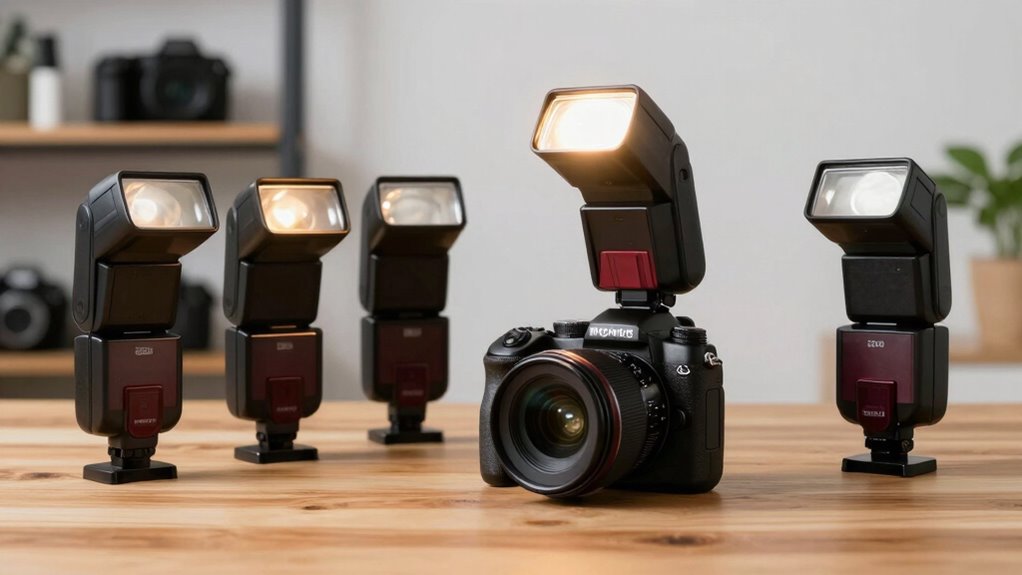

Choosing the right camera flash for beginners often comes down to balancing affordability with ease of use. My top recommendation for most new photographers is the Godox TT600, which offers reliable manual control and wireless capabilities without breaking the bank. For those seeking a compact, no-fuss option, the Godox iM30 Mini stands out for its portability and simple interface. However, beginners must decide between fully manual flashes, which require learning exposure settings, and TTL-compatible speedlights, which automate power but cost more. The following guide breaks down these tradeoffs to help you select the right tool for your specific camera system and learning style.

Get the latest gadgets delivered free with Prime
- Fast, free delivery on millions of items
- Prime Video, Amazon Music and more included
- Member-only deals all year
Complete the kit



Key Takeaways
- Manual flashes like the Powerextra DF-400 are excellent for learning exposure fundamentals but require more time to master than TTL options.
- Guide Number (GN) alone is a poor metric for comparison; flash duration and recycle time often impact shooting speed more heavily.
- Compatibility is the primary friction point; universal hot-shoe flashes lack advanced features like TTL and HSS found in brand-specific models.
- Compact mini-flashes like the Ulanzi SL03 sacrifice power for portability, making them ideal for fill light rather than primary studio lighting.
- Wireless triggering capability, even in manual mode, offers greater creative flexibility than built-in pop-up flashes for beginner setups.
| Ulanzi SL03 Mini Camera Flash |  | Best for Travel and Creative Fill Light | Guide Number: GN8 (ISO 100) | Color Temperature: 6500K | CRI: 97 | VIEW ON AMAZON | See Our Full Breakdown |
| NEEWER Z150 Mini Manual Camera Flash |  | Best Value for Everyday Carry | Output: 20Ws | Guide Number: 15 (ISO 100, meters) | Flash Power Range: 1/64 to 1/1 | VIEW ON AMAZON | See Our Full Breakdown |
| Powerextra DF-400 GN33 Manual Speedlite Flash |  | Best for Learning Bounce Lighting | Flash type: Manual speedlite | Guide number: GN33 (ISO 100/1 m) | Power levels: 8 (1/128 to 1/1) | VIEW ON AMAZON | See Our Full Breakdown |
| Godox iM30 Mini Manual Camera Flash |  | Best Compact Brand Reliability | Model: iM30 | Flash type: Manual mini flash | Guide number: 15 | VIEW ON AMAZON | See Our Full Breakdown |
| FocusFoto YINYAN CY-20 Universal Hot Shoe Camera Flash |  | Best for Older DSLR Owners | Guide Number: GN20 (ISO 100, DIN 21) | Color Temperature: 5600 K | Flash Coverage: Horizontal 60°, vertical 40° | VIEW ON AMAZON | See Our Full Breakdown |
| PHOTOOLEX Camera Flash for Cameras with Single-Contact Hot Shoe |  | Best Budget Entry Point | Guide Number: 33 | Power Levels: 22 (1/128 to 1/4) | Color Temperature: 5500K ± 200K | VIEW ON AMAZON | See Our Full Breakdown |
| PHOTOOLEX FK310 Camera Flash Speedlite with LCD Display |  | Best Manual Flash with Display | Guide Number: 33 | Display: LCD Screen | Power Levels: 22 (1/128 to 1/4) | VIEW ON AMAZON | See Our Full Breakdown |
| NEEWER Basics Z120 SE 5600K Mini Camera Flash |  | Best Ultra-Compact Travel Flash | Guide Number: 12 (m, ISO 100) | Battery Type: Built-in 2000mAh Lithium | Weight: 128g | VIEW ON AMAZON | See Our Full Breakdown |
| Godox TT600 2.4G Wireless Speedlite Flash |  | Best for Wireless Creative Control | Guide Number: 60 (m, ISO 100) | Wireless System: Godox 2.4G X System | Flash Count: ~230 full-power flashes | VIEW ON AMAZON | See Our Full Breakdown |
| NEEWER TT560 Manual Camera Flash |  | Best Value Bounce Flash | Guide Number: 38 (ISO 100) | Power Levels: 8 (1/128 to 1/1) | Flash Head: Tilt 0-90°, Rotate 0-270° | VIEW ON AMAZON | See Our Full Breakdown |
| ULANZI SL03 Mini Camera Flash with Fill Light |  | Best Hybrid Flash for Beginners | Guide Number: GN8 (ISO 100) | Power Levels: 4 (1/1, 1/2, 1/4, 1/8) | Head Adjustment: 90° tilt | VIEW ON AMAZON | See Our Full Breakdown |
| ULANZI SL01 Mini Camera Flash Speedlite |  | Best Minimalist Entry-Level Flash | Guide Number: GN8 (ISO 100) | Power Levels: 4 (1/1, 1/2, 1/4, 1/8) | Weight: 0.07 lbs | VIEW ON AMAZON | See Our Full Breakdown |
| Godox iM30 Mini Camera Flash with Diffuser |  | Best for Creative Control and Modifiers | Guide Number: GN15 (ISO 100, meters) | Power Levels: 7 (1/64 to 1/1) | Weight: 78 g | VIEW ON AMAZON | See Our Full Breakdown |
| camera flash for beginner | Guide Number | Power levels | Power source |
|---|---|---|---|
| Ulanzi SL03 Mini Camera Flash | GN8 (ISO 100) | — | — |
| NEEWER Z150 Mini Manual Camera | 15 (ISO 100, meters) | — | — |
| Powerextra DF-400 GN33 Manual | GN33 (ISO 100/1 m) | 8 (1/128 to 1/1) | 4 AA batteries (not included) |
| Godox iM30 Mini Manual Camera | 15 | 7 (1/64 to 1/1) | 2 AAA batteries (not included) |
| FocusFoto YINYAN CY-20 Univers | GN20 (ISO 100, DIN 21) | — | — |
| PHOTOOLEX Camera Flash for Cam | 33 | 22 (1/128 to 1/4) | 4 AA Batteries |
| PHOTOOLEX FK310 Camera Flash S | 33 | 22 (1/128 to 1/4) | 4 AA Batteries |
| NEEWER Basics Z120 SE 5600K Mi | 12 (m, ISO 100) | — | — |
| Godox TT600 2.4G Wireless Spee | 60 (m, ISO 100) | — | 4 AA Batteries |
| NEEWER TT560 Manual Camera Fla | 38 (ISO 100) | 8 (1/128 to 1/1) | 4 AA Batteries |
| ULANZI SL03 Mini Camera Flash | GN8 (ISO 100) | 4 (1/1, 1/2, 1/4, 1/8) | — |
| ULANZI SL01 Mini Camera Flash | GN8 (ISO 100) | 4 (1/1, 1/2, 1/4, 1/8) | — |
| Godox iM30 Mini Camera Flash w | GN15 (ISO 100, meters) | 7 (1/64 to 1/1) | 2 AAA batteries |
More Details on Our Top Picks
Ulanzi SL03 Mini Camera Flash
This compact flash stands out because it doubles as a continuous LED light, a feature missing from the NEEWER Z150 and Godox iM30. While its guide number of 8 is modest compared to the Powerextra DF-400‘s GN33, the SL03 compensates with utility. It excels at close-range fill light and video work, offering a 6500K color temperature that matches daylight. The USB-C charging is a significant convenience for travelers who want to reduce cable clutter. However, the lack of TTL means you must manually adjust exposure, which requires a learning curve compared to automatic options. It is not a primary lighting source for dark environments but rather a versatile accessory for those prioritizing portability and hybrid photo-video use.
Pros:- Integrated continuous LED light for video and AF assist
- Convenient USB-C charging eliminates need for spare batteries
- Extremely lightweight and pocketable at 1.16 oz
- High CRI of 97 ensures accurate color rendering for video
Cons:- Low guide number (GN8) limits reach and power
- Single-contact hot shoe may not fit cameras with proprietary shoes
- Manual-only control requires guessing exposure settings
Best for: Travelers and vloggers who need a tiny, dual-purpose light for fill and video.
Not ideal for: Photographers shooting in low light or needing high power output for large rooms.
- Guide Number:GN8 (ISO 100)
- Color Temperature:6500K
- CRI:97
- Flash Power Levels:1/1, 1/2, 1/4, 1/8
- Flash Angle:Adjustable up to 90°
- Mount:Single-contact hot shoe
- Battery Life:500 full-power flashes; 47 min continuous
- Charging:USB-C; approx. 1 hour
- Weight:1.16 oz
Our verdict“Choose this if you value extreme portability and need a backup continuous light for video.”
NEEWER Z150 Mini Manual Camera Flash
The NEEWER Z150 offers a better balance of power and size than the Ulanzi SL03, delivering a guide number of 15 versus the SL03’s GN8. This extra punch makes it more viable for indoor events where the SL03 would struggle. It includes a rechargeable lithium-ion battery, avoiding the AA battery hassle found in the Powerextra DF-400. The inclusion of S1 and S2 optical slave modes allows for basic off-camera lighting setups, a feature the Godox iM30 lacks. The tradeoff is its incompatibility with electronic shutter modes, meaning you must use a mechanical shutter. For beginners wanting a step up from smartphone flash without breaking the bank, this is a solid middle ground.
Pros:- Rechargeable battery included, reducing ongoing costs
- S1/S2 slave modes enable basic wireless off-camera use
- Guide number of 15 provides decent reach for small rooms
- Compact form factor fits easily in a camera bag
Cons:- Does not trigger with electronic shutter mode
- No TTL support requires manual exposure calculation
- Recycle time of 3.1 seconds can slow down rapid shooting
Best for: Beginners who want a rechargeable flash with enough power for casual indoor portraits.
Not ideal for: Users with mirrorless cameras that rely heavily on electronic shutter or silent shooting.
- Output:20Ws
- Guide Number:15 (ISO 100, meters)
- Flash Power Range:1/64 to 1/1
- Recycle Time:3.1 seconds
- Color Temperature:6000K ±200K
- Flash Modes:Manual, S1, S2 optical slave
- Flash Sync Speed:1/200s
- Weight:103g (3.6oz)
- Battery:Rechargeable lithium-ion, included
Our verdict“A reliable, rechargeable option that offers more power than ultra-compact alternatives.”
Powerextra DF-400 GN33 Manual Speedlite Flash
Unlike the fixed-head NEEWER Z150 or the small Godox iM30, the Powerextra DF-400 features a tilting and swiveling head. This allows you to bounce light off ceilings and walls, creating softer, more natural-looking shadows—a critical skill for beginner photographers. With a guide number of 33, it is significantly more powerful than the other mini flashes in this group, capable of lighting larger spaces. The downside is its bulk and reliance on four AA batteries, which are heavier and less convenient than the rechargeable options. However, for those willing to carry extra weight, the creative control offered by the movable head makes it the best educational tool for understanding flash direction.
Pros:- Tilting and swiveling head enables bounce flash for soft light
- High guide number of 33 provides strong output
- PC sync port allows wired off-camera triggering
- Broad compatibility with standard hot shoe cameras
Cons:- Uses four AA batteries, adding weight and cost
- Bulkier than mini flashes like the Ulanzi SL03
- No TTL support means manual exposure adjustments
Best for: Students and hobbyists learning to shape light using bounce techniques.
Not ideal for: Travelers seeking minimal weight or those who dislike managing AA batteries.
- Flash type:Manual speedlite
- Guide number:GN33 (ISO 100/1 m)
- Power levels:8 (1/128 to 1/1)
- Color temperature:5500K ± 200K
- Head movement:0°–90° tilt; 0°–270° rotation
- Recycle time:Approximately 3 seconds
- Power source:4 AA batteries (not included)
- Flash modes:Manual, S1, S2
- Sync:Optical wireless and wired PC sync
Our verdict“The best choice for beginners who want to learn bounce lighting and need high power.”
Godox iM30 Mini Manual Camera Flash
Backed by Godox‘s reputation for consistent lighting gear, the iM30 is a polished alternative to the Ulanzi SL03. It shares a similar guide number of 15 with the NEEWER Z150 but uses two AAA batteries, which are lighter than the AA batteries required by the Powerextra DF-400. The build quality feels more refined than many generic competitors, and the 7 power levels offer fine-grained control for fill flash. However, it lacks the continuous light mode of the Ulanzi and the bounce head of the Powerextra. It is strictly a manual flash, so it demands practice to master exposure. This pick suits those who trust established brands and want a simple, no-nonsense backup flash.
Pros:- Trusted brand quality with consistent color temperature
- Lightweight AAA battery configuration
- Seven power levels allow precise manual adjustments
- Compatible with multiple major camera brands
Cons:- Batteries not included in the box
- No TTL or high-speed sync support
- Fixed head prevents bounce lighting techniques
Best for: Beginners who prefer a trusted brand name and need a lightweight backup flash.
Not ideal for: Users who need bounce capabilities or continuous lighting for video.
- Model:iM30
- Flash type:Manual mini flash
- Guide number:15
- Power levels:7 (1/64 to 1/1)
- Maximum flashes:Up to 230
- Power source:2 AAA batteries (not included)
- Recycle time:3.6 seconds at full power
- Color temperature:6500K ± 200K
- Mount:Single-contact hot shoe
Our verdict“A reliable, brand-name mini flash for those who prioritize build quality over extra features.”
FocusFoto YINYAN CY-20 Universal Hot Shoe Camera Flash
The FocusFoto CY-20 occupies a unique niche by including a 2.5 mm PC sync port and a head that tilts to fixed angles, bridging the gap between the basic Godox iM30 and the fully rotatable Powerextra DF-400. Its guide number of 20 offers more punch than the mini flashes but less than the Powerextra. This flash is particularly useful for owners of older DSLRs that lack modern electronic flash contacts but have a standard hot shoe. The 7-second recycle time is its major weakness, significantly slower than the NEEWER Z150‘s 3.1 seconds. It is a utilitarian choice for specific legacy gear setups rather than a general-purpose beginner flash.
Pros:- Includes PC sync port for wired off-camera triggering
- Tilting head allows for some bounce lighting
- Compatible with a wide range of legacy camera models
- Guide number of 20 provides decent mid-range power
Cons:- Slow 7-second recycle time hinders rapid shooting
- Batteries not included
- Fixed tilt angles limit bounce flexibility compared to full swivel
Best for: Owners of older Canon or Nikon DSLRs needing a simple, compatible manual flash.
Not ideal for: Users shooting fast action or events due to the slow 7-second recycle time.
- Guide Number:GN20 (ISO 100, DIN 21)
- Color Temperature:5600 K
- Flash Coverage:Horizontal 60°, vertical 40°
- Sync Port:2.5 mm PC sync
- Power:Two AA batteries (not included)
- Recycle Time:7 seconds
- Flash Duration:1/1000 second (manual)
- Dimensions:65 × 60 × 98 mm
- Weight:100 g
Our verdict“A practical option for older camera systems that need a simple manual flash with sync port.”
PHOTOOLEX Camera Flash for Cameras with Single-Contact Hot Shoe
This unit serves as a minimalist introduction to off-camera lighting. Unlike the Godox TT600, it lacks wireless control, meaning you cannot trigger it remotely without an extra receiver. However, for beginners learning flash physics, this limitation is actually a feature: it forces you to understand manual power ratios without relying on auto-exposure crutches. The 22 power levels offer finer control than the NEEWER TT560’s eight steps, allowing for more precise exposure balancing. It is strictly wired, so if you plan to shoot events or dynamic portraits where you need to bounce light off walls or ceilings remotely, this is the wrong tool. It is best for static setups where you can physically connect the flash or use optical slaves.
Pros:- Offers 22 distinct power levels for precise manual exposure control
- Includes useful accessories like color gels and a stand
- Universal compatibility with most single-contact hot shoes
Cons:- No TTL support requires manual calculation of exposure
- Lacks wireless triggering capabilities entirely
- Bulkier than modern mini-flashes
Best for: Students learning flash basics who want low-cost manual control without wireless complexity
Not ideal for: Photographers who need off-camera flash or TTL automation for fast-paced events
- Guide Number:33
- Power Levels:22 (1/128 to 1/4)
- Color Temperature:5500K ± 200K
- Flash Modes:Manual, S1, S2, Multi
- Power Source:4 AA Batteries
- Connectivity:Wired Hot Shoe
Our verdict“Choose this if you want to learn manual flash fundamentals cheaply and don’t need wireless freedom.”
PHOTOOLEX FK310 Camera Flash Speedlite with LCD Display
The FK310 upgrades the basic manual experience by adding an LCD screen, which solves the guesswork found on older units like the NEEWER TT560. Instead of counting clicks or memorizing dial positions, you see your exact power setting and battery status instantly. This is critical for beginners who often struggle with exposure consistency. While it shares the GN33 output with the simpler PHOTOOLEX model, the visual feedback makes learning faster. It also includes a 3.5mm sync port, offering a cheap path to off-camera flash via cable, unlike the wireless-only focus of the Godox TT600. It remains manual-only, so you lose the speed of TTL, but gain clarity and control.
Pros:- LCD display provides clear readout of power and battery level
- 3.5mm sync port enables easy wired off-camera setups
- Fine-grained 22-step power adjustment
Cons:- No TTL support for automatic exposure
- Requires four AA batteries which add weight
- No built-in wireless radio trigger
Best for: Beginners who want manual control but need visual feedback to avoid exposure errors
Not ideal for: Users who require TTL automation or built-in wireless radio triggers
- Guide Number:33
- Display:LCD Screen
- Power Levels:22 (1/128 to 1/4)
- Sync Port:3.5mm Jack
- Flash Modes:Manual, Multi, S1, S2
- Power Source:4 AA Batteries
Our verdict“A solid manual flash that adds necessary visual feedback for those learning to dial in exposure.”
NEEWER Basics Z120 SE 5600K Mini Camera Flash
If portability is your primary concern, the Z120 SE is unmatched in size. At just 128g, it disappears in a pocket, whereas the Godox TT600 requires a dedicated bag slot. Its built-in rechargeable battery eliminates the recurring cost and bulk of AA batteries, offering up to 500 flashes per charge. However, this compactness comes at a steep power cost: a Guide Number of 12 is very low compared to the GN33 or GN60 of larger units. It is designed for soft fill light in daylight or close-range indoor shots, not as a primary light source. It lacks TTL and HSS, making it a specialist tool for casual shooters rather than a general-purpose workhorse.
Pros:- Extremely lightweight and compact for travel
- Built-in lithium battery eliminates AA battery costs
- Includes a diffuser for softer, more flattering light
Cons:- Low Guide Number (GN12) limits working distance
- No TTL, HSS, or automatic exposure features
- Limited power output compared to full-sized speedlites
Best for: Travelers and street photographers who prioritize pocketability over raw power
Not ideal for: Portrait photographers who need to overpower the sun or shoot subjects beyond 2-3 meters
- Guide Number:12 (m, ISO 100)
- Battery Type:Built-in 2000mAh Lithium
- Weight:128g
- Flash Modes:Manual, S1, S2
- Recycle Time:0.1–1.8 seconds
- Dimensions:73.7 × 71.1 × 46.8 mm
Our verdict“Perfect for adding a subtle pop of light to travel photos without carrying a heavy brick.”
Godox TT600 2.4G Wireless Speedlite Flash
The Godox TT600 is the gateway to serious creative lighting. Its built-in 2.4G wireless system allows you to trigger it off-camera without cables, a capability absent in the PHOTOOLEX FK310 and basic manual units. With a Guide Number of 60, it delivers four times the power of the NEEWER TT560, allowing you to overpower the sun or light large groups. However, it is strictly manual; you must buy a separate Godox trigger for full remote control and HSS. This adds cost and complexity. For beginners, it is a steep learning curve, but it offers the most room for growth into professional multi-flash setups compared to the limited options in this list.
Pros:- Built-in 2.4G wireless receiver for off-camera triggering
- High Guide Number (60) for powerful output
- Fast recycle time supports rapid shooting
Cons:- Requires a separate wireless trigger for full control
- No TTL support on the hot shoe
- AA batteries not included
Best for: Ambitious beginners ready to invest in off-camera flash and studio-style setups
Not ideal for: Casual users who want simple point-and-shoot automation or TTL
- Guide Number:60 (m, ISO 100)
- Wireless System:Godox 2.4G X System
- Flash Count:~230 full-power flashes
- Recycle Time:0.1–2.6 seconds
- Power Source:4 AA Batteries
- Compatibility:Universal Single-Contact Hot Shoe
Our verdict“The best choice if you plan to expand into multi-light wireless setups, provided you accept manual exposure.”
NEEWER TT560 Manual Camera Flash
The TT560 distinguishes itself with a tilting and rotating head, a feature missing from the fixed-head PHOTOOLEX models. This allows you to bounce light off ceilings or walls for softer, more natural illumination, which is far more flattering than direct flash. While it lacks the fine control of the PHOTOOLEX FK310’s 22 power steps—offering only 8—it is significantly easier to operate for quick adjustments. It does not have wireless radio or TTL, but its PC sync port and optical slave modes make it versatile for basic off-camera work. It strikes a balance between the raw power of the Godox TT600 and the simplicity of a basic speedlite.
Pros:- Tilting and rotating head enables bounce flash
- Optical slave modes allow for off-camera triggering
- PC sync port offers alternative connection options
Cons:- Only 8 power levels limit precise exposure control
- No TTL or HSS support
- No built-in wireless radio trigger
Best for: Portrait beginners who want to use bounce flash for softer light without complex settings
Not ideal for: Users needing precise power control or wireless radio triggering capabilities
- Guide Number:38 (ISO 100)
- Power Levels:8 (1/128 to 1/1)
- Flash Head:Tilt 0-90°, Rotate 0-270°
- Sync Speed:1/200 second
- Modes:Manual, S1, S2 Optical Slave
- Power Source:4 AA Batteries
Our verdict“An affordable manual flash that excels at bounce lighting for softer portraits.”
ULANZI SL03 Mini Camera Flash with Fill Light
This flash stands out because it combines a manual strobe with a constant LED fill light, a feature missing in competitors like the ULANZI SL01. The 90-degree adjustable head allows you to bounce light off ceilings or walls, creating softer shadows than direct flash. For beginners struggling with harsh lighting, this adjustability offers a gentle learning curve. However, the GN8 output is modest, meaning it struggles to overpower bright sunlight compared to higher-power units. You must also manage two lighting sources separately, which adds complexity. While the USB-C charging is convenient, the small battery capacity limits extended sessions. It is ideal for those who want one device for both video assist and still photography, but less suitable for fast-action events where simplicity matters more than flexibility.
Pros:- Includes a constant LED fill light for focusing and video
- 90° adjustable head enables bounce flash for softer light
- Rechargeable via USB-C with support for use while charging
- High CRI of 97 ensures accurate color reproduction
Cons:- Manual operation only; no TTL or automatic exposure
- Low guide number limits range and power in bright environments
- Hot shoe compatibility varies by camera model
Best for: Beginners who shoot both video and stills and need a built-in focus light.
Not ideal for: Photographers needing high power for outdoor daytime portraits or fast sports action.
- Guide Number:GN8 (ISO 100)
- Power Levels:4 (1/1, 1/2, 1/4, 1/8)
- Head Adjustment:90° tilt
- Fill Light:12 LEDs, 90 lumens
- Battery:Built-in 250mAh Li-ion
- Charging Port:USB-C
- Flash Duration:Sync up to 1/250s
Our verdict“Choose this if you want a versatile tool that doubles as a video light, but skip it if you prioritize raw power or automated settings.”
ULANZI SL01 Mini Camera Flash Speedlite
Stripping away the extras found in the ULANZI SL03, the SL01 offers a streamlined experience for those who want zero distractions. At just 0.07 lbs, it is one of the lightest options available, making it perfect for travel where every gram counts. The four power levels provide basic control, but the fixed angle means you cannot bounce light, resulting in harsher direct flash. Unlike the Godox iM30, it uses a built-in rechargeable battery, eliminating the hassle of sourcing AAAs. However, the GN8 rating remains low, restricting its use to indoor events or close-up subjects. It serves as a simple ‘on/off’ light source, ideal for beginners who find complex menus overwhelming, but it lacks the creative flexibility of adjustable heads.
Pros:- Extremely lightweight at 0.07 lbs
- Built-in rechargeable battery eliminates need for AAAs
- Simple four-step power control is easy to learn
- High CRI ensures natural-looking skin tones
Cons:- Fixed flash head prevents bounce techniques
- Charger and cable are not included in the box
- No fill light or slave modes for advanced setups
Best for: Travel photographers who prioritize extreme portability and simplicity over features.
Not ideal for: Users who need bounce flash capability or higher power for larger rooms.
- Guide Number:GN8 (ISO 100)
- Power Levels:4 (1/1, 1/2, 1/4, 1/8)
- Weight:0.07 lbs
- Battery Life:500+ full-power flashes
- Charging:USB-C (approx. 60 mins)
- Sync Speed:Up to 1/250s
- Mount:Single-contact hot shoe
Our verdict“This is the best choice for minimalists who want a tiny, rechargeable light for casual snapshots, provided they accept direct flash only.”
Godox iM30 Mini Camera Flash with Diffuser
The Godox iM30 distinguishes itself with a significantly higher GN15 output, delivering nearly double the light power of the ULANZI SL01. This extra punch allows beginners to shoot subjects at greater distances or overpower ambient light more effectively. It also includes a diffuser cap in the box, helping to soften harsh shadows immediately—a major advantage over bare-bulb competitors. The seven power levels offer finer exposure control than the four-level Ulanzi models. However, the reliance on two AAA batteries adds ongoing cost and weight, and the sync speed caps at 1/200s. While the optical slave modes allow for off-camera triggering, the lack of TTL means you must manually dial in settings, which requires more trial and error.
Pros:- Higher GN15 output provides better range than GN8 rivals
- Includes a diffuser cap to soften direct flash light
- Seven power levels allow for precise exposure adjustments
- S1/S2 optical slave modes enable basic off-camera setups
Cons:- Requires two AAA batteries (not included)
- Lower maximum sync speed of 1/200s
- May cast harsh shadows with wide-angle lenses
Best for: Beginners willing to learn manual exposure who need more power and built-in diffusion.
Not ideal for: Those who prefer rechargeable lithium batteries or need sync speeds above 1/200s.
- Guide Number:GN15 (ISO 100, meters)
- Power Levels:7 (1/64 to 1/1)
- Weight:78 g
- Power Source:2 AAA batteries
- Included Accessories:Diffuser, storage bag
- Sync Speed:1/200s
- Flash Modes:Manual, S1, S2 slave
Our verdict“Select this model if you want a step up in power and included light modifiers, accepting the trade-off of using disposable batteries.”

How We Picked
I evaluated these flashes based on ease of use, compatibility breadth, and build quality. For beginners, the learning curve is often steeper than the technical limitations, so models with intuitive controls and clear LCD displays received higher rankings. I also prioritized flashes that offer a clear path to growth, meaning they either support wireless triggering or have a robust ecosystem of accessories.
Ranking logic favored versatility over raw power. A flash with a moderate Guide Number that offers TTL and HSS (High-Speed Sync) is generally more useful for a beginner than a powerful manual-only unit. However, I included several high-value manual options for those who prefer to learn lighting physics directly. Price-to-performance ratios were judged strictly on feature sets, ignoring marketing claims.
Factors to Consider When Choosing Camera Flash For Beginners
Selecting a flash involves more than just picking the cheapest unit on the shelf. These factors help you avoid common pitfalls and match the tool to your actual shooting scenarios.TTL vs. Manual: Understanding the Learning Curve
TTL (Through-The-Lens) metering allows the camera to communicate with the flash, automatically adjusting power output for correct exposure. This is ideal for beginners who want to capture events quickly without adjusting settings for every shot. In contrast, Manual flashes require you to set the power level yourself, which demands a deeper understanding of ISO, aperture, and distance. While manual flashes are cheaper, they can frustrate newcomers during fast-paced shoots. If you plan to learn lighting theory gradually, manual is fine; if you need reliable results now, TTL is the safer bet.
Guide Number (GN) and Real-World Power
The Guide Number indicates the maximum distance a flash can effectively illuminate a subject at ISO 100 with f/1.0 aperture. A higher GN means more power, but beginners often overvalue this spec. Most portrait work happens within 10-15 feet, where even modest flashes perform well. A higher GN becomes critical only when using bounce flash (which loses light) or shooting large groups outdoors. Don’t pay a premium for extreme power if your primary use is indoor portraits or close-up fill light.
Camera Compatibility and Hot Shoe Types
Not all flashes fit all cameras. Universal hot-shoe flashes use a single central contact, supporting only basic manual firing. These are safe for almost any camera but lack advanced features. Dedicated flashes have multiple pins to communicate with specific brands like Canon, Nikon, or Sony, enabling TTL and HSS. Buying a universal flash for a modern mirrorless camera often results in wasted potential. Verify your camera’s hot shoe pin layout before purchasing to avoid compatibility issues.
Recycle Time and Battery Efficiency
Recycle time is how long the flash waits between shots. Slow recycling can cause you to miss moments during event photography. AA batteries are common, but performance varies wildly between alkaline and NiMH rechargeables. Some budget flashes struggle with battery drain, leading to frequent replacements. Look for models that support external battery packs or have efficient power management if you shoot frequently. A flash that recycles in under 2 seconds is preferable for active beginners.
Build Quality and Durability
Plastic housings on budget flashes can feel brittle, especially the hot shoe mount and swivel mechanisms. Rotating heads are essential for bounce flash techniques, which soften light dramatically. If the head feels loose or stiff, it will hinder your workflow. Check for weather sealing if you shoot outdoors, though this is rare in beginner-tier gear. Investing in a flash with solid metal contacts and a sturdy lock ring prevents accidental detachment and ensures consistent firing over time.
The Role of Wireless Triggering
Many beginners underestimate the value of wireless triggering. Even a manual flash can be used off-camera if it supports radio triggering. This allows you to move the light away from the lens, creating depth and drama. Optical triggering (using the camera’s pop-up flash to signal the external flash) is prone to failure in bright sunlight. Radio-based systems, like Godox’s 2.4G, are more reliable and expand your creative options significantly as your skills improve.
Frequently Asked Questions
Do I need a TTL flash if I only shoot in manual mode?
No, you do not need TTL if you are comfortable setting your camera and flash settings manually. In fact, a manual flash is often cheaper and teaches you the fundamentals of lighting exposure. TTL is primarily a convenience feature for fast-moving situations where you cannot adjust settings between shots. If you have time to set up your light and camera, a manual unit like the Godox TT600 provides excellent results at a lower cost.Why does my flash fire at full power even when I set it to low?
This usually happens if the flash is not communicating correctly with the camera, often due to using a universal flash on a camera that requires a dedicated protocol for power control. Universal flashes only send a ‘fire’ signal, not power instructions, so they default to their last manual setting or full power. Check your flash’s manual mode settings directly on the unit’s LCD. If you are using a dedicated flash, ensure the hot shoe contacts are clean and the flash is locked in properly.Is High-Speed Sync (HSS) worth it for a beginner?
HSS allows you to use shutter speeds faster than the camera’s flash sync speed (usually 1/200s or 1/250s), which is useful for balancing flash with bright sunlight. For most beginners shooting indoors or in shaded areas, HSS is not necessary. However, if you plan to shoot portraits outdoors in bright light with wide apertures, HSS becomes valuable. Dedicated flashes offer this feature, while manual universal flashes do not. Prioritize HSS only if you specifically plan to fight the sun.Can I use a flash from one brand on a different camera brand?
You can physically mount a flash on most cameras if the hot shoe fits, but functionality varies. A Canon flash on a Nikon camera will typically only fire in manual mode, losing TTL and HSS capabilities. Some third-party flashes like those from Godox offer specific versions for each major brand (Canon, Nikon, Sony, Fuji) to ensure full compatibility. Always buy the version of the flash that matches your camera brand to retain all features.Why is my flash leaving a dark band across my photos?
This dark band appears when your shutter speed is faster than your camera’s maximum flash sync speed. The camera’s shutter curtains are not fully open when the flash fires, so part of the sensor is covered. To fix this, lower your shutter speed to the sync speed (check your camera manual, usually 1/200s or 1/250s) or enable High-Speed Sync (HSS) on your flash if it supports it. This is a common setting error for beginners using flash outdoors.Conclusion
For the best overall balance of price, power, and reliability, the Godox TT600 remains the smart choice for beginners willing to learn manual settings. If you prioritize ease of use and automatic exposure, the Godox iM30 Mini (in its TTL-compatible variant) is the superior pick for compact kits. For those on a strict budget who want to learn the hard way, the Powerextra DF-400 offers impressive power for the price. Finally, if you need portability above all else, the Ulanzi SL03 is an excellent fill-light companion. Choose based on whether you value automation or control, and ensure the flash matches your camera brand for full functionality.