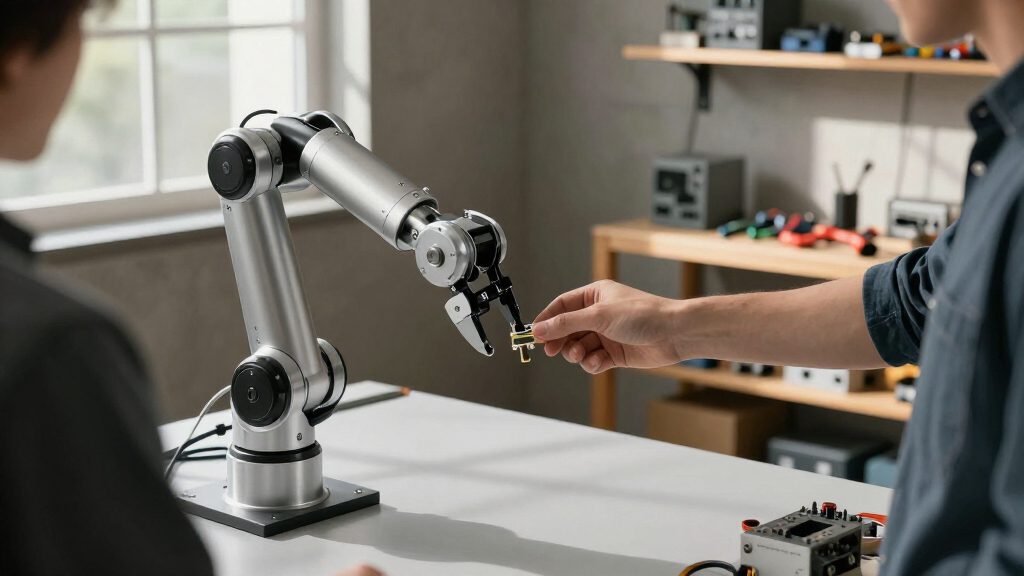

When searching for the best robotic arms, it’s essential to consider your experience level, intended use, and budget. The LewanSoul Robotic Arm stands out as the best overall due to its versatile 6DOF design and broad compatibility. For those focused on educational value, the Thames & Kosmos Bionic Robotic Arm STEM Kit offers engaging learning opportunities. Meanwhile, the Wlkata Mirobot delivers a compact, industrial-grade experience in a small form factor. Each of these options balances performance, ease of use, and price differently, making clear tradeoffs along the way. Continue reading for a detailed comparison to help you find the perfect fit.

Get the latest gadgets delivered free — and shop member deals
- Fast, free delivery on millions of items
- Access to Prime Big Deal Days deals on October 6–7
- Prime Video, Amazon Music and more included
Complete the kit



Key Takeaways
- Versatility in software compatibility is key—robots like the LewanSoul and reBot support multiple programming environments.
- Educational kits excel for beginners but often lack industrial precision or advanced features.
- Higher-priced options tend to offer better build quality, more precise control, and advanced AI integration.
- Compact models like the Wlkata Mirobot are ideal for small spaces but may sacrifice some power or range.
- Ease of setup and programming varies widely; beginner-friendly options prioritize simple interfaces over customizable complexity.
| LewanSoul Robotic Arm 6DOF Robot Arm Kit with Arduino Compatibility |  | Best for Creative DIY and Education | Number of Degrees of Freedom: 6 | Material: Aluminum alloy | Servo Type: Intelligent serial bus servos | VIEW LATEST PRICE | See Our Full Breakdown |
| Hiwonder AI Robotic Arm Kit with Imitation Learning and Open Source 6-Axis Metal Robot Arm |  | Best for AI Development and Advanced Robotics | Number of Items: 1 | Reach: 500mm | Payload: 500g | VIEW LATEST PRICE | See Our Full Breakdown |
| AI Robotic Arm Kit with Servo Motors – LeRobot SO-ARM101 Pro Low-Cost, 6-DOF, Open-Source, NVIDIA Jetson Compatible |  | Best for AI Learning and Research on a Budget | Number of Degrees of Freedom: 6-DOF | Compatibility: NVIDIA Jetson, LeRobot | Includes: Servo motors, assembly guides | VIEW LATEST PRICE | See Our Full Breakdown |
| Thames & Kosmos Bionic Robotic Arm STEM Experiment Kit |  | Best for Hands-On Mechanical Learning | Number of Pieces: Approx. 300 | Power Source: None (manual) | Recommended Age: 10+ with help, 14+ independent | VIEW LATEST PRICE | See Our Full Breakdown |
| Robotic Arm for Arduino Coding Programming 6DOF Hiwonder-xArm1S STEM Educational Building Robot Arm Kit |  | Best for Programmers and Educators Focused on Coding | Number of Axes: 6 | Material: Aluminum alloy | Maximum Load: 500g | VIEW LATEST PRICE | See Our Full Breakdown |
| reBot B601-DM Assembled Robotic Arm Kit with Gripper, 6+1 DoF, Open-Source, Python SDK & ROS1/ROS2 Compatible |  | Best Overall for Research and Development | Degrees of Freedom: 6+1 | Payload: 1.5 kg | Reach: 767 mm | VIEW LATEST PRICE | See Our Full Breakdown |
| Hiwonder SO-ARM101 Robotic Arm Kit with AI Vision and 6-Axis, Open Source |  | Best for AI Vision and Advanced Research | Number of axes: 6 | Servo motors: 12 high-torque | Camera system: Dual-camera | VIEW LATEST PRICE | See Our Full Breakdown |
| Waveshare Robotic Arm Kit, 4-DOF Desktop Robot with ESP32, High-Torque Serial Bus Servo, Wireless Control, Supports Expansion and Secondary Development |  | Best for Wireless and Educational Applications | Degrees of Freedom: 4 | Payload: 0.5 kg | Base Movement: 360° omnidirectional | VIEW LATEST PRICE | See Our Full Breakdown |
| Wlkata Mirobot 6DoF Mini Industrial Robotic Arm Professional Kit |  | Best for Education and Art Applications | Degrees of Freedom: 6DoF | Control Methods: Software, mobile app, virtual | Expansion Interfaces: Multiple | VIEW LATEST PRICE | See Our Full Breakdown |
| LewanSoul MaxArm Robotic Arm Kit for Arduino and Python Programming |  | Best for Coding and Payload Precision | Control Methods: Python, Arduino, app, PC | Sensor Expansion: Yes | Payload Capacity: Significant | VIEW LATEST PRICE | See Our Full Breakdown |
| Robotic Arm Kit 6DOF with Programming and Control Options |  | Best for Educational and Creative Projects | Controller: ESP32 | Servos: 6 smart PWM servos | Control Methods: App, PC software, wireless controller | VIEW LATEST PRICE | See Our Full Breakdown |
More Details on Our Top Picks
LewanSoul Robotic Arm 6DOF Robot Arm Kit with Arduino Compatibility
The LewanSoul 6DOF robotic arm kit stands out for its versatile control options, including PC, mobile app, and wireless controllers, making it highly adaptable for creative projects. Its high-precision intelligent servos enable accurate movements, comparable to more industrial options like the Wlkata Mirobot, but at a more accessible price point. The included sensor expansion kit adds potential for advanced experimentation, though it demands some technical skill to set up and program, which could challenge beginners. Compared to the Hiwonder-xArm1S, it offers similar control flexibility but might be less durable due to its plastic components. Overall, this pick excels for learners and hobbyists eager to explore programming and automation without complex hardware.Pros:- Supports multiple control methods including PC, mobile app, and wireless controllers
- High-precision servos enable accurate and repeatable movements
- Sensor expansion kit enhances customization and functionality
- Ideal for education, coding, and creative projects
Cons:- Requires some technical knowledge for setup and programming
- Limited to objects weighing up to 500g, restricting heavier tasks
Best for: DIY enthusiasts, students, and educators seeking a flexible, programmable robotic arm for learning and experimentation.
Not ideal for: Absolute beginners with no technical background or those looking for a plug-and-play experience, as setup and programming can be complex.
- Number of Degrees of Freedom:6
- Material:Aluminum alloy
- Servo Type:Intelligent serial bus servos
- Max Grasping Load:500g
- Control Methods:PC, Mobile App, Mouse, Wireless PS2 controller
- Includes:Sensor expansion kit, Arduino support, detailed code
Our verdict“This robotic arm suits learners and educators who want a customizable, multi-control platform for creative and educational uses.”
Hiwonder AI Robotic Arm Kit with Imitation Learning and Open Source 6-Axis Metal Robot Arm
The Hiwonder AI robotic arm is tailored for users interested in AI integration, offering industrial-grade metal construction and high-precision magnetic encoder servos that outperform typical hobbyist arms like the LewanSoul in accuracy. Its open-source platform, coupled with tutorials and schematics, makes it ideal for advanced learners and developers aiming to customize or expand their AI capabilities. While it’s robust and supports AI vision and voice modules, it’s less accessible for beginners due to its complex setup and lack of beginner-friendly features. Compared with the LeRobot SO-ARM101 Pro, it provides higher durability and industrial-grade performance but requires more technical skill. This model is best suited for serious robotics projects or AI research rather than casual experimentation.Pros:- Industrial-grade full-metal construction for durability
- High-precision magnetic encoder servos for accurate movements
- Open-source design with extensive tutorials and schematics
- Supports AI vision and voice integration for complex projects
Cons:- Requires technical expertise for assembly and calibration
- No 3D printed parts included, additional printing needed
Best for: Robotics researchers, students specializing in AI, and hobbyists with technical skills seeking a durable, high-precision robotic arm for advanced applications.
Not ideal for: Beginners or casual users who prefer straightforward plug-and-play solutions, as it demands significant setup and programming knowledge.
- Number of Items:1
- Reach:500mm
- Payload:500g
- Repeatability:±2mm
- Control Architecture:ESP32 + AT32 dual-chip
- Material:Full metal
Our verdict“This arm is designed for developers and researchers who need a robust, customizable platform for AI robotics and industrial applications.”
AI Robotic Arm Kit with Servo Motors – LeRobot SO-ARM101 Pro Low-Cost, 6-DOF, Open-Source, NVIDIA Jetson Compatible
The LeRobot SO-ARM101 Pro offers a cost-effective entry into AI robotics, with 6-DOF movement and compatibility with NVIDIA Jetson devices, making it suitable for reinforcement learning projects. Its open-source nature and detailed assembly guides make it accessible for those willing to handle assembly and calibration—similar to the Hiwonder arm but at a lower price point. While it may lack some of the industrial robustness of the Hiwonder, it provides a flexible platform for experimentation and AI training, especially for users focusing on reinforcement learning or edge AI deployment. However, the absence of 3D-printed parts and the need for technical skills make it less ideal for absolute beginners or casual users.Pros:- Open-source design with extensive resources
- Compatible with NVIDIA Jetson for AI development
- Enhanced wiring and smooth gear motor performance
- Affordable option for AI experimentation
Cons:- Requires technical knowledge for assembly and calibration
- 3D printed parts are not included, additional printing needed
Best for: Students, hobbyists, and researchers interested in affordable AI robotics projects, especially with NVIDIA Jetson compatibility.
Not ideal for: Beginner users or those seeking ready-to-use robotic arms without assembly or complex calibration tasks.
- Number of Degrees of Freedom:6-DOF
- Compatibility:NVIDIA Jetson, LeRobot
- Includes:Servo motors, assembly guides
- 3D Printed Parts:Not included
Our verdict“This arm is well-suited for tech-savvy learners aiming for affordable AI robotics and reinforcement learning, not for complete beginners.”
Thames & Kosmos Bionic Robotic Arm STEM Experiment Kit
The Thames & Kosmos Bionic Robotic Arm offers a highly engaging, manual experience with nearly 300 pieces, emphasizing mechanical understanding over electronic complexity. It’s ideal for introducing younger users or beginners to robotics concepts through hands-on assembly, especially compared to electronic-driven models like the Hiwonder or LewanSoul. Its manual control via joysticks fosters a tactile understanding of mechanical linkages, but it won’t suit those seeking electronic or programmable features. The lack of motors and batteries simplifies the build but limits functionality, making it more educational than practical for automation tasks. This kit excels for classroom settings or family projects focused on foundational STEM concepts.Pros:- No motors or batteries required, making it safe and straightforward
- Provides hands-on learning about mechanical engineering
- Includes detailed manual and scientific insights
- Suitable for developing fine motor skills and understanding linkages
Cons:- Requires adult assistance for younger children
- Limited to mechanical movement without electronic components
- Assembly can be complex for some users
Best for: Educators, parents, and children aged 10+ who want to learn about robotics through manual assembly and mechanical systems.
Not ideal for: Users seeking electronic control, automation, or programmable robotic arms, as it relies solely on manual operation.
- Number of Pieces:Approx. 300
- Power Source:None (manual)
- Recommended Age:10+ with help, 14+ independent
- Includes:Manual, cables, joysticks
Our verdict“This kit is ideal for educational settings and families interested in understanding mechanical robotics through hands-on building.”
Robotic Arm for Arduino Coding Programming 6DOF Hiwonder-xArm1S STEM Educational Building Robot Arm Kit
The Hiwonder-xArm1S offers a well-rounded platform for students and educators looking to combine coding with robotics. Its high-precision servos and aluminum alloy construction make it more durable and accurate than simpler kits like the Thames & Kosmos. Its multiple control options, including PC, app, and wireless controllers, provide flexible interaction modes, similar to LewanSoul but with a focus on programming. While it requires some familiarity with coding and setup, it’s designed for users aged 14 and above who want to develop programming skills or customize actions. Compared to the LeRobot, it’s more robust and suitable for more complex projects but might be less accessible for absolute beginners. This model makes the most sense for those aiming to learn coding within a robotic context.Pros:- High-precision servos and durable aluminum alloy build
- Multiple control options including wireless and app control
- Supports custom programming and action editing
- Suitable for educational and intermediate robotics projects
Cons:- Requires some programming knowledge for advanced functions
- Limited to objects weighing up to 500g, restricting heavier tasks
Best for: Middle and high school students, educators, and hobbyists interested in coding, automation, and mechanical design.
Not ideal for: Complete beginners or users seeking a simple, ready-to-run robotic arm without programming complexity.
- Number of Axes:6
- Material:Aluminum alloy
- Maximum Load:500g
- Control Methods:PC, phone app, mouse, wireless PS2 controller
- Servo Feedback:Position, voltage, temperature
- Recommended Age:14+
Our verdict“This arm is best for motivated learners who want to develop coding skills through a robust, educational robotic platform.”
reBot B601-DM Assembled Robotic Arm Kit with Gripper, 6+1 DoF, Open-Source, Python SDK & ROS1/ROS2 Compatible
The reBot B601-DM stands out as the most comprehensive option for those engaged in advanced robotics, offering a fully assembled setup that minimizes initial complexity. Its support for open-source software like Python SDK and ROS makes it highly customizable, ideal for research, AI prototyping, and STEM education. Compared with the Wlkata Mirobot, this model provides a higher payload capacity and longer reach, though it demands more technical knowledge to set up and operate effectively. The inclusion of Bluetooth, Ethernet, USB, and Wi-Fi connectivity expands its integration possibilities, but the lack of detailed motor performance specs can make troubleshooting challenging for newcomers. This pick makes the most sense for research labs, educators, and developers seeking a flexible, high-capability robotic arm.
Pros:- Pre-assembled for quick deployment and use
- Supports open-source hardware and software customization
- High payload capacity and long reach for versatile applications
- Compatible with ROS1 and ROS2 for advanced robotics development
Cons:- Setup complexity requires technical expertise
- Limited detailed motor performance specifications
- No explicit pricing information available
Best for: Research institutions, advanced STEM educators, and AI developers needing a versatile, open-source platform
Not ideal for: Beginners or hobbyists with limited technical skills who prefer plug-and-play solutions
- Degrees of Freedom:6+1
- Payload:1.5 kg
- Reach:767 mm
- Repeatability:0.2 mm
- Dimensions:16.41″L x 9.88″W x 27.16″H
- Connectivity:Bluetooth, Ethernet, USB, Wi-Fi
Our verdict“This is best suited for experienced users aiming for a fully customizable, research-grade robotic arm.”
Hiwonder SO-ARM101 Robotic Arm Kit with AI Vision and 6-Axis, Open Source
The Hiwonder SO-ARM101 makes the list for those interested in integrating AI vision with robotics, featuring dual-camera systems and high-torque servo motors for smooth, precise motion. Its open-source compatibility with LeRobot framework is a boon for customization, especially for researchers exploring imitation learning. Compared with the LewanSoul MaxArm, this model offers more advanced sensory integration, but its complex setup and limited available information can pose hurdles for less experienced users. The inclusion of professional debugging tools simplifies calibration, yet the system’s sophistication demands a good level of technical skill. This robotic arm is ideal for developers and hobbyists pursuing AI-enabled robotic experimentation and vision-based tasks.
Pros:- Supports advanced imitation learning with dual-camera vision
- High-performance servo motors ensure smooth motion
- Open-source compatible for extensive customization
- Includes professional debugging tools for calibration
Cons:- Setup complexity requires technical expertise
- Limited information on price and availability
- Designed primarily for research and hobbyist use
Best for: AI researchers, robotics hobbyists, and developers focused on vision integration and imitation learning
Not ideal for: Beginners or casual users seeking straightforward, ready-to-use robotic arms
- Number of axes:6
- Servo motors:12 high-torque
- Camera system:Dual-camera
- Open-source compatibility:Yes
- Control system:Hiwonder BusLinker V3.0
Our verdict“Best suited for technically skilled users aiming to develop vision-based AI robotics projects.”
Waveshare Robotic Arm Kit, 4-DOF Desktop Robot with ESP32, High-Torque Serial Bus Servo, Wireless Control, Supports Expansion and Secondary Development
The Waveshare 4-DOF Robotic Arm appeals most to those seeking an accessible, wireless-controlled platform for STEM projects, thanks to its lightweight design and ESP32-based wireless control. Its omnidirectional base offers a wide range of motion in compact spaces, making it ideal for mobile robotics or classroom demonstrations. Compared with the LewanSoul MaxArm, it’s more portable but supports a lower payload capacity, limiting its use for heavier tasks. Its open-source control codes and expansion options make it attractive for secondary development, yet the moderate customer rating suggests some users find setup or reliability issues. This arm is best for students, educators, or hobbyists wanting a wireless, expandable robot for light tasks and experimentation.
Pros:- Supports multiple wireless control modes
- Open source design allows extensive customization
- Compact and lightweight for mobile use
- Supports expansion and secondary development
Cons:- Customer ratings are moderate, indicating mixed experiences
- Setup may be complex for beginners
- Limited payload capacity for heavier applications
Best for: STEM students and educators interested in wireless robotics and easy expansion
Not ideal for: Users needing high payload capacity or industrial-grade precision
- Degrees of Freedom:4
- Payload:0.5 kg
- Base Movement:360° omnidirectional
- Control Module:ESP32 MCU
- Compatibility:ROS2, various host computers
Our verdict“Ideal for educational and lightweight mobile projects emphasizing wireless control and expandability.”
Wlkata Mirobot 6DoF Mini Industrial Robotic Arm Professional Kit
The Wlkata Mirobot makes this list as a compact, versatile option for educational settings, creative projects, and basic training in robotics. Its multiple control options—software, mobile app, virtual interface—make it accessible, while the support for hardware expansion allows for some customization. Compared with the LewanSoul MaxArm, it offers a more user-friendly setup for beginners, but its relatively limited payload and precision may not suit industrial or heavy-duty tasks. Its laser engraving, drawing, and handling capabilities broaden its appeal for art and design projects, though the setup can be somewhat intricate for newcomers. This robot is best for learners, hobbyists, and artists exploring robotics in creative ways.
Pros:- Multiple control methods including software and mobile app
- Supports hardware expansion for custom functions
- Suitable for art, engraving, and handling tasks
- Compact, lightweight design
Cons:- Setup can be complex for beginners
- Limited payload and precision for industrial use
- Potentially higher cost for casual hobbyists
Best for: Educational institutions, hobbyists, and artists interested in creative robotics and basic automation
Not ideal for: Industrial applications or heavy payload tasks requiring high precision
- Degrees of Freedom:6DoF
- Control Methods:Software, mobile app, virtual
- Expansion Interfaces:Multiple
- Applications:Education, art, AI voice training
Our verdict“Best for education, art, and amateur projects where versatility and ease of control are valued over heavy-duty performance.”
LewanSoul MaxArm Robotic Arm Kit for Arduino and Python Programming
The LewanSoul MaxArm is designed for users seeking high accuracy and payload capacity, leveraging inverse kinematics for precise movement along x, y, and z axes. Its support for multiple control methods—Python, Arduino, and wireless apps—makes it highly flexible for STEM projects and custom coding. Compared with the Waveshare Robotic Arm, it offers superior payload handling and more advanced sensor expansion options, though its setup can be daunting for beginners. The high-performance smart bus servos ensure smooth, accurate motion suitable for heavier loads, but the complexity of features may overwhelm users with limited technical background. This arm fits best for students, hobbyists, and developers working on precise automation or AI integrations.
Pros:- Supports multiple control methods including Python and Arduino
- Features sensor expansion ports for AI and custom applications
- High accuracy and payload capacity with smart bus servos
- Open source design for extensive development
Cons:- Requires some technical knowledge for setup and programming
- Not suitable for very young children or complete novices
- Complex features may be overwhelming for casual users
Best for: STEM students and hobbyists focused on coding, automation, and payload handling
Not ideal for: Complete beginners or users seeking straightforward, plug-and-play robotic solutions
- Control Methods:Python, Arduino, app, PC
- Sensor Expansion:Yes
- Payload Capacity:Significant
- Intended Age Range:16+
- Support:AI, automation
Our verdict“Best for technically skilled users aiming for high precision and payload performance in robotics projects.”
Robotic Arm Kit 6DOF with Programming and Control Options
This open-source robotic arm stands out for its versatile control options, including app, PC software, and wireless, offering flexibility for users who want to experiment with different interfaces. Compared to the LewanSoul Robotic Arm, which relies solely on physical controls or basic programming, this model provides a richer interaction experience, especially for those interested in integrating sensors or AI. Its support for extensive sensor expansion and AI applications makes it ideal for learning complex concepts or developing custom automation projects. However, its advanced features come with a learning curve that may challenge complete beginners, especially those unfamiliar with programming or electronics. Nonetheless, for students and hobbyists eager to explore AI integration and sensor-based automation, this kit provides a comprehensive foundation.
Pros:- Multiple control methods including app, PC, and wireless for flexible interaction
- Supports extensive sensor expansion, enabling AI and voice projects
- Comprehensive tutorials and open-source resources streamline learning
Cons:- Requires some technical knowledge, making initial setup challenging for novices
- Complex features may be overwhelming without prior experience in programming or electronics
Best for: Educators, students, and hobbyists wanting a flexible, sensor-expandable robotic arm for learning and experimentation
Not ideal for: Beginners seeking a plug-and-play solution with minimal setup or those without technical background
- Controller:ESP32
- Servos:6 smart PWM servos
- Control Methods:App, PC software, wireless controller
- Expansion Ports:Multiple
- Sensor Compatibility:AI vision, voice, ultrasonic, acceleration sensors
- Included Resources:200+ tutorials, sample experiments, open-source code
Our verdict“This robotic arm is best suited for learners and innovators ready to handle a bit of complexity for maximum customization.”
How We Picked
I evaluated these robotic arms based on several critical factors that matter to potential buyers. Performance was assessed through degrees of freedom, precision, and load capacity, ensuring each model can handle intended tasks. Usability considerations included setup complexity, programming options, and compatibility with popular platforms like Arduino or Python. Build quality, durability, and price also played a significant role, helping to differentiate budget-friendly kits from more advanced systems. The ranking favors models that balance these aspects effectively for different user needs, from hobbyists to educators and professionals.Factors to Consider When Choosing Best Robotic Arms
Choosing the right robotic arm involves balancing several factors based on your experience, intended use, and budget. It’s important to consider the robot’s degrees of freedom, compatibility with existing hardware, and ease of programming. A common mistake is opting for a model that is either too simple or overly complex for your needs, leading to frustration or underperformance. Understanding these tradeoffs can help you avoid costly errors and select a robotic arm that will grow with your skills or meet your project requirements.Performance and Precision
Look for a robotic arm with sufficient degrees of freedom (typically 4-6) to perform your desired tasks effectively. Higher precision and load capacity are crucial for industrial or complex applications but may come at a higher cost. For hobbyist or educational use, a simpler model with enough range of motion can still deliver meaningful results without breaking the bank.
Ease of Programming and Compatibility
Assess whether the robotic arm supports familiar programming environments like Arduino, Python, or ROS. User-friendly interfaces and extensive documentation reduce the learning curve, making it easier to get started. Be wary of models requiring proprietary software or complex setup procedures, especially if you’re new to robotics.
Build Quality and Durability
Robotic arms built from high-quality materials like metal tend to last longer and perform more reliably than plastic counterparts. Consider the operating environment—industrial models need rugged construction, while educational kits can prioritize lightweight designs. Investing in better build quality can pay off in consistent performance over time.
Budget and Value
Budget constraints influence your options significantly. Cheaper models often lack advanced features or precision but can serve as excellent starting points. Conversely, paying more typically grants better control, durability, and expandability. Focus on models that offer the best feature set within your price range to maximize value.
Expandability and Future-Proofing
Consider whether the robotic arm can be upgraded or integrated with additional sensors, tools, or software. Models compatible with open-source platforms and standard APIs tend to support future enhancements. Avoid overly proprietary systems if you anticipate needing to scale or customize your setup down the line.
Frequently Asked Questions
Can I use a robotic arm for industrial automation at home?
While some robotic arms are capable of industrial tasks, most are designed for educational, hobbyist, or light-duty applications. Industrial-grade robotic arms tend to be expensive, require specialized knowledge, and need professional setup. For home use, look for models with sufficient load capacity, stability, and software support that match your specific tasks without the complexity and cost of full industrial systems.
What is the easiest robotic arm to program for a beginner?
Robotic arms with graphical programming interfaces or simple code examples are ideal for newcomers. Kits like the Thames & Kosmos Bionic Arm or the LewanSoul models often include beginner-friendly tutorials and compatible platforms like Arduino. These options minimize setup complexity and allow quick experimentation, making them perfect starting points for learning robotics fundamentals.
How important is build quality when choosing a robotic arm?
Build quality directly impacts the durability, precision, and reliability of a robotic arm. A well-constructed model with metal joints and high-quality servos will perform more consistently over time and withstand frequent use. Cheaper plastic models may be suitable for light tasks or learning, but they can wear out faster or lack the accuracy required for more demanding projects.
Should I prioritize price or features when selecting a robotic arm?
This depends on your goals. If you’re just starting or have a limited budget, a more affordable model with basic features can provide valuable hands-on experience. However, if you require precise control, expanded capabilities, or industrial-grade performance, investing in a higher-end model may be justified. Weigh your immediate needs against future plans to find the best balance.
Are open-source robotic arms better than proprietary ones?
Open-source robotic arms offer greater flexibility for customization, troubleshooting, and expanding functionality. They typically support standard programming languages and platforms, making them ideal for learning and experimentation. Proprietary systems may offer more polished interfaces and dedicated support but often limit modifications and scalability, which can be frustrating for advanced users or those with specific project needs.
Conclusion
For general-purpose use and versatility, the LewanSoul Robotic Arm remains the best overall choice due to its strong feature set and compatibility options. Beginners and educators will find the Thames & Kosmos Bionic Robotic Arm STEM Kit ideal for learning foundational concepts. The Wlkata Mirobot appeals to those seeking a compact, industrial-grade solution that fits into small spaces. Budget-conscious buyers should consider the simpler, more affordable kits, while professional users with advanced needs may prefer premium models with higher precision and expandability. Carefully aligning your priorities with these profiles ensures a satisfying purchase.Evergreen bestsellers Picks
bestsellers
As an affiliate, we earn on qualifying purchases.