
TL;DR

Get the latest gadgets delivered free with Prime
- Fast, free delivery on millions of items
- Prime Video, Amazon Music and more included
- Member-only deals all year
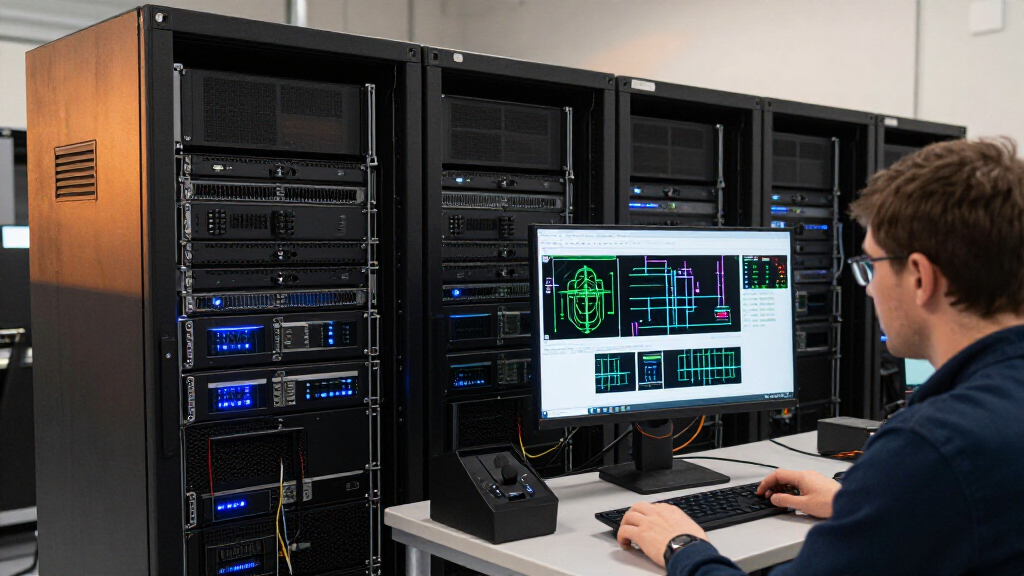
NVIDIA says it simulated a 104-qubit fault-tolerant quantum processor on JUPITER, the exascale supercomputer at Germany’s Jülich Supercomputing Centre. The simulation modeled magic-state cultivation under realistic hardware noise; NVIDIA says the method studied could require 90% fewer qubits for producing magic states than previous methods.
NVIDIA says it has simulated a 104-qubit fault-tolerant quantum processor on JUPITER, the exascale supercomputer at Germany’s Jülich Supercomputing Centre. The calculation used 8,192 GPUs to model magic-state cultivation under realistic hardware noise, a step researchers can use to examine quantum processor designs before building them.
The simulation focused on magic-state cultivation, a method for generating the special states used in fault-tolerant quantum computation. Quantum hardware is vulnerable to noise and errors, and fault-tolerant systems must repeatedly produce and consume magic states as they perform computations. NVIDIA says the approach examined in the simulation could use 90% fewer qubits for producing magic states than previous methods. That comparison is the company’s characterization of the approach, not a reported independent assessment.
NVIDIA said the work is the largest comprehensive simulation of a fault-tolerant quantum processor to date. It used NVIDIA GH200 superchips on JUPITER and the company’s cuQuantum software and CUDA-Q platform. The source material does not give an independent benchmark or third-party confirmation of the “largest” description.
Before the JUPITER run, researchers developed and tested their methods on an NVIDIA GB200 NVL72 system at the company’s Accelerated Quantum Research Center. NVIDIA said the team scaled tests from four GPUs to hundreds on that development system before moving the calculation to JUPITER. The company also said this preparation reduced a simulation effort that would have taken weeks to a matter of days; it did not provide a separate run-time breakdown for the full JUPITER simulation.
Testing Quantum Designs Before Construction
Large simulations can help researchers investigate how proposed quantum processors may behave before committing to hardware construction. Modeling realistic hardware noise, rather than assuming ideal conditions, can reveal how errors affect a fault-tolerant design and help researchers compare possible approaches. That matters because the resources needed to correct errors and repeatedly produce magic states are part of the challenge of building useful quantum computers.
The result is a demonstration of classical supercomputing applied to quantum research, not a report that a fault-tolerant quantum computer has been built or has run a useful application. NVIDIA says the work could help research in areas such as drug discovery, financial modeling and materials science, but the announcement does not report a completed quantum application or a timeline for one.
quantum computing hardware simulation software
As an affiliate, we earn on qualifying purchases.
As an affiliate, we earn on qualifying purchases.
From Ideal Models to Noisy Systems
The report distinguishes this work from an earlier Jülich simulation of 50 qubits under ideal, noiseless conditions. The new project instead modeled magic-state cultivation with realistic hardware noise, according to NVIDIA. That change is relevant because calculations that omit noise do not capture one of the central obstacles in operating quantum hardware.
Simulations of quantum systems can demand rapidly growing memory and computing resources as the number of qubits rises. NVIDIA says its development work on the GB200 system let researchers test their methods and assess how accuracy changed as computing resources increased before using JUPITER’s 8,192 GPUs. JUPITER is described in the source material as Europe’s first exascale supercomputer.
““Understanding how they behave at scale is essential to building” fault-tolerant quantum systems.”
— Jensen Huang, NVIDIA founder and chief executive
Limits of the Reported Results
The announcement does not include a peer-reviewed paper, independent replication, or detailed measurements that would allow readers to assess the simulation’s accuracy and performance. NVIDIA’s 90% qubit reduction figure is presented as a comparison with previous methods, but the supplied report does not specify the full baseline or provide a detailed accounting of which resources are included.
It is also unclear how closely the simulated noise matches the behavior of any particular quantum processor, how the findings may change with different hardware assumptions, and when the tested designs might be implemented in physical systems. The simulation evaluates a method; it does not establish that a future device will achieve the same results in operation.
Further Validation and Hardware Tests
The next steps will depend on researchers using the simulation methods to test and refine quantum processor designs, then comparing predictions with results from physical hardware as it becomes available. The source material does not announce a publication date, independent review, follow-up simulation, or hardware demonstration. Those details will be needed to judge how well the modeled performance translates beyond the supercomputer calculation.
Key Questions
What did NVIDIA simulate?
NVIDIA says it modeled a 104-qubit fault-tolerant quantum processor, focusing on magic-state cultivation under realistic hardware noise.
Where did the simulation run?
The calculation ran on JUPITER at the Jülich Supercomputing Centre in Germany, using 8,192 GPUs, according to NVIDIA.
What does the 90% figure refer to?
NVIDIA says the magic-state cultivation approach studied could require 90% fewer qubits than previous methods. The announcement does not provide a detailed baseline or independent verification of that comparison.
Does this mean a fault-tolerant quantum computer is ready?
No. The announcement describes a classical supercomputer simulation used to study processor designs. It does not report a completed quantum computer or a useful quantum application running on one.
Source: rss
Fall Picks
fall essentials
As an affiliate, we earn on qualifying purchases.