TL;DR

Get the latest gadgets delivered free with Prime
- Fast, free delivery on millions of items
- Prime Video, Amazon Music and more included
- Member-only deals all year
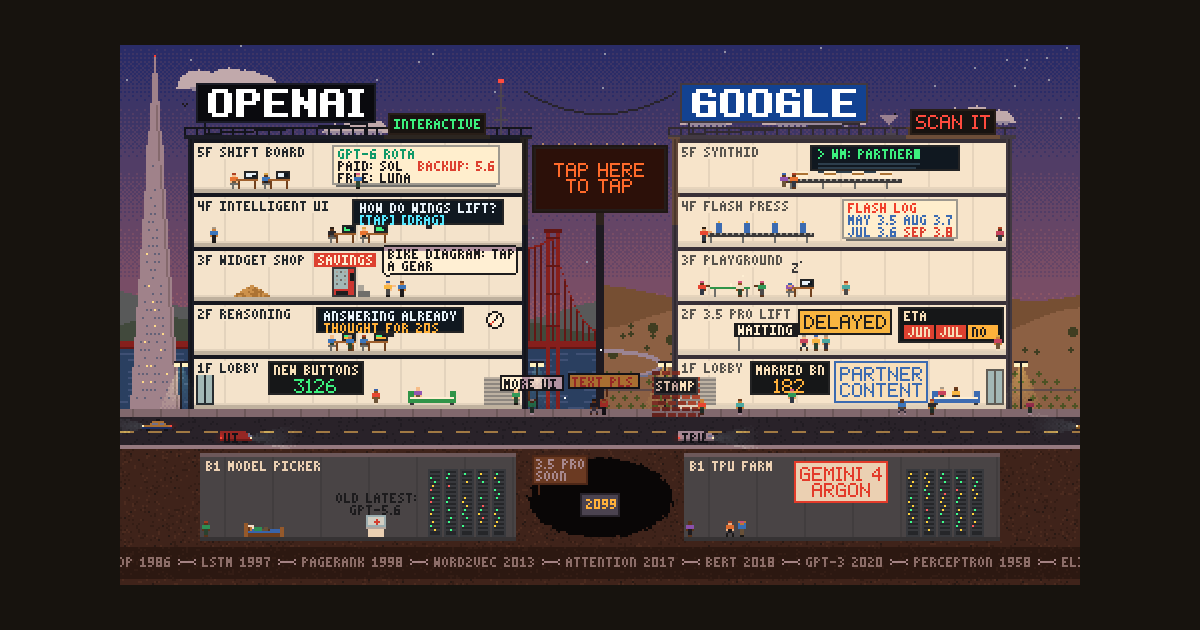
Pixel Rivals has a new animated pixel-art diorama called “Buttons vs Watermarks” that turns OpenAI and Google developments into a playful company duel. The browser-based scene is drawn entirely in code, loops from day to night and is presented as parody, not an affiliated with the companies shown.
Pixel Rivals’ “Buttons vs Watermarks” is a free animated pixel-art diorama that turns OpenAI and Google developments into a playful corporate face-off. Readers can open the scene in a browser, where two cut-away towers loop through day and night, with gags drawn from public reporting.
The OpenAI tower is arranged around the Intelligent UI and GPT-6 news, with floors labeled for a widget shop, reasoning and an interface. Across the street, Google’s tower features SynthID, an experimental game-making Playground and a lift marked “3.5 Pro.” A billboard, street and cave complete the miniature scene. The scene is parody and is not affiliated with the companies shown.
Pixel Rivals describes the work as a company duel, with each gag based on public reporting. The scene page lists sources for factual jokes. The gallery says its scenes are drawn pixel by pixel using a small project-specific engine, with no image generator involved. Each diorama runs live in a browser and can also be watched as a 45-second, 1080p clip.
The project’s other scene formats include movie homages using parody names and imaginative “go-wild” places. Pixel Rivals says it is not affiliated with the companies depicted; it uses no real logos or named individuals. Thorsten Meyer built the gallery with an AI coding assistant.
The diorama offers a visual, comic way to revisit a OpenAI and Google developments, . Its tower layout turns interface features, watermark checks and delayed product plans into small scenes .
That format also makes the work a compact example of code-based digital art: the motion and pixel imagery are generated by the project’s own engine, while the factual gags in company duels are based on public reporting. The distinction matters because the scene is an interpretation of public developments, .
A Gallery of Living Scenes
Pixel Rivals is a free web gallery of animated pixel-art dioramas. Scenes loop continuously and shift from day to night; viewers can watch them in-browser or choose the short video version. Its company duels depict businesses as cut-away towers, while other entries draw on film and imaginary settings.
The project says it was built with help from an AI coding assistant: Meyer supplied eight reference images and a wish list, and the engine and eleven scenes followed about a day later. Pixel Rivals says nine scenes were developed in parallel by separate AI agents, then checked by a lead agent with fourteen automatic checks, including checks for seamless loops, constant motion and nights that are not completely dark.
The scene includes gags based on public reporting about OpenAI’s Intelligent UI and Google’s SynthID Detector. The scene includes labels for Google’s Playground and 3.5 Pro.
“”
The scene is parody based on public reporting, not a company announcement. Google’s FAQ says, “This is not a general AI detector.”
Pixel Rivals says it publishes a new scene every Thursday at 16:00 Berlin time, alternating company duels with movie and place scenes. The gallery also posts daily clips on X at @pixelrivalsart. “Buttons vs Watermarks” is a scene on Pixel Rivals.
Key Questions
What is “Buttons vs Watermarks”?
It is a Pixel Rivals animated pixel-art diorama depicting OpenAI and Google as cut-away towers, with factual gags based on public reporting.
Can I view it for free?
Yes. Pixel Rivals describes its gallery as free and browser-based. The scene loops live, and the gallery says each scene is also available as a 45-second, 1080p clip.
Was the artwork made with an image generator?
No. Pixel Rivals says the dioramas are drawn in code using a small engine built for the project, with no image generator involved.
Is Pixel Rivals affiliated with OpenAI or Google?
The scene is parody and is not affiliated with the companies shown. Pixel Rivals describes the scene as parody, says it uses no real logos or named individuals, and says it is not affiliated with the companies depicted.
Source: Pixel Rivals
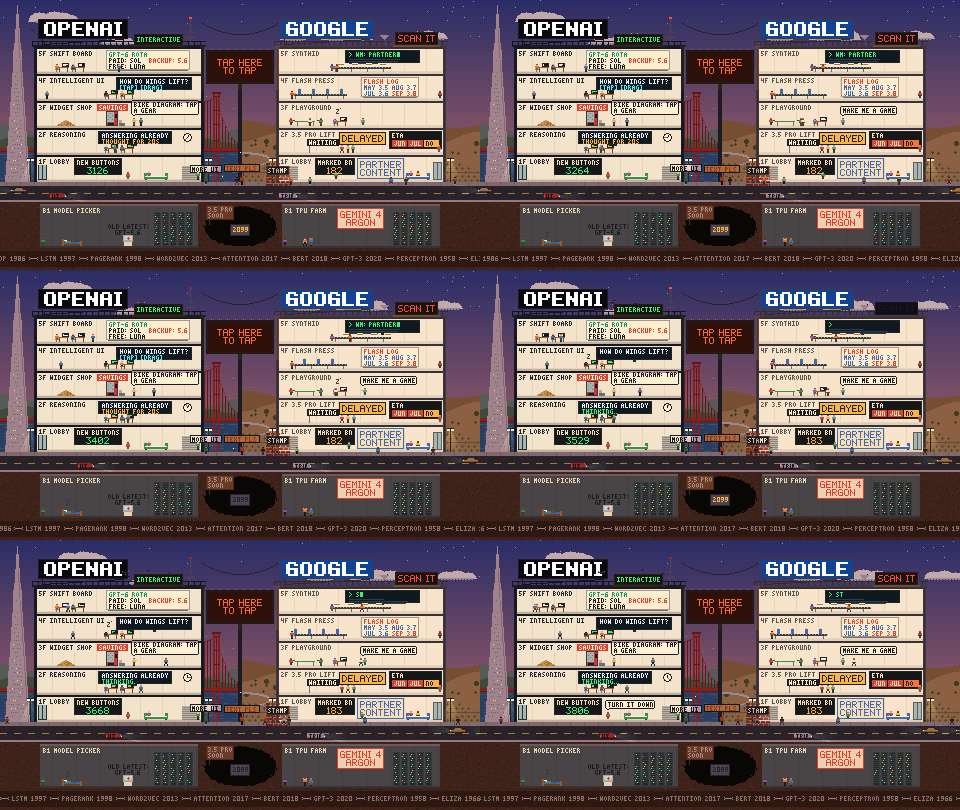
Watch the dioramas live at pixelrivals.com. A new scene arrives every Thursday; daily clips run on X at @pixelrivalsart.
Fall Picks
fall essentials
As an affiliate, we earn on qualifying purchases.