
🔍 Read the full analysis: A Closer Look At AI Video Generation With Trainium3 And LTX-2.5 on ThorstenMeyerAI.com

Get the latest gadgets delivered free with Prime
- Fast, free delivery on millions of items
- Prime Video, Amazon Music and more included
- Member-only deals all year
TL;DR
A Hugging Face engineer says an adapted LTX-2.5 workflow generated a 10-second video with sound in 22–23 seconds on half of an AWS Trainium3 system, once the models were loaded. The result is an engineering demonstration, not a standardized benchmark; differences in resolution and timing methods limit comparisons with LTX’s online API.
A Hugging Face engineer reports generating a 10-second video with sound in 22–23 seconds using Lightricks’ LTX-2.5 model on an AWS Trainium3 machine, after the models had loaded, as described in the original analysis. The test used half of a 64-NeuronCore system and produced a 2048×1024 clip, offering an engineering example of video generation on AWS’s AI accelerator, but not a standardized performance benchmark.
The engineer described the run in an account about a month of access to a Trainium3 trn3.48xlarge instance, provided through a Hugging Face partnership with AWS. Most of the access period was spent testing models and getting them to run; the LTX-2.5 video work took place in the final five days. The reported 22–23 seconds measures generation after model loading, not the complete time from startup to finished video.
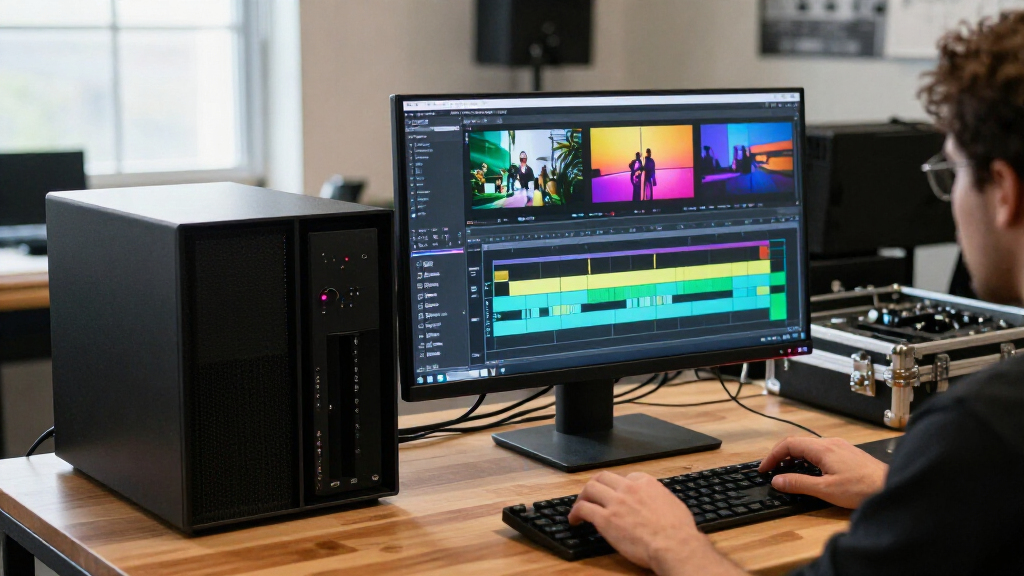
The work involved more than generating one clip from one prompt. The engineer used three Diffusers pipelines and a JSON storyboard to create a sequence of shots, with prompts describing each shot’s subject, camera, lighting, motion and sound. Frames from neighboring shots were used to carry a subject’s appearance and movement across cuts. About 160 lines of additional Python handled shot ordering, trimming, captions, sound levels and assembly.
Getting to the final result required software changes. The engineer says an initial attempt took about 5 minutes 20 seconds to generate a 10-second clip at 960×544, while the NeuronCores were computing for about 45 seconds. The model did not initially fit on one NeuronCore, and Diffusers did not automatically distribute it across cores. The first working version used a four-core split and patches; later pipeline changes supported the higher-resolution output and shorter reported generation time.
Trainium3 runs LTX-2.5Video with sound, on AWS hardware
A Hugging Face engineer generated a connected, multi-shot video sequence on Trainium3. The result offers a useful engineering example, not a general performance benchmark.
From slow first run to faster generation
The final timing came after adapting the setup; model loading was excluded.
- About 5 minutes 20 seconds for a 10-second clip
- Output was 960×544
- NeuronCores computed for roughly 45 seconds
- 22–23 seconds after models were loaded
- Reported output was 2048×1024
- Used half of the Trainium3 machine
A sequence, not just one prompt
The workflow connected shots using frames from neighboring scenes to carry appearance and movement across cuts.
A JSON storyboard specified style, subject, camera, lighting, motion and sound.
Frames from earlier or later shots helped link the subject across cuts.
Three Diffusers pipelines shared the models; added Python handled ordering, trimming, captions, sound levels and assembly.
What the comparison can tell us
The timings are in a similar range, but the reported figures do not establish equivalent performance.
Local workflow
The experiment shows LTX-2.5 can be adapted for a multi-shot, sound-generating workflow on Trainium3.
Different conditions
The API figure is for 1080p; measurement methods and setup details are not fully specified.
One reported run
Repeated results and a comparable end-to-end timing breakdown were not provided.
What the Trainium3 Test Shows
The report gives developers a concrete example of LTX-2.5 running on Trainium3 through a workflow they could adapt, rather than only through a hosted video-generation service. Local control over shot sequencing and post-processing may matter to teams that want to integrate video generation into their own tools or manage how prompts and clips are handled.
The engineer compared the result with LTX’s statement that its online API generates a 10-second 1080p clip in 23.7 seconds. That puts the two reported times in a similar range, but does not establish equal performance: the Trainium3 clip was listed at 2048×1024, and the accounts do not specify whether setup and processing were measured in the same way. The figures are best treated as a limited comparison point, not a ranking of the accelerator against the API or other hardware.
The early run also illustrates why performance claims need clear measurement boundaries. Its 5-minute-20-second elapsed time and roughly 45 seconds of NeuronCore computation describe different parts of the process. The final account does not provide the same compute-time breakdown for the optimized run, making it hard to determine how much of the improvement came from accelerator execution, pipeline changes or other elapsed-time factors.
Products Worth Considering

DJI Mic 3 Wireless Microphone Kit (2 Transmitters, 1 Receiver, Charging Case)

DJI Mic 2 Wireless Microphone System (2 Transmitters, 1 Receiver, Charging Case)

Logitech MX Master 4 Ergonomic Wireless Mouse with Haptic Feedback, Graphite
As an affiliate, we earn on qualifying purchases.
From Initial Run to Final Pipeline
LTX-2.5, made by Lightricks, generates video and sound together. The engineer’s project account describes adapting the Hugging Face Diffusers workflow to run it on Trainium3, including changes to how the model was split across NeuronCores. The first attempt did not reach the target resolution and took substantially longer than the later run.
The optimized workflow used two pipelines for shots generated from prompts or conditioned on frames from other shots. A third upscaled the latent representation by a factor of two before three final generation steps; the first two pipelines used an eight-step distilled recipe. For a “seal” sequence, the engineer generated the iceberg rollover as a key moment first, then built neighboring shots from its frames. The account also describes fox and goat examples.
The engineer says the implementation is available in the dacorvo/video-generation repository, with example films and JSON shot descriptions in a linked project bucket. The account presents these materials as project resources, but does not report independent replication.
“By the end, once the models were loaded, a 10-second clip with sound took 22 to 23 s to generate, on half of the machine.”
— Hugging Face engineer, in the project account
Limits of the Timing Comparison
The account does not provide a reproducible benchmark protocol, repeated-run results, full hardware-utilization data or a stage-by-stage breakdown of the final 22–23 seconds. It also does not say whether the LTX API timing includes model startup or other processing comparable to the Trainium3 measurement.
The reported outputs differ in resolution: the Trainium3 clip is listed as 2048×1024, while the API comparison is for 1080p. The account does not explain how those output specifications were compared, and the timing figures alone do not show whether the quality or content was equivalent. It remains unclear how the workflow performs across other prompts, longer videos or repeated production workloads, and whether other developers have reproduced the result.
Reproduction and Broader Testing
Developers can inspect the published implementation and example storyboard materials, though the account does not confirm independent replication or announce a follow-up benchmark. A stronger comparison would report the precise software and hardware setup, distinguish model-loading time from generation time, provide repeated runs and use matching clip specifications across systems.
No broader release schedule or maintenance plan for the pipeline is given. Whether the engineer or other teams will publish additional results, or test the workflow on more prompts and configurations, remains unknown.
Key Questions
What did the Trainium3 test generate?
The engineer reports generating a 10-second video with sound using Lightricks’ LTX-2.5 model, with an output listed at 2048×1024.
How long did generation take?
The reported time was 22–23 seconds after the models were loaded. It is not an end-to-end startup measurement.
Can the result be directly compared with LTX’s API?
Not conclusively. LTX’s reported API figure is 23.7 seconds for a 10-second 1080p clip, while the Trainium3 output and measurement details differ or are unspecified.
Was this a standardized benchmark?
No. The account describes an engineering experiment and does not give a full benchmark protocol, repeated-run results or a complete timing breakdown.
Is the implementation available?
The engineer says the code is in the dacorvo/video-generation repository, with example videos and JSON shot descriptions in a linked project bucket. Independent reproduction is not reported.
Primary source: Hugging Face · via ThorstenMeyerAI.com