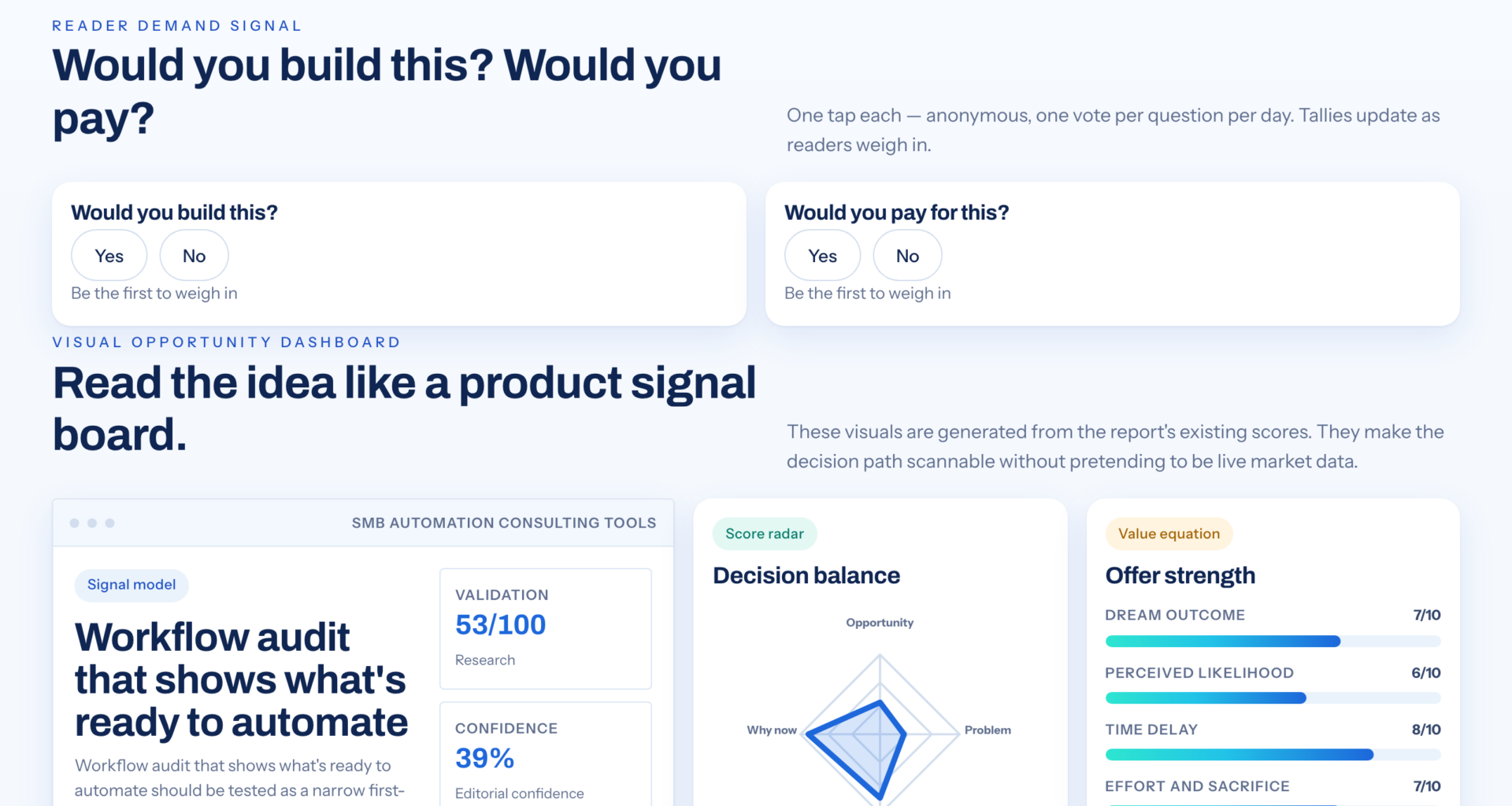

📊 Full opportunity report: Find Automation Candidates With A Workflow Review on IdeaNavigator AI — validation score, market gap, and execution plan.

Get the latest gadgets delivered free with Prime
- Fast, free delivery on millions of items
- Prime Video, Amazon Music and more included
- Member-only deals all year
TL;DR
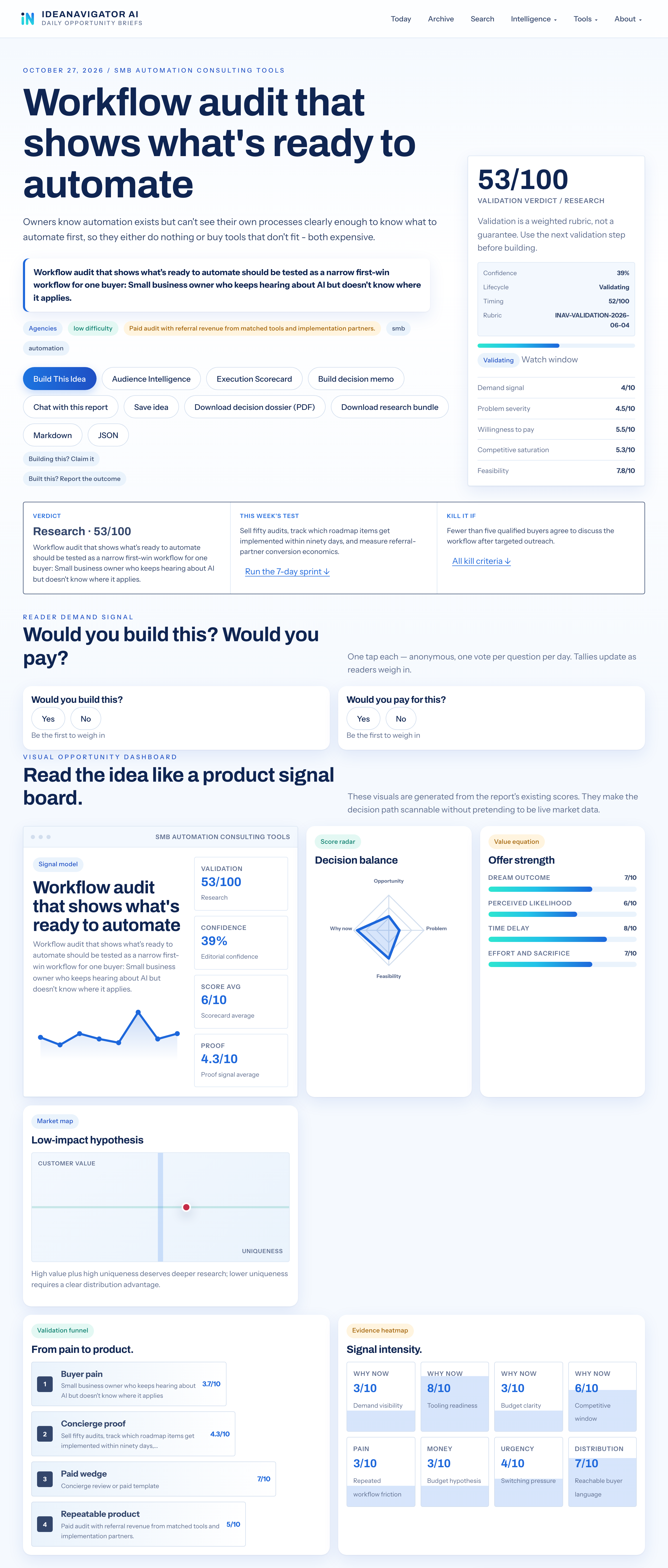
IdeaNavigator AI proposes a paid workflow audit for small-business owners who are unsure where automation or AI could help. The concept would produce a process map, ranked automation opportunities, tool suggestions and a 90-day roadmap; its commercial potential has not yet been validated.
IdeaNavigator AI has proposed a paid workflow audit to help small-business owners identify which tasks may be suitable for automation, turning a broad interest in AI tools into a process-specific plan. The concept remains a proposed product, with no evidence provided that the service has launched or that customers have bought audits, according to the company’s proposal.
In its proposal, IdeaNavigator AI says the audit would use a guided interview to walk an owner through business operations and create a process map. The service would score potential automation candidates on readiness, possible return on investment and difficulty, then arrange recommendations into a sequenced 90-day roadmap.
The proposal also says each suggested step would include matching software tools. The business model pairs a paid assessment with possible referral revenue from tool providers and implementation partners. These are proposed revenue streams, not reported results.
IdeaNavigator AI identifies the proposed first test as an effort to sell 50 audits and track which roadmap items customers implement within 90 days. The test would also measure conversion economics for referral partners. The proposal provides no price, customer results, implementation rate or referral figures.
IdeaNavigator AI · Concept Brief
Find Automation Candidates With A Workflow Review
A proposed paid audit would help small-business owners map their operations, spot tasks that may suit automation, and turn recommendations into a practical 90-day plan. Commercial demand has not yet been validated.
01 / The proposed model
Make the work visible first
The service starts with a business’s actual processes, then connects possible improvements to tools and the effort required to put them in place.
INPUT · Guided interview
Map operations
Walk an owner through recurring work to create a process map and identify tasks that might be suitable for automation.
ASSESS · Prioritize
Rank opportunities
Score candidates by readiness, possible return on investment, and difficulty—criteria whose methodology is not yet specified.
OUTPUT · Take action
Plan the next 90 days
Sequence recommendations into a roadmap with suggested software tools and implementation steps.
02 / Owner journey
From uncertainty to a testable plan
Buying software is not the same as improving a workflow. The proposed review aims to make the choices and the work of change easier to compare.
Describe the business
Guided questions explore how day-to-day operations work.
Capture the process
Recurring tasks are organized into a process map.
Compare candidates
Potential readiness, return, and difficulty inform priorities.
Sequence the work
Tools and actions are arranged in a proposed 90-day roadmap.
03 / Validation plan
Demand and results remain untested
IdeaNavigator AI proposes a first test, but reports no launch, customers, price, implementation rate, or referral figures.
04 / Open questions
A useful idea still needs evidence
A polished report alone cannot establish value. Results must show that owners buy, use the recommendations, and receive sound guidance.
The proposal does not confirm that the audit has been built, launched, or sold. Pricing, interview length, delivery format, and customer or partner names are not provided.
It also leaves open how scores would account for privacy, integrations, staff training, and ongoing maintenance. No evidence establishes that an interview can capture enough detail to rank workflows reliably.
The business model combines assessment fees with possible referrals to software providers and implementation partners. Both revenue streams—and the neutrality of recommendations—remain to be proven.
What would an owner receive?
A process map, scores for readiness, possible ROI and difficulty, tool suggestions, and a sequenced 90-day roadmap.
Is the audit available now?
The information describes a proposal; it does not confirm a launch or sales.
When might results appear?
No launch date or test schedule is announced, so timing is unknown.
What evidence would help?
Paid demand, a clear scoring method, and reported implementation and referral outcomes.
Turning AI Interest Into Workflows
For a small-business owner, the practical question is often not whether automation exists but which recurring task is worth changing. A process review could help make that choice more concrete by linking recommendations to the way a business actually operates, rather than beginning with a particular tool.
The proposed format also recognizes that buying software is not the same as improving a workflow. A roadmap that includes implementation steps and difficulty ratings could help owners compare potential benefits against the effort and cost of changing established processes. Whether it does so effectively remains untested.
The business case depends on more than producing a polished audit. The 50-customer test would need to show that owners pay for the assessment, implement recommendations and generate enough referral income to support the service. Until those measures are available, the concept is an idea to validate—not evidence that a new market or product has succeeded.
Products Worth Considering

Logitech MX Mechanical Wireless Illuminated Keyboard, Tactile Quiet, Graphite

LG 34GX90SA-W 34-inch Ultragear WQHD OLED Curved Gaming Monitor

Jackery HomePower 1000 Plus v2 Portable Power Station
As an affiliate, we earn on qualifying purchases.
The Proposed Audit Model
IdeaNavigator AI’s proposal identifies a specific audience: small-business owners who hear about AI but do not know where it fits. It says these owners may lack a clear view of their own processes, leaving them unsure what to automate first. The stated risk is two-sided: doing nothing, or buying tools that do not fit the work.
The proposal’s timing rationale is that the expansion of AI tools has created decision pressure and confusion, while large language models may make guided process-mapping interviews easier to deliver. This is the company’s rationale; the proposal provides no evidence on model performance, audit accuracy or whether interviews can reliably capture a business’s operations.
IdeaNavigator AI describes the proposed category as automation consulting tools for small and medium-sized businesses. Rather than offering a general AI explainer, the service would assess workflows, prioritize candidate tasks and connect recommendations to tools and implementation support. The outlined 90-day period is a measurement window for testing adoption, not a reported product milestone.
Demand and Results Remain Untested
IdeaNavigator AI’s proposal does not confirm that the audit has been built, launched or sold. Pricing, interview length, assessment methodology and delivery format are not specified, and no small-business customers or partners are named.
The proposal also does not define how it would calculate automation readiness, ROI or difficulty, or how recommendations would account for privacy, integration costs, staff training and ongoing maintenance. It reports no results establishing that a guided interview can gather enough reliable detail to rank workflows accurately.
The central commercial questions remain open: Will owners pay for an audit? Will they implement its recommendations within 90 days? And will tool or implementation referrals produce sustainable revenue without compromising the neutrality of recommendations? IdeaNavigator AI says the proposed test is intended to address some of these questions, but its outcomes are not yet available.
A 50-Audit Validation Test
IdeaNavigator AI says the next proposed step is to try to sell 50 audits, then follow whether customers implement the recommended roadmap items during the following 90 days. The company also proposes measuring referral-partner conversion to test whether the second revenue stream contributes to the model.
For readers evaluating the concept, the useful milestones would be evidence of paid demand, a clear account of how recommendations are scored, and reported implementation and referral outcomes. No launch date or test schedule is announced in the proposal, so it is not clear when results might be reported.
Source: IdeaNavigator AI proposal
Key Questions
What is the proposed workflow audit?
IdeaNavigator AI describes it as a proposed paid assessment for small businesses. A guided interview would map operations and identify tasks that may be suitable for automation.
What would an owner receive?
According to the proposal, the output would include a process map, scores for readiness, ROI and difficulty, a sequenced 90-day roadmap and tool suggestions for recommended steps.
Is the audit available now?
The information provided describes a proposal and does not confirm that the service has launched or begun selling audits.
How would the idea be tested?
IdeaNavigator AI proposes selling 50 audits, tracking which recommendations customers implement within 90 days and measuring referral-partner conversion economics. No results are reported.
How would the service make money?
The proposed model combines fees for the audit with referral revenue from matched software tools and implementation partners. Its pricing and actual referral economics remain unknown.
Source: IdeaNavigator AI