
📊 Full opportunity report: Lahori Zeera And The Latest Food And Beverage Trends Explained on IdeaNavigator AI — validation score, market gap, and execution plan.
TL;DR
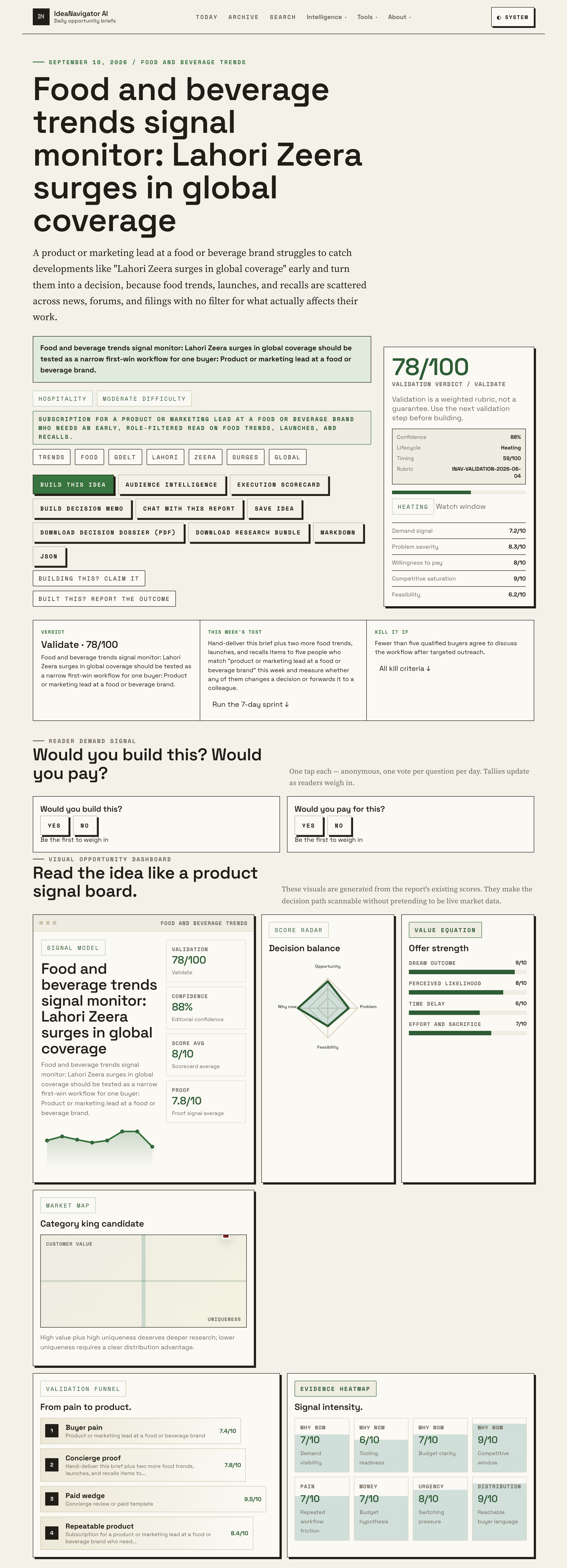
Data from the GDELT media-monitoring system flagged ‘Lahori Zeera surges in global coverage’ with an 88/100 signal score, indicating a sharp rise in international media attention to the Pakistani cumin-based beverage. The signal, surfaced via an IdeaNavigator AI trend monitor, is proposed as the basis for a role-filtered alerts service for food and beverage brand managers.
A surge in global media coverage of Lahori zeera — a spiced cumin-based drink originating from Lahore, Pakistan — has been detected by the GDELT media-monitoring system, which scored the trend at 88 out of 100, according to an analysis published by IdeaNavigator AI. The signal suggests the traditional beverage is attracting unusually high international attention, a development that matters to product and marketing teams at food and beverage brands tracking emerging flavor trends.
Lahori zeera (also written zeera or jeera) is a savory, spiced beverage built around roasted cumin, typically blended with black salt, mint, lemon and sparkling water. It has long been a street-drink staple in Lahore, especially in hot weather, but has historically received little coverage outside South Asian food media. According to the IdeaNavigator AI report, GDELT — a global news-tracking database that indexes thousands of outlets in dozens of languages — surfaced the phrase "Lahori Zeera surges in global coverage" as a high-confidence trend signal.
The 88/100 score is a measure of the signal’s strength in GDELT’s monitoring output, not a measure of sales or consumer demand. What the score indicates is a marked increase in the volume of media mentions relative to typical baseline coverage. The raw comparison basis — how many mentions constitute the baseline, and over what exact time window the surge occurred — was not specified in the report, so the figure should be read as a directional indicator rather than a quantified growth rate.
IdeaNavigator AI frames the signal as a business opportunity: a role-filtered monitoring service that watches GDELT and similar feeds for food trends, product launches and recalls, and converts each relevant item into a short brief covering what changed, why it matters, and what a product or marketing lead should do. The proposed target buyer is a product or marketing lead at a food or beverage brand, offered as a subscription product.
Why Brands Track Beverage Trend Signals
For food and beverage companies, early detection of flavor and beverage trends can shape product development, menu planning and marketing calendars. Drinks built on regional South Asian flavors — from masala sodas to spiced lassis — have repeatedly moved from niche ethnic retail into mainstream product lines once media attention broadened. A surge in coverage of Lahori zeera could precede similar movement, or it could prove fleeting.
The report argues that trends, launches and recalls are currently scattered across news, forums and regulatory filings with no filter separating what matters for a specific role from general noise. A same-day, filtered read, the analysis contends, outperforms waiting for weekly industry roundups when product decisions are time-sensitive. That claim is a hypothesis the report proposes to test, not a demonstrated result.
As an affiliate, we earn on qualifying purchases.
From Lahore Street Drink to Global Signal
Lahori zeera belongs to a family of South Asian savory beverages that includes jaljeera and masala soda. Cumin-based drinks are valued in the region for their digestive and cooling associations, and vendors in Lahore have sold versions of the drink for generations. The drink sits within a broader pattern in which regional beverages gain international visibility through food media, diaspora communities, restaurant menus and social platforms.
GDELT, the system that detected the signal, continuously monitors worldwide news coverage and is frequently used by analysts, brands and researchers to spot emerging topics before they appear in conventional market reports. Trend signals from such systems are early indicators, and their reliability varies — a spike in coverage can reflect genuine consumer interest, a single viral story, or coordinated media attention around one event.
What the Coverage Spike Does Not Show
Several things remain unclear. The report does not establish why coverage surged — whether driven by consumer interest, a specific viral moment, restaurant launches, export activity, or a single widely syndicated story. It also does not provide baseline mention counts or a defined time window, so the size of the increase cannot be independently verified from the published data.
There is no confirmed evidence yet of corresponding sales growth, retail listings or product launches tied to Lahori zeera in Western markets. The commercial proposal built on the signal — a subscription monitoring service — is itself unvalidated; the report explicitly proposes a small-scale test rather than claiming proven demand.
Testing the Trend Before It Peaks
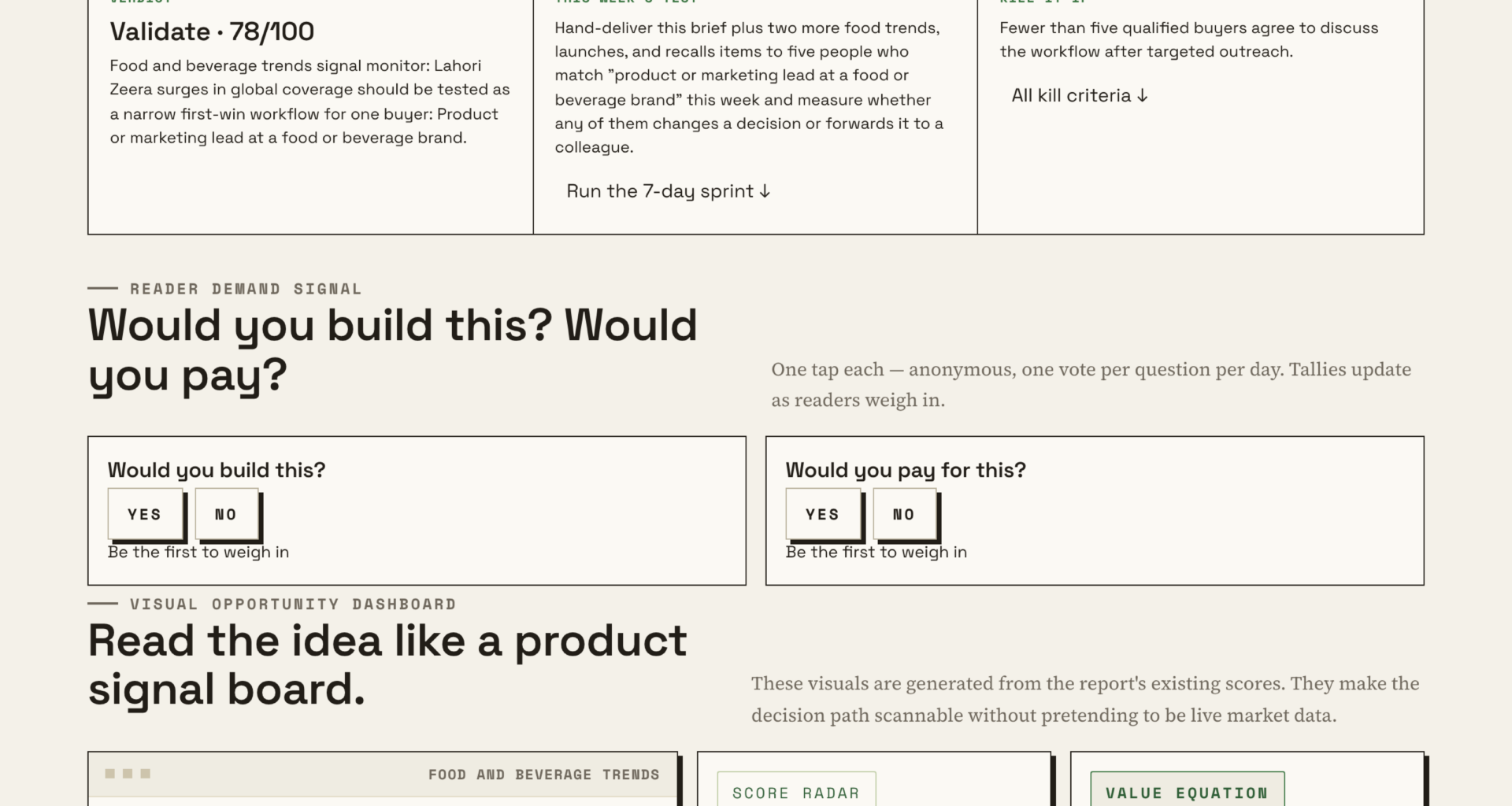
The report proposes a concrete validation step: delivering the Lahori zeera brief, plus two additional food and beverage trend items, to five professionals matching the target buyer profile within the week, then measuring whether any recipient changes a decision or forwards the brief internally. That outcome would indicate whether role-filtered trend monitoring carries genuine commercial value.
For industry observers, the next indicators to watch include whether major beverage brands or restaurant chains introduce cumin-based or South Asian savory drinks, whether the GDELT signal sustains over weeks rather than spiking once, and whether retail or import data begins to reflect demand. If coverage returns to baseline quickly, the surge may represent transient media attention rather than a durable trend.
Source: IdeaNavigator AI
Key Questions
What is Lahori zeera?
Lahori zeera is a spiced beverage from Lahore, Pakistan, made with roasted cumin, black salt, mint, lemon and usually sparkling water. It is a long-standing street drink in the region, known for its savory, tangy flavor profile.
What does the 88/100 GDELT score mean?
The score reflects the strength of the media-coverage signal in GDELT’s monitoring output — a measure of how sharply mentions rose relative to typical coverage. It is not a measure of sales, popularity or consumer demand, and no baseline count or time window was published.
Does the coverage surge mean Lahori zeera products are launching globally?
No. The signal shows increased media attention only. As of the report, there is no confirmed evidence of new product launches, retail listings or sales growth tied to Lahori zeera in international markets.
Why would a food or beverage brand care about this signal?
Early visibility into flavor trends can inform product development and marketing timing. Regional beverages have repeatedly crossed into mainstream markets after media attention broadened, so an early read gives brands lead time to evaluate whether to act.
How will the trend be validated?
The IdeaNavigator AI report proposes delivering trend briefs to five matching industry professionals and measuring whether any of them changes a decision or forwards the material — a direct test of whether the monitoring service has practical value.
Source: IdeaNavigator AI