

📊 Full opportunity report: What To Include In An Empty Trust Funding Tracker on IdeaNavigator AI — validation score, market gap, and execution plan.
TL;DR
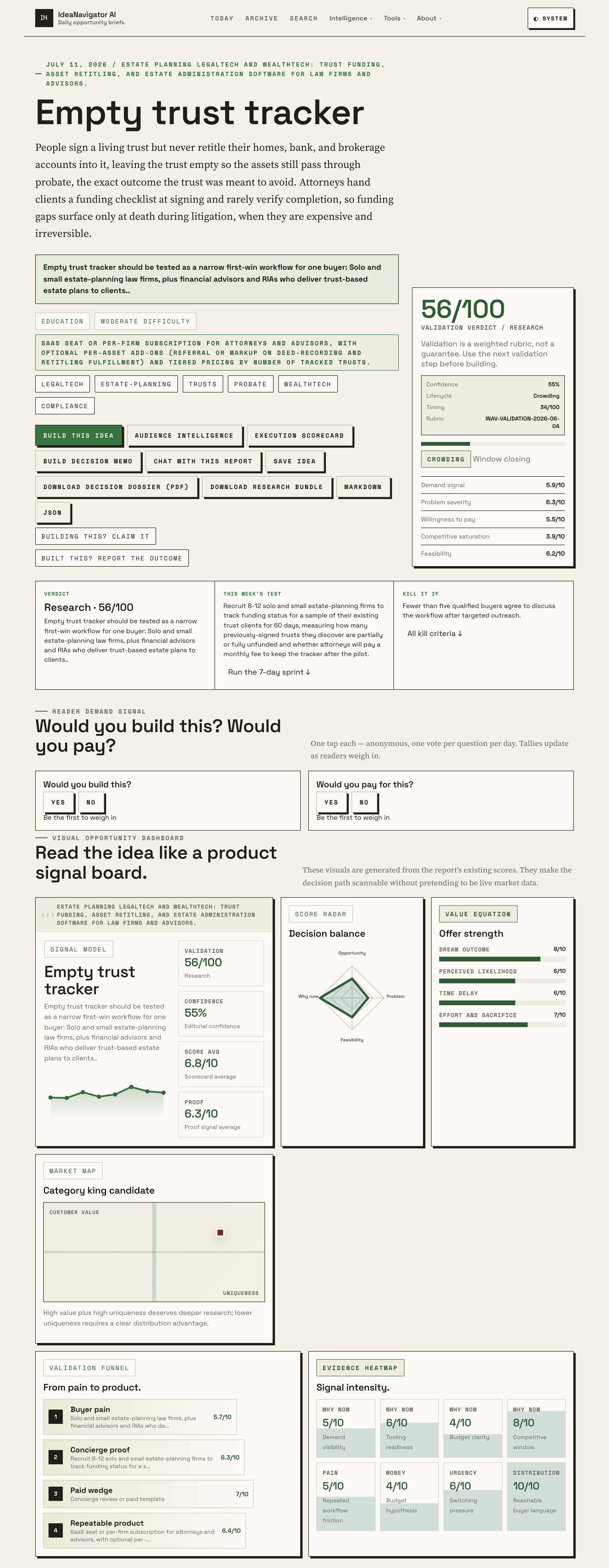
IdeaNavigator AI proposes testing a client-by-client tracker that records whether assets have been transferred into living trusts and stores supporting proof. The concept is aimed at small estate-planning firms and financial advisers; no pilot results, customer commitments or product launch are reported.
IdeaNavigator AI has proposed an early-stage trust funding tracker for solo and small estate-planning law firms, financial advisers and registered investment advisers. The suggested tool would help professionals monitor whether clients transfer assets into living trusts, a step that can determine whether those assets are handled by the trust as intended.
The proposed tracker would let a firm create a funding checklist for each trust, covering assets such as real estate, bank and brokerage accounts, business interests and beneficiary designations. Users could mark each item as pending, in progress or confirmed funded, attach supporting records such as a recorded deed or retitled account statement, and send reminders to clients.
A firm dashboard would summarize the funding status across its clients, including the share of listed assets marked complete. The proposal describes this as a way for attorneys or advisers to identify trusts with significant outstanding items and follow up before a funding gap becomes harder to address. It does not report that such a product has been built or deployed.
For validation, IdeaNavigator AI proposes recruiting eight to 12 small estate-planning firms to track a sample of existing trust clients over 60 days. The test would measure how many trusts are found to be partly or wholly unfunded and whether participating firms would pay a monthly fee to continue using the tracker. No pilot findings or customer commitments are provided.
Tracking Assets After Signing
A living trust document alone does not necessarily place a person’s assets under the trust. Ownership or account arrangements may need to be changed for assets to be held by the trust, while some assets may instead involve beneficiary designations or other planning choices. If a transfer is not completed, the asset may not be handled through the trust as the client expects; the precise consequences depend on the asset, the documents and applicable law.
The proposed tracker focuses on the period after a plan is signed, when clients may be responsible for completing practical transfer steps and professionals may have limited visibility into whether they did so. A shared record of status and proof could make follow-up more organized. Whether it would reduce probate disputes, prevent costly problems or save firms time remains unproven and would need to be measured.
The concept also raises a commercial question: will firms pay for ongoing tracking when they currently rely on checklists and manual follow-up? IdeaNavigator AI suggests subscriptions by firm or user, with pricing tiers based on the number of trusts tracked. It also describes optional services related to deed recording or retitling. These are proposed revenue approaches, not reported sales or established market demand.
The Post-Signing Funding Gap
The proposal identifies a gap between preparing estate-planning documents and completing asset transfers. It says attorneys commonly give clients a funding checklist at signing, but completion may not be verified. It describes the resulting risk as a trust remaining empty or only partly funded while assets remain outside it. These are the problem statement and assumptions behind the product idea; the material does not provide independent research on how frequently this occurs.
IdeaNavigator AI states that about 11% of Americans hold a trust and points to growing estate-planning adoption and digital tools in 2026. It gives no supporting survey details, date range or comparison baseline for those figures, so they should be treated as claims in the proposal rather than independently established measures. The proposal also says trust funding remains a manual and fragmented task that document-drafting software does not resolve.
As additional market context, the proposal points to advisers and registered investment advisers seeking to include funded estate plans in client offerings, and to per-deed funding services priced from $250. It does not identify providers, describe the services’ terms or show how large the market is. The tracker is framed as a possible layer for monitoring progress alongside fulfillment services, rather than as a replacement for legal advice or asset-transfer work.
Pilot Results Still Pending
No product launch, pilot outcome or paying customer is reported. It is unclear whether firms have agreed to participate, how the proposed tracker would be integrated into existing legal or advisory workflows, or what evidence would count as confirmation that an asset is funded.
The proposal also does not specify how the service would handle sensitive financial and legal records, verify uploaded documents, distinguish assets requiring different transfer steps, or address changes in a client’s circumstances. These details could affect both the usefulness of the dashboard and the work required of professionals. The suggested 60-day test would provide an initial measure of detected funding gaps and willingness to pay, but its results and limitations are not yet available.
A Proposed 60-Day Firm Test
The next proposed step is a 60-day pilot with eight to 12 small firms, using a sample of existing trust clients. The test would check how often previously signed trusts have pending or incomplete funding tasks and ask whether firms would pay to keep using the service. No timeline for recruitment or pilot completion has been announced.
If carried out, the pilot’s findings could clarify whether firms see enough value in post-signing tracking to adopt a paid tool. Until then, demand, pricing, workflow fit and the tracker’s effect on completed transfers remain open questions.
Source: IdeaNavigator AI
Key Questions
What would the trust funding tracker do?
It would let a law firm or adviser list a client’s trust-related funding tasks, record each item’s status, attach supporting documents and send reminders. The proposal also includes a dashboard showing the status of trusts across a firm.
Has the tracker launched?
No launch is reported. IdeaNavigator AI presents the tracker as a product concept and proposes a pilot to test it.
What would the proposed pilot measure?
A 60-day test with eight to 12 solo or small estate-planning firms would examine how many existing trusts are found to be partly or wholly unfunded and whether firms would pay a monthly fee to continue.
Does signing a living trust transfer assets into it?
Signing the document does not by itself establish that every asset has been transferred. The steps depend on the asset and the client’s plan; the proposal focuses on tracking those steps and their supporting records.
Source: IdeaNavigator AI