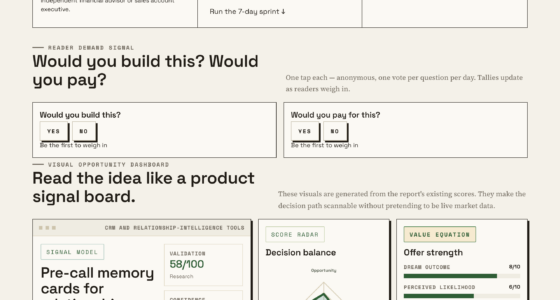
📊 Full opportunity report: What A Good Advisor Relationship Can Look Like After Inheriting on IdeaNavigator AI — validation score, market gap, and execution plan.

Get the latest gadgets delivered free — and shop member deals
- Fast, free delivery on millions of items
- Access to Prime Big Deal Days deals on October 6–7
- Prime Video, Amazon Music and more included
TL;DR
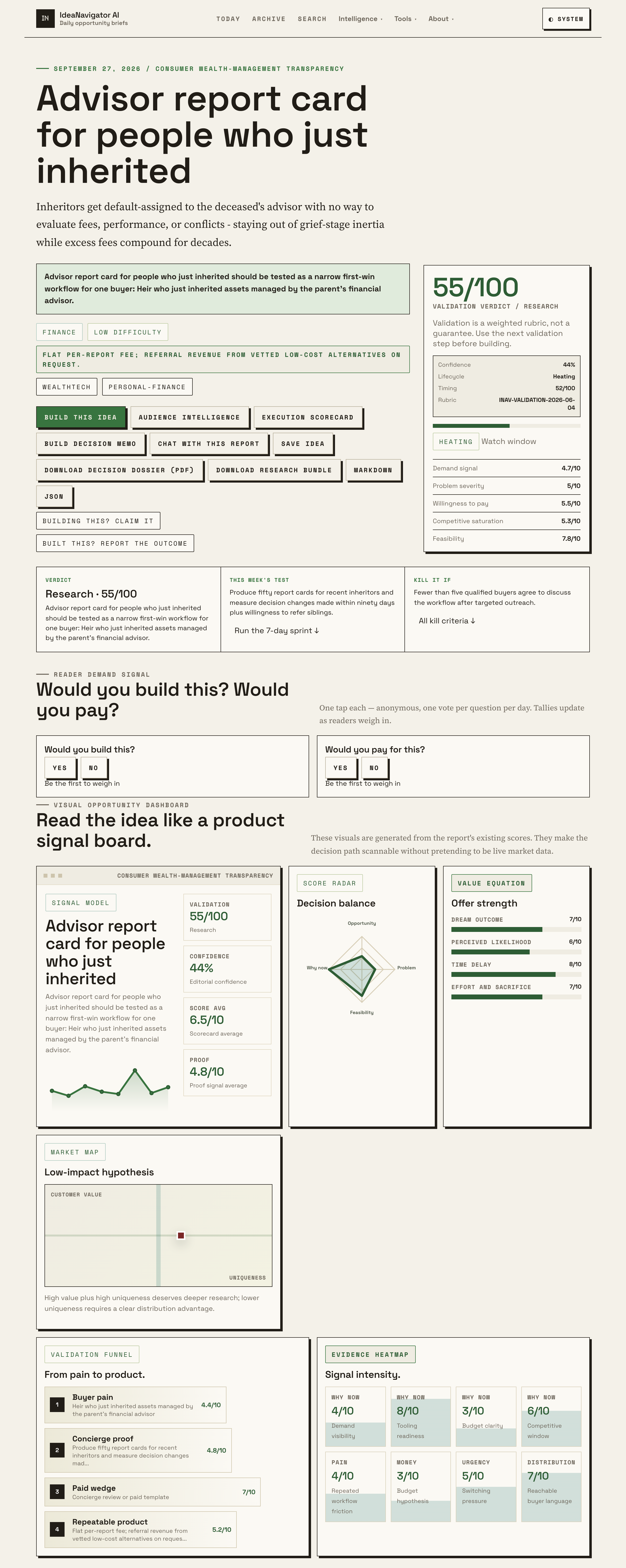
IdeaNavigator AI has outlined a proposed report-card service for people who inherit assets managed by a parent’s financial advisor. The concept would assess fees, regulatory history and disclosed conflicts, but it remains an idea to validate, not a launched service with demonstrated results.
IdeaNavigator AI has proposed an advisor report card for people who inherit assets managed by a parent’s financial advisor, aiming to help them review fees, performance and disclosed conflicts before deciding whether to stay, negotiate or switch. The concept is at the testing stage: no operating service, customer outcomes or evidence of savings are described.
The proposed first version would serve one group: heirs who have just inherited assets overseen by the deceased parent’s advisor. A user would enter the advisor’s name and upload account statements. The report would then combine regulatory history and disclosed conflicts with an estimate of the account’s all-in fees, based on the statements, and comparisons with alternatives.
The report would offer stay, negotiate or switch guidance, along with scripts for conversations with the advisor. The outline does not specify which data sources, comparison methods or assumptions would determine a recommendation, nor how the service would handle differences in investment goals, tax situations or inherited account structures.
The proposed business model is a flat fee per report, with referral revenue from lower-cost alternatives if a customer requests them. IdeaNavigator AI also proposes creating 50 reports for recent inheritors, then measuring whether recipients make a decision within 90 days and whether they would refer siblings. Those are planned validation measures, not reported results.
A Review Before Heirs Decide
When an heir inherits assets already managed by a family advisor, the existing relationship may continue by default. A structured review could give the heir a clearer basis for asking about what the advice costs, how the portfolio is managed and whether disclosed conflicts are relevant. That could matter especially when the new client did not choose the advisor or establish the original relationship.
The proposal connects this handover problem to the transfer of wealth to heirs over the coming decade, which it describes as involving trillions of dollars. It provides no specific estimate or time series for that claim. The practical stakes for an individual would depend on the account, the fees charged, the advisor’s services and the heir’s circumstances. A report could inform a conversation, but the outline does not establish that it can determine which advisor is best or that switching would improve outcomes.
From Inheritance to Advisor Review
The proposal identifies a particular moment of financial decision-making: after a parent dies, an heir receives assets that may still be managed by the parent’s advisor. It characterizes the risk as default continuation, with grief and administrative demands making it harder to scrutinize the relationship. The outline does not provide research showing how often heirs stay with an advisor for those reasons or how much they pay as a result.
Its suggested approach relies on information that may be available in Form ADV and fee disclosures, paired with language-model tools to parse account documents. The plan is to turn those records and statements into a consumer-facing review. No technical design, privacy safeguards, regulatory review or accuracy checks are described, so the proposal does not yet show how a finished product would handle incomplete or difficult-to-interpret records.
Questions Before a Pilot
The proposal does not say whether the service has been built, whether any inheritors have used it or whether a pilot is underway. It gives no findings on fee levels, decision changes or customer demand. The suggested 50-report exercise is a validation plan, not a completed study.
Important product questions also remain open: how alternatives would be selected and benchmarked; how performance comparisons would account for risk and time periods; whether referral payments could affect recommendations; and how sensitive financial documents would be stored and processed. The outline does not describe controls for these issues or say who would review reports for accuracy.
Testing the First Fifty Reports
The next stated step is to produce 50 report cards for recent inheritors and track whether recipients change their advisor decision within 90 days. The plan also calls for measuring willingness to refer siblings. No schedule, recruitment process or threshold for judging the test successful is provided.
Those results could help determine whether the proposed service merits further development and whether a per-report fee is viable. Until the test is carried out and its methods and results are reported, the service’s usefulness, accuracy and effect on advisor choices remain unproven.
Source: IdeaNavigator AI
Key Questions
What is the proposed advisor report card?
It is a proposed service for heirs to review an advisor managing assets they inherited. It would assess fees, regulatory history and disclosed conflicts, then offer stay, negotiate or switch guidance.
Is the service available now?
The proposal describes an MVP and a plan to test 50 reports. It does not say the service has launched or that a pilot has begun.
How would it assess an advisor?
The proposed process would use the advisor’s name and uploaded account statements, along with regulatory records and disclosed conflicts. The methods for fee calculations and comparisons with alternatives are not specified.
How would the service make money?
The proposed model combines a flat fee for each report with referral revenue from lower-cost alternatives when a customer requests them. The outline does not explain how it would manage potential conflicts tied to referrals.
What would the proposed test measure?
It would track decision changes within 90 days among 50 recent inheritors who receive reports, as well as their willingness to refer siblings. No test results are available in the proposal.
Source: IdeaNavigator AI
Fall Picks
fall essentials
As an affiliate, we earn on qualifying purchases.