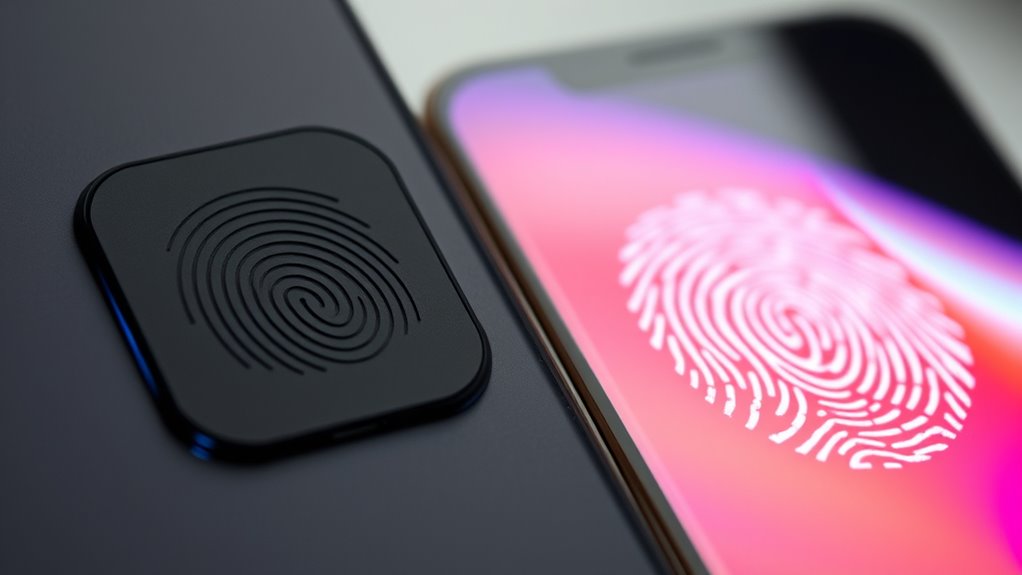

Ultrasonic fingerprint sensors use high-frequency sound waves to create detailed 3D images of your fingerprint, making them more accurate and reliable, especially in challenging conditions like wet or dirty fingers. Optical sensors rely on light to capture 2D images, which are cheaper and easier to produce but more vulnerable to spoofing and surface contamination. If you want to discover which technology suits your needs best, you’ll find more insights ahead.

Get the latest gadgets delivered free — and shop member deals
- Fast, free delivery on millions of items
- Access to Prime Big Deal Days deals on October 6–7
- Prime Video, Amazon Music and more included
Key Takeaways
- Ultrasonic sensors provide higher biometric accuracy and security by capturing detailed 3D fingerprint features, even in challenging conditions.
- Optical sensors are more cost-effective and easier to manufacture, making them suitable for mainstream consumer devices.
- Ultrasonic technology performs better with wet, oily, or dirty fingers, while optical sensors are more affected by surface contamination.
- Ultrasonic sensors are complex and costly, whereas optical sensors are simpler, leading to broader adoption in budget devices.
- The choice depends on balancing security and accuracy needs against manufacturing complexity and cost constraints.
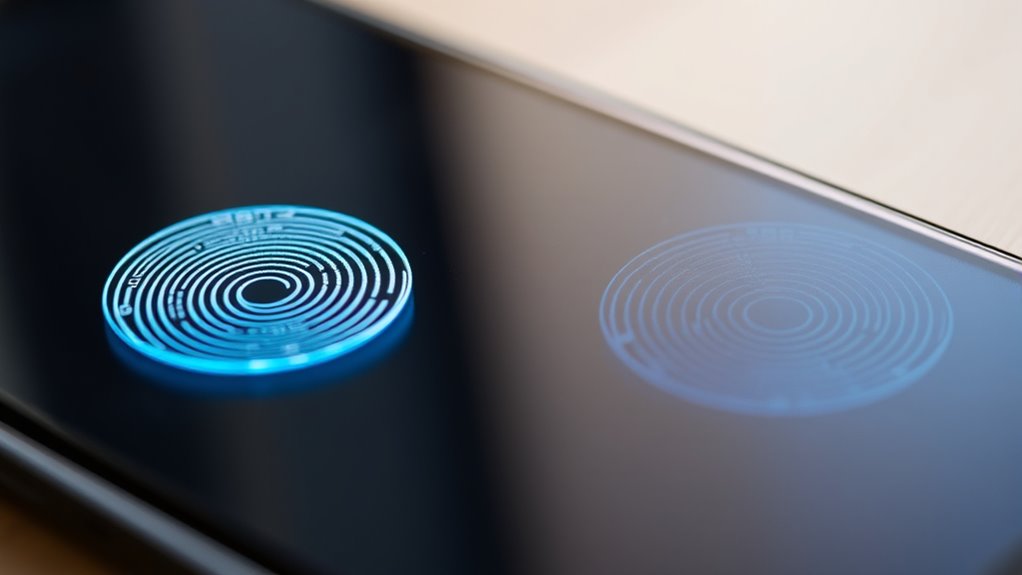
When choosing a fingerprint sensor for your device, understanding the differences between ultrasonic and optical technologies is essential. Both types serve the same purpose—security and quick access—but their underlying mechanisms impact biometric accuracy and manufacturing complexity in distinct ways. Ultrasonic sensors use high-frequency sound waves to create a detailed 3D image of your fingerprint, capturing ridges, pores, and sweat glands with impressive precision. This results in higher biometric accuracy, especially in challenging conditions like wet, dirty, or oily fingers. Because ultrasonic sensors rely on complex sound wave transmission and reception, their manufacturing process tends to be more intricate and costly. The advanced components and calibration required make them less common in budget devices but preferred in premium models for their superior reliability. Additionally, ultrasonic sensors are better suited for resilient security****, making them ideal for high-security applications where robustness is crucial.
Ultrasonic fingerprint sensors offer higher accuracy and security but involve more complex and costly manufacturing processes.
In contrast, optical fingerprint sensors operate by shining a light—usually LED-based—onto your finger and capturing an image of the fingerprint pattern with a camera. This approach is typically simpler to produce, making optical sensors less expensive and easier to integrate into a variety of devices. However, their biometric accuracy can be lower compared to ultrasonic sensors, particularly when the finger’s surface is dirty, oily, or wet. Since optical sensors only capture a 2D image, they’re more susceptible to spoofing or falsification using high-resolution images and are generally less adept at handling difficult conditions. Despite these limitations, optical sensors are still popular due to their cost-effectiveness and straightforward manufacturing process, which allows manufacturers to produce them at scale and keep consumer prices competitive.
When evaluating these technologies, you’ll want to give thought to how biometric accuracy aligns with your security needs. Ultrasonic sensors provide a more secure and reliable fingerprint reading, especially in real-world, everyday scenarios. Their ability to capture detailed 3D images enhances security by making spoofing more difficult. On the other hand, optical sensors may suffice for less sensitive applications, where cost and ease of manufacturing are more critical factors. It’s also worth noting that ultrasonic sensors tend to have a higher manufacturing complexity because they require advanced hardware and precise calibration, which can influence the overall device cost and design choices.
Ultimately, your decision hinges on balancing biometric accuracy with manufacturing complexity and budget constraints. Ultrasonic sensors excel in accuracy and security but come with higher production costs. Optical sensors are more economical and easier to produce but may fall short in environments demanding higher security and robustness. Knowing these differences helps you pick the right technology to meet your specific needs and expectations.
As an affiliate, we earn on qualifying purchases.
Frequently Asked Questions
How Do Ultrasonic Sensors Perform in Extreme Weather Conditions?
Ultrasonic sensors perform well in extreme weather conditions because of their sensor durability and weather resilience. You’ll find they work reliably even in rain, snow, or dirt, as they can detect fingerprints through moisture and debris. Unlike optical sensors, ultrasonic ones aren’t affected by water or grime on the surface, making them a dependable choice if you need consistent performance in harsh environments.
Are Optical Sensors More Vulnerable to Dirt and Grime?
You might notice that optical sensors are more vulnerable to dirt and grime, with studies showing up to 60% of fingerprint recognition failures caused by dirt buildup. Their sensor durability suffers when exposed to dust, oil, or smudges, leading to frequent maintenance challenges. You’ll need to clean the surface regularly to guarantee reliable performance, making optical sensors less ideal for harsh environments compared to ultrasonic ones.
What Is the Typical Lifespan of Ultrasonic Versus Optical Sensors?
Ultrasonic sensors typically last longer than optical sensors because of their superior sensor durability. They are more resistant to dirt, grime, and scratches, reducing maintenance requirements and extending lifespan. Optical sensors, on the other hand, tend to wear out faster due to their vulnerability to dirt and smudges, which can affect performance. If longevity and minimal maintenance are priorities, ultrasonic sensors generally offer a more durable and reliable solution.
Can Both Sensor Types Be Integrated Into the Same Device?
Think of your device as a castle needing both a moat and a drawbridge. You can indeed integrate ultrasonic and optical sensors into the same device, like adding multiple defenses. This sensor integration enhances device compatibility, providing layered security and flexibility. By combining these technologies, you guarantee more reliable fingerprint recognition, offering a robust user experience. Just make certain your device’s hardware supports this multi-sensor setup for seamless operation.
How Do Sensor Costs Compare for Mass Production?
You’ll find that ultrasonic sensors generally have higher manufacturing costs due to their complex components, which can impact production scalability. Optical sensors tend to be cheaper and easier to produce at scale, making them more cost-effective for mass production. When choosing between them, consider how manufacturing costs and production scalability align with your device’s budget and market demands to optimize overall cost-efficiency.
Conclusion
Whether you choose ultrasonic or optical sensors, you’re securing your space with smart, seamless security. Ultrasonic sensors offer advanced accuracy and anonymity, attacking threats with astonishing precision. Optical sensors, on the other hand, provide simple, swift scans with stunning clarity. Both boast benefits, but your choice depends on your needs. So, select the sensor that suits your security stance, and step confidently into a safer, smarter future—shielded by the sleek strength of superior sensor technology.
Halloween Picks
halloween
As an affiliate, we earn on qualifying purchases.