
TL;DR

Get the latest gadgets delivered free with Prime
- Fast, free delivery on millions of items
- Prime Video, Amazon Music and more included
- Member-only deals all year
A solar tire pressure monitor is a dash-mounted display that wirelessly reads pressure and temperature from valve-stem sensors, with a small solar panel keeping the display’s battery charged (sensors still use replaceable coin batteries). If you were looking at the Tymate TM3 RV system, comparable options include the Tymate TM2, the Tymate TM8, and several generic solar-and-USB systems with 4 external sensors and color LCD displays. Match specs — sensor count, alarm modes, power source, and display — rather than chasing one model number.
You’re searching for the Tymate TM3 RV tire pressure monitoring system with solar charging and a color LCD — and you’ve likely hit a wall finding it in stock anywhere. That’s the reality of the budget TPMS market: models appear, sell well for a year or two, then quietly vanish from listings.
Here’s the good news. The TM3 wasn’t magic. It was a solid, mid-range solar TPMS with a specific recipe of features — and several current systems match or beat that recipe. You just need to know which ingredients matter.
In this guide, you’ll learn exactly how solar tire pressure monitors work, what the TM3’s specs actually delivered, which comparable systems are on the market right now, and how to install and live with one once it’s on your dash. Let’s take the guesswork out of it.
Only the display is solar-powered in these systems — tire sensors run on replaceable CR1632/CR2032 coin batteries lasting 1–2 years, so keep spares in the glov…
The Tymate TM3’s core recipe (color LCD, 4 external sensors, 5+ alarm modes, solar/USB-C/cigarette-lighter charging) is matched by the Tymate TM8 and several g…
Match the pressure ceiling to your tires: RV and trailer owners need systems rated to at least their cold inflation pressure (e.g., a 98 PSI-capable unit), not…
Use the anti-theft locking nuts on external sensors, and recheck pressures with a gauge one week and one month after install to catch valve-stem seepage.
Budget TPMS listings often omit battery life and charging details — ‘not specified’ on a spec sheet is your cue to verify in the listing’s Q&A before buying.
What a Solar TPMS Actually Does (and What the Solar Panel Really Powers)
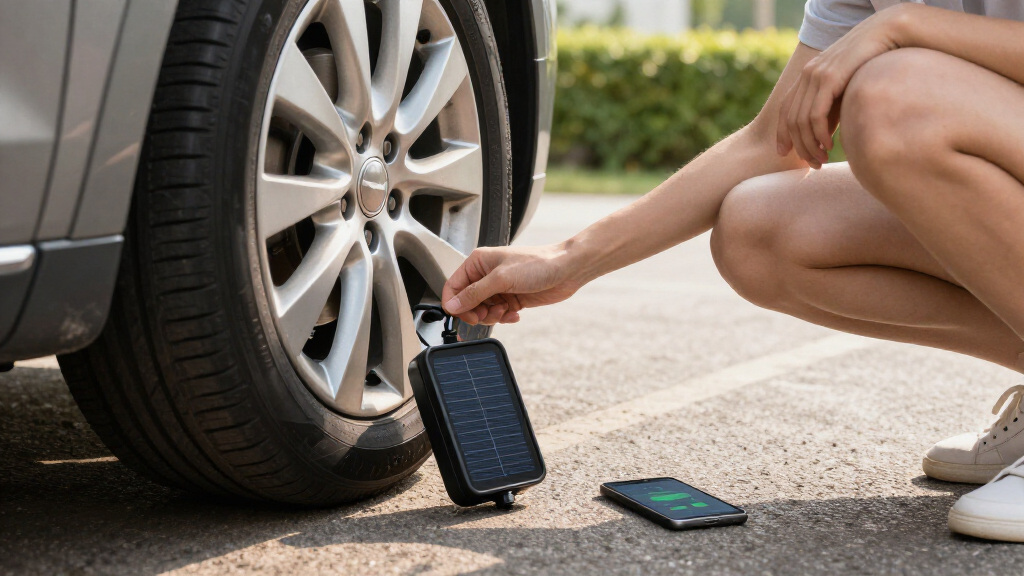
A solar tire pressure monitoring system is an aftermarket safety device that shows your tire pressure and temperature in real time on a small dash-mounted screen, with a photovoltaic panel on top of that screen keeping its internal battery topped up. The sensors themselves — the little caps that screw onto your valve stems — run on replaceable coin-cell batteries, not sunlight. That’s the single most common misconception about these products.
Here’s the flow: each external sensor measures pressure and temperature, then transmits the data wirelessly (usually over a 433MHz radio signal) to the display unit a few feet away on your dashboard. The display refreshes readings continuously and screams at you — visually and audibly — when something drifts out of range. Think of it as a smoke detector for your tires: silent and forgettable until the moment it saves you.
The solar panel is the convenience layer. Because the display charges itself from ambient light, you don’t have a cable snaking across your dash or a plug hogging your cigarette lighter. Nearly every model, including the Tymate TM3, still includes a USB-C or USB backup charging port, because solar alone can’t keep up in garages, cloudy climates, or short winter days.
Key fact: solar TPMS solar panels charge the display only. Sensors use replaceable CR1632 or CR2032 coin batteries that last roughly 1–2 years.
Why bother with any of this? Because underinflation is a leading cause of tire blowouts, and the U.S. Department of Energy estimates that properly inflated tires improve fuel economy by roughly 0.6–3%. NHTSA has also linked underinflated tires to a significant share of tire-related crashes. For an RV owner with $2,000 worth of rubber underneath them, a $40–90 monitoring system is cheap insurance.
Top picks for "tymate tire pressure"
As an affiliate, we earn on qualifying purchases.
What Made the Tymate TM3 Worth Searching For — Spec by Spec
The Tymate TM3 was an RV-focused solar TPMS that paired a color LCD display with four external sensors and a triple-charging setup: solar panel, USB-C, and a cigarette-lighter cable. That flexibility was its strongest selling point — three ways to keep the screen alive meant the system worked whether your rig sat in an Arizona lot or a Pacific Northwest driveway.
Its alert package was equally complete. The TM3 covered leak detection, high and low pressure, high temperature, and voltage loss — so a slow overnight leak or a brake dragging heat into a wheel would both trigger a warning before you found out the hard way. Battery life on the sensors was rated at up to two years, and the whole kit weighed in around 10.8 ounces, light enough to mount with a simple bracket or adhesive pad.
So when the TM3 becomes hard to find, you’re not losing a one-of-a-kind product. You’re losing a specific combination: color screen, 4 external sensors, 5+ alarm types, 2-year sensor batteries, and 3 charging methods. That combination is reproducible. And that’s exactly what you should shop for.
One honest caveat: product availability in this category shifts month to month, and I can’t verify current listings. Treat this article as your spec checklist, not a stock ticker — and confirm details on any listing page before you buy.
4 Solar TPMS Options That Cover the Same Ground
If the Tymate TM3 is hard to track down, four current systems cover most of its feature set. Here’s how they stack up against the TM3’s specs — and against each other.
| Spec | Tymate TM3 (reference) | Solar & USB TPMS, 4 Sensors (B0DYPFBGNF) | Tymate TM2 (B0CW9GXBCB) | RV TPMS w/ Solar & USB, 0-98 PSI (B0GYSK3FF5) | Tymate TM8 (B0DF2LJ4R2) |
|---|---|---|---|---|---|
| Display | Color LCD | LCD with adaptive backlight | Color LCD, auto backlight | Color LCD, auto backlight | Color LCD |
| Sensor type | External | External | External TPMS | External | Not specified |
| Sensor count | 4 | 4 | 4 | 4 | Not specified |
| Alarm modes | Leak, high/low pressure, high temp, voltage loss | 6 | Not specified | 6 (leak, low/high pressure, high temp, low battery) | 6 (high/low pressure, rapid air loss, high temp, low sensor battery, lost signal) |
| Sensor battery life | Up to 2 years | Up to 2 years | Up to 6 months per sensor | Not specified | Not specified |
| Power source | Solar, USB-C, cigarette lighter | Not specified | Not specified | Not specified | Solar, USB, cigarette lighter |
| Weight | 10.8 oz | Not specified | 9.6 oz | Not specified | Not specified |
The Tymate TM8 is arguably the closest spiritual successor to the TM3: same brand, same triple charging (solar, USB, cigarette lighter), same color display, and a six-mode alarm set that adds rapid air loss and lost-signal alerts. The generic Solar & USB system (B0DYPFBGNF) matches the TM3’s sensor count, sensor type, battery life claim, and beats its alarm count at six modes. The Tymate TM2 keeps the color LCD and lighter weight (9.6 ounces) but trades away half the sensor battery life — expect six months per sensor instead of two years, which means more frequent coin-cell swaps.
The fourth option — the RV system rated to 98 PSI with solar and USB charging — matters if you run a trailer or motorhome with higher cold pressures. A 98 PSI ceiling covers most light-truck and RV applications where a standard passenger-car TPMS would max out.
Notice the pattern, though: not specified appears a lot. Budget TPMS listings are notorious for omitting battery life and power details. If a listing doesn’t state how a unit charges or how long sensor batteries last, treat that as a yellow flag and dig into the questions-and-answers section before committing.
External vs. Internal Sensors: The Decision That Shapes Everything Else
External sensors screw onto your valve stems like smarter valve caps; internal sensors mount inside the tire against the wheel. External wins on convenience — a 10-minute DIY install with no tire dismounting — while internal wins on security and accuracy, since it can’t be stolen and isn’t exposed to curbs, weather, or thieves. Every system in the table above uses external sensors, which is standard for this price tier.
External sensors have two real weaknesses. First, theft: a $15 sensor is exactly the kind of thing that walks off at a trailhead parking lot. Most kits include anti-theft locking nuts and a small wrench — use them. Second, slow leakage at the valve stem: a poorly seated sensor can seep air over weeks. After installation, check each tire with a gauge after a week and again after a month.
Internal sensors solve both problems but cost you a tire-shop visit for mounting and balancing, and another one every time a battery dies. For an RV owner who parks for months at a time, externals make sense — you can pull them, check them, swap batteries yourself. For a daily driver in a rough neighborhood, internals earn their hassle.
Rule of thumb: external sensors for DIYers and seasonal rigs, internal sensors for daily drivers where theft or vandalism is a realistic risk.
How to Install a Solar TPMS in About 15 Minutes
Installing an external-sensor solar TPMS takes about 15 minutes with no tools beyond what’s in the box. Here’s the full process:
- Park in good light and let the display charge. Give the solar panel an hour of sun or top it up via USB-C before you start pairing — a half-dead display makes pairing flaky.
- Check and set your tire pressures with a trusted gauge first. The sensors report what’s there; they don’t fix baseline errors. Set every tire to your door-placard pressure (or your RV’s placard, not the tire sidewall max).
- Pair each sensor to its wheel position. Most systems pair by triggering one sensor at a time — typically by unscrewing and rescrewing it, or via a menu button. Do them in order: front-left, front-right, rear-right, rear-left.
- Hand-tighten each sensor onto its valve stem, then snug it with the included wrench. Don’t crank it — you can damage the valve core.
- Install the anti-theft locking nuts where the kit provides them.
- Mount the display on your dash with the bracket or adhesive pad, somewhere sunlight reaches it but it doesn’t block your view.
- Verify all four readings against your gauge. Expect a 1–2 PSI difference between sensor and gauge — that’s normal tolerance. If one tire reads zero or nothing at all, reseat the sensor or re-pair it.
- Set your alert thresholds. Most systems default to alerts roughly ±25% from your baseline; tighten that to your manufacturer’s cold-pressure recommendations.
One scenario worth knowing: you install the system, drive off, and the rear sensors drop out intermittently. On longer vehicles and trailers, the 433MHz signal can struggle with distance and metal in the way. Some kits include or sell a signal repeater that plugs into a 12V outlet midway down the rig — that’s the fix, not a defective sensor.
Where Solar TPMS Units Fall Short — Before You Blame the Product
Solar charging has honest limits, and knowing them prevents most disappointment. A panel the size of a matchbox can’t overcome a vehicle parked in a garage, a Pacific Northwest winter, or weeks of gray skies. The display battery in these units is small by design — that’s why every reputable model includes USB backup. Plan on topping up via USB monthly if your rig doesn’t live outdoors.
Winter introduces a second wrinkle: cold air drops tire pressure roughly 1 PSI for every 10°F drop in temperature. A system that was happy in October will throw low-pressure alarms all through January. That’s the system working correctly — your tires genuinely are low — but expect the chorus and don’t mute it.
Accuracy claims deserve scrutiny too. Premium models advertise ±1 PSI accuracy and faster refresh rates, but budget units can drift. Cross-check against a quality dial or digital gauge when you install, and again every season. If a sensor consistently reads 4 PSI off, note the offset or replace it — don’t mentally compensate forever, because you’ll forget on the day it matters.
- Garage parkers: solar won’t cut it; rely on USB-C top-ups.
- Theft-prone areas: install the locking nuts, or choose internal sensors.
- Long rigs and trailers: budget for a signal repeater.
- Coin batteries: they die without warning at the 1–2 year mark; keep spares in the glovebox.
Finally, a legal note: an aftermarket TPMS adds monitoring, but it doesn’t replace the regulatory TPMS required on vehicles sold in the U.S. since the 2007 model year. If your vehicle’s factory system flags a fault, fix that — don’t just cover the warning light with a solar unit.
Your 6-Point Buying Checklist for Any Solar TPMS
Whether you end up with a Tymate TM8, a generic solar-and-USB kit, or something that launches next month, the same six checks separate a good buy from a regret. Run down this list on every listing you open.
- Sensor count matches your rig. Four sensors cover a car or truck. Towing a trailer? You need a system supporting 6 or more sensors — many displays handle up to 10 for multi-axle motorhomes.
- Pressure range fits your tires. A system topping out at 60 PSI is useless on an RV running 95 PSI cold. Check the ceiling — the 98 PSI system in our table covers most RV applications.
- Alarm coverage includes temperature. Pressure-only systems miss overheating wheels — the early warning for dragging brakes or a failing bearing. Insist on high-temperature alerts plus leak/rapid-loss detection.
- USB backup charging exists. A solar-only unit with no port is a bet against weather. USB-C is the current standard; micro-USB is a sign of older stock.
- Stated sensor battery life (and replaceability). Look for 1–2 year claims and standard coin cells like CR1632 or CR2032 you can buy anywhere. Sealed, non-replaceable sensor batteries mean rebuying sensors.
- Brand support and signal repeater availability. Tymate, EEZTire, GUTAM, Autowanderer, and B-Qtech are established names in this space. Check that replacement sensors are sold separately — because you will lose or kill one eventually.
One more buying habit worth adopting: read the listing’s questions-and-answers section, not just the description. That’s where real owners report whether the solar panel actually holds a charge and whether the alarm is loud enough to hear over a diesel engine. Manufacturer claims tell you intentions; owner questions tell you reality.
Is a Solar TPMS Worth It vs. a $12 Gauge and Monthly Checks?
A tire pressure monitoring system beats a monthly gauge check for one reason: it catches the failures that happen between checks. A nail in your tread on Tuesday doesn’t wait for your first-of-the-month ritual. A slow leak overnight at a campground doesn’t care about your routine. Continuous monitoring is the difference between noticing a 12 PSI drop at 60 mph and discovering it when the sidewall lets go.
The economics tilt hardest for RV and towing owners. An RV tire can run $300–500, and a blowout often takes a wheel well, fender skirt, or body panel with it — repairs measured in thousands. Against that math, a sub-$100 monitoring system pays for itself if it prevents a single incident across a 2–5 year lifespan, which is the typical service life of these units.
For a daily commuter in a mild climate with a healthy factory TPMS already on the dash? The case is weaker. Your OEM system already alerts on low pressure; an aftermarket solar unit adds temperature data, per-tire numbers on screen, and faster alerts, but that’s a convenience upgrade rather than a safety gap.
The honest verdict: for RVs, trailers, trucks, and older pre-TPMS vehicles, a solar tire pressure monitor is one of the highest-value safety upgrades per dollar. For a modern daily driver, it’s a nice-to-have layer on top of what your car already does.
Frequently Asked Questions
Does the solar panel charge the tire sensors too?
No. The solar panel charges only the dash-mounted display unit’s internal battery. The sensors run on replaceable coin-cell batteries — typically CR1632 or CR2032 — that last about 1–2 years. When a sensor dies, you swap its battery; solar charging plays no role in keeping sensors alive.
Is the Tymate TM3 discontinued?
I can’t confirm its official status, but it has become difficult to find through typical retail channels, which often indicates a product is being phased out or replaced. Comparable current options include the Tymate TM8 (same brand, same solar/USB/cigarette-lighter charging, six alarm modes) and several generic solar-and-USB systems with 4 external sensors and color LCD displays. Compare specs against the TM3’s feature set rather than searching for the exact model number.
Do solar TPMS units work in winter or cloudy weather?
Partially. The small solar panel struggles in low-light conditions — cloudy climates, garages, and short winter days will not keep the display charged. That’s why nearly every model includes USB or cigarette-lighter backup charging. Plan on monthly USB top-ups if your vehicle doesn’t sit in direct sunlight regularly. Also expect more low-pressure alarms in cold weather, since tire pressure drops about 1 PSI per 10°F of temperature drop.
Will a solar TPMS drain my car battery?
No. The display is self-powered by its solar-charged internal battery, and the sensors run on their own coin cells. Nothing in the system draws from your vehicle’s electrical system unless you choose to plug the included USB or cigarette-lighter cable in as backup charging.
Can I install one myself, and will it fit my valve stems?
External-sensor systems are a 10–15 minute DIY job: pair each sensor, screw it onto the valve stem, install the locking nuts, and mount the display. Internal sensors require a tire shop. On valve fitment, most external sensors fit standard passenger-car and light-truck stems; for RVs and high-pressure truck stems, verify the sensor’s pressure range and thread compatibility in the listing before buying.
Conclusion
If you came here hunting the Tymate TM3, treat this as good news rather than a dead end: the specs that made it appealing are a checklist, not a unicorn. Find a current system with a color display, the right sensor count and pressure range for your rig, temperature alerts, and USB backup charging — the Tymate TM8 and the 98 PSI solar-and-USB RV system both fit that mold today.
The best tire pressure monitor is the one you can see, hear, and trust at 65 mph with a trailer behind you. Mount it in the sunlight, lock the sensors down, set your thresholds, and let it do the watching — so the next slow leak announces itself politely, instead of as shredded rubber on the interstate.
Halloween Picks
halloween
As an affiliate, we earn on qualifying purchases.