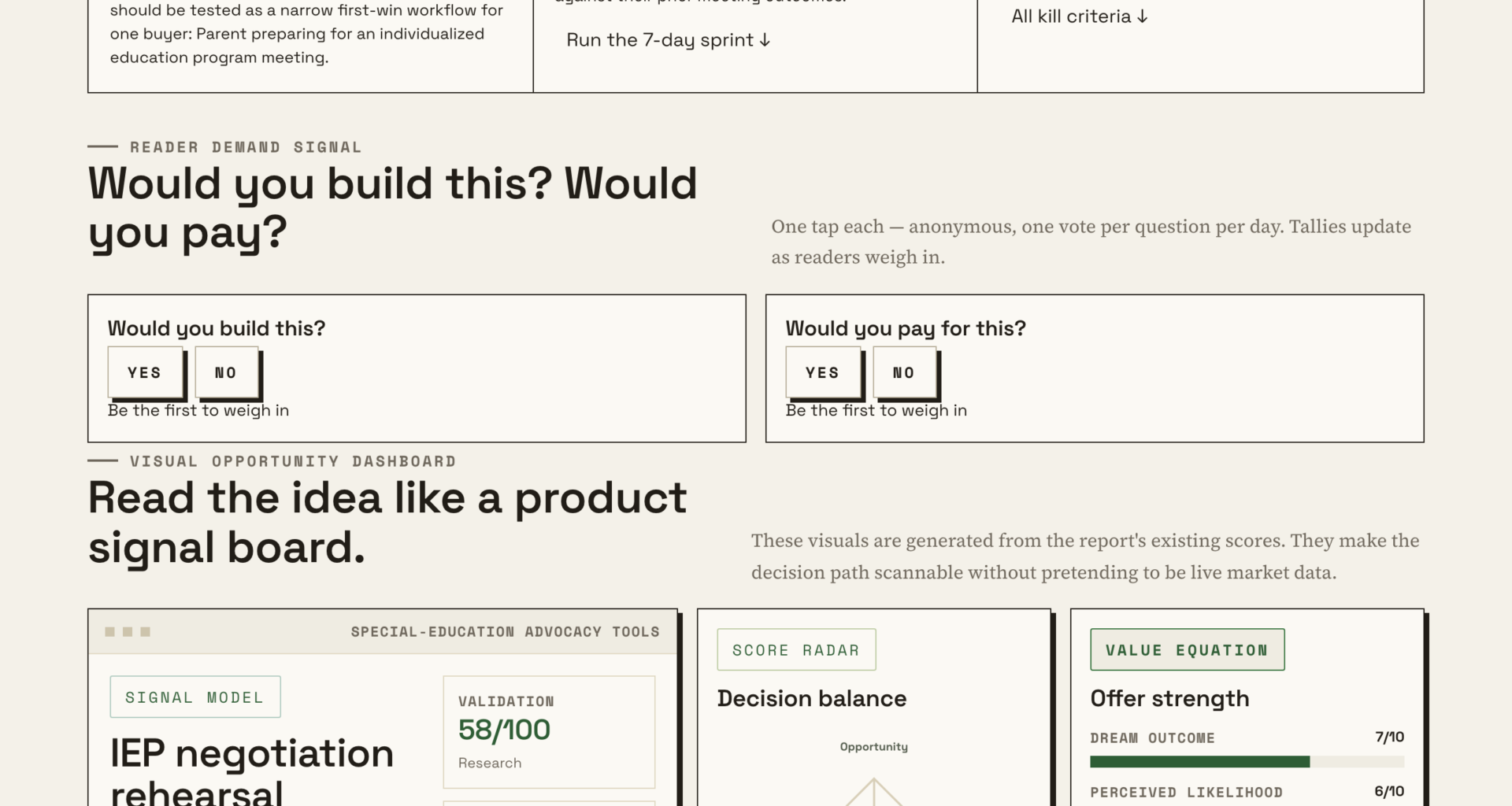

📊 Full opportunity report: Special-Education Advocacy: IEP Rehearsal Simulators For Parents on IdeaNavigator AI — validation score, market gap, and execution plan.

Get the latest gadgets delivered free with Prime
- Fast, free delivery on millions of items
- Prime Video, Amazon Music and more included
- Member-only deals all year
TL;DR
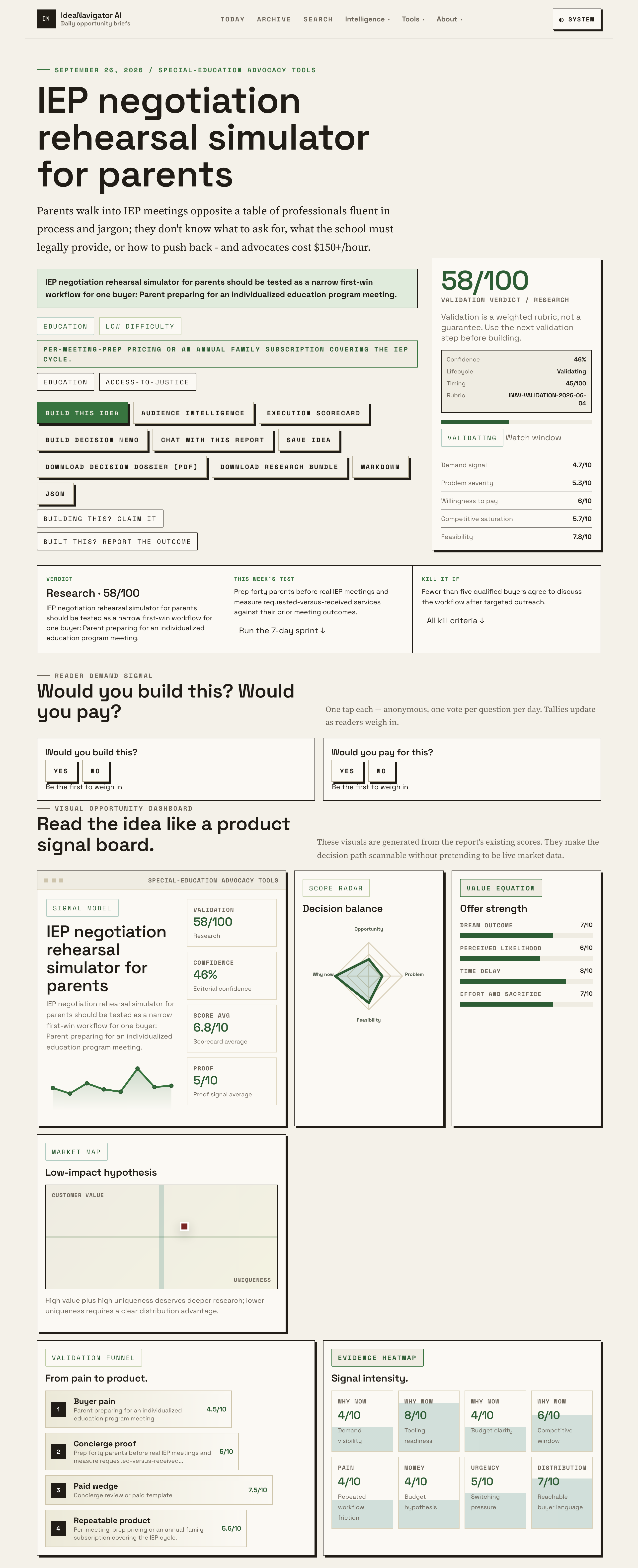
A product concept from IdeaNavigator AI proposes an AI-powered rehearsal simulator that prepares parents for special-education IEP meetings by role-playing negotiations and explaining legal entitlements in plain language. The idea targets a gap left by costly human advocates, who charge $150 or more per hour. No such tool has been built or validated yet; the proposal calls for testing with forty parents.
A product concept published by IdeaNavigator AI proposes an AI-driven rehearsal simulator that would let parents of children in special education practice their individualized education program (IEP) meetings before walking into the real one. The proposed tool would analyze a family’s existing IEP and evaluation reports, explain the child’s legal entitlements in plain language, generate a request list with legal grounding, and then role-play the meeting — including realistic pushback from school staff — until the parent can hold their positions. The concept remains unbuilt and unvalidated, but it targets a well-documented power imbalance that shapes outcomes for millions of students.
According to the proposal, the simulator is designed for one specific user: a parent preparing for an IEP meeting. The problem it aims to address is structural. Parents typically enter these meetings alone, facing a table of education professionals who are fluent in the process, the jargon, and the district’s obligations. Many parents do not know what to ask for, what the school is legally required to provide under special-education law, or how to push back when a request is declined. Professional advocates who fill that gap charge $150 or more per hour, a cost that puts expert preparation out of reach for many families.
The minimum viable product, as described by IdeaNavigator AI, would work in three stages. First, the parent uploads their child’s current IEP and evaluation reports. Second, the tool explains the family’s entitlements in plain language and generates a prioritized request list, with each request tied to its legal basis. Third, the simulator runs a role-play of the meeting itself — including objections and resistance modeled on how real meetings unfold — repeating until the parent can maintain their positions under pressure.
The proposed business model is either per-meeting-prep pricing or an annual family subscription covering the full IEP cycle, which typically includes an annual review and reevaluations every three years. The concept sits within the broader special-education advocacy tools market.
Why Parents May Want This Now
The proposal arrives at a moment when two trends are converging, according to the concept document. First, large language model role-play has improved enough to simulate a realistic, adversarial IEP meeting rather than a generic conversation — the technology only recently crossed that threshold. Second, special-education identification rates keep climbing while district resources tighten, a combination the proposal says is making meetings more adversarial as schools face pressure to limit costly services while more students qualify for them.
For families, the stakes are concrete. The services written into an IEP — therapy hours, classroom supports, accommodations, placement decisions — determine much of a child’s day-to-day school experience. Parents who arrive unprepared may accept weaker plans simply because they lack the vocabulary and legal grounding to contest them. A rehearsal tool priced below human advocate rates could widen access to effective preparation, though that outcome depends entirely on whether the simulator works as described.
Products Worth Considering

Samsung 32-Inch Odyssey OLED G8 (G80SH) 4K Gaming Monitor

Bose QuietComfort True Wireless Earbuds with Active Noise Cancellation, Black

Amazon Kindle Scribe Colorsoft 64GB (1st Generation)
As an affiliate, we earn on qualifying purchases.
The Advocate Gap in IEP Meetings
IEP meetings are a routine part of special education in the United States, mandated under federal law for every student who qualifies for special-education services. School districts staff these meetings with teams that may include teachers, psychologists, therapists, and administrators — all of whom run such meetings regularly. Most parents attend a handful over their child’s entire school career.
That asymmetry has long supported a market of paid special-education advocates who attend meetings alongside parents, draft requests, and interpret district language. Advocates commonly charge upward of $150 per hour, and rates in some regions run higher, according to the pricing cited in the concept. AI-based preparation tools represent an attempt to deliver some of that function — knowledge and rehearsal rather than in-room representation — at software prices.
What the Concept Does Not Yet Prove
No product has been built, no pricing has been set, and no outcomes data exists. The single most important open question is whether rehearsing with an AI simulator translates into better services actually written into IEPs — the metric that matters to families. The proposal itself acknowledges this gap and prescribes a validation method: prep forty parents before real IEP meetings and measure requested-versus-received services against each family’s prior meeting outcomes.
Additional unknowns include the accuracy of the tool’s legal grounding across different states, which set their own special-education rules within federal law; how the simulator handles sensitive documents such as evaluation reports; and whether role-play pressure realistically approximates the dynamics of a live meeting with a full district team. The claim that LLM role-play is now sufficiently realistic is the concept’s own assessment, not an independently tested finding.
The Forty-Parent Validation Test
The immediate next step laid out in the concept is a validation study: recruit forty parents ahead of real IEP meetings, run them through the full preparation workflow, and compare the services they request and receive against their previous meeting results. That before-and-after comparison would provide the first evidence of whether AI rehearsal changes real outcomes.
If the validation proceeds, other milestones would follow: building the document-analysis pipeline that turns uploaded IEPs and evaluations into plain-language entitlement explanations, tuning the role-play to reflect realistic district pushback, and choosing between per-meeting and subscription pricing. Any working product would also need to address accuracy of legal claims and privacy of student records. None of these steps has a published timeline.
Source: IdeaNavigator AI
Key Questions
Does an AI IEP meeting simulator exist today?
No. What has been published is a product concept by IdeaNavigator AI describing what such a tool would do. It has not been built, launched, or validated in a study.
How would the proposed simulator work?
According to the concept, a parent would upload their child’s current IEP and evaluation reports. The tool would explain entitlements in plain language, generate a request list with legal grounding, and then role-play the meeting — including realistic pushback — repeating until the parent can hold their positions.
How is this different from hiring a special-education advocate?
An advocate typically attends the meeting with the parent and charges $150 or more per hour. The simulator would provide preparation and rehearsal only — no in-room representation — at software pricing, either per meeting prep or as an annual family subscription.
Is there evidence that rehearsing an IEP meeting improves outcomes?
Not yet. The concept proposes a validation study of forty parents comparing requested-versus-received services against their prior meetings, but that study has not been run.
Why is this idea being raised now?
Two reasons cited in the concept: LLM role-play quality has improved enough to simulate realistic adversarial meetings, and rising special-education identification rates combined with tightening district resources are making IEP meetings more contentious.
Source: IdeaNavigator AI