📊 Full opportunity report: Men's Grooming Meets Tech: Measuring Skincare Routine Progress on IdeaNavigator AI — validation score, market gap, and execution plan.

Get the latest gadgets delivered free with Prime
- Fast, free delivery on millions of items
- Prime Video, Amazon Music and more included
- Member-only deals all year
TL;DR
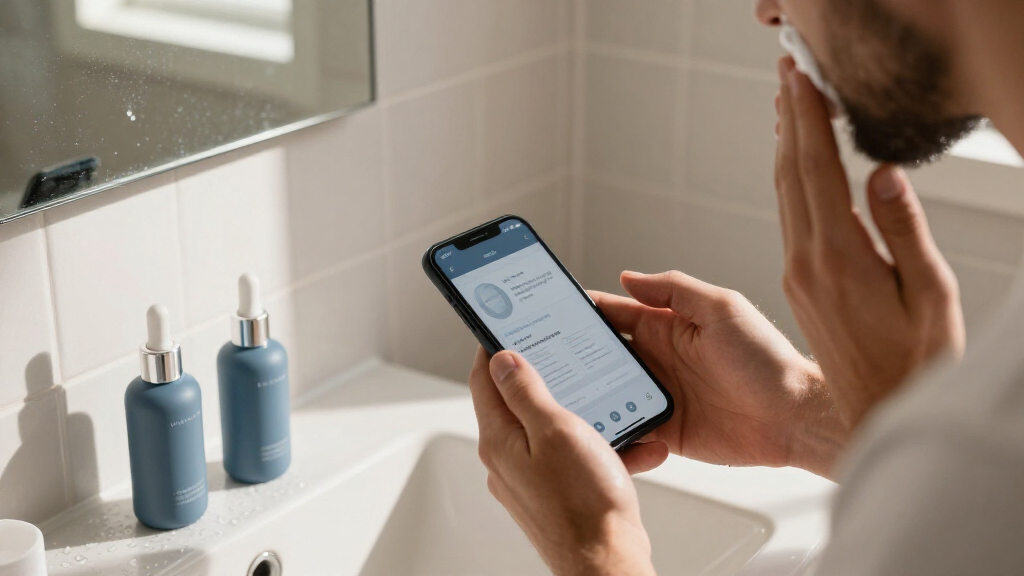
IdeaNavigator AI has outlined a product concept for men who want measurable feedback on skincare routines: weekly guided selfies, skin-focused scores, routine logs and progress cards. The proposal recommends testing the product’s positioning and user retention before treating demand or performance as established.
IdeaNavigator AI has proposed testing a skincare progress-tracking app aimed at men newly starting routines, with weekly guided selfies and routine logs designed to show whether habits are producing visible changes. The concept is a product proposal, not a reported app launch or evidence that the tracking method improves skin.
The proposed first audience is men newly invested in skincare who want visible feedback on whether their routine is working. IdeaNavigator AI describes a gap between that desire for measurable progress and beauty apps whose design, language or marketing may not appeal to some male users. The proposal does not quantify how many users are affected or provide user research supporting that assessment.
The suggested minimum viable product would prompt users to take weekly guided selfies and track skin clarity, texture and dark circles. It would pair those images with routine logging, streaks and progress cards, framing results as training-style metrics rather than beauty scores. The proposal does not explain how the app would calculate scores, control for lighting or other image differences, or distinguish routine effects from ordinary changes in skin.
For revenue, the concept suggests a subscription alongside affiliate product recommendations linked to measured gaps. To test whether the framing attracts users, IdeaNavigator AI recommends comparing a men’s-training brand with a neutral brand, then measuring conversion and retention by segment. No pricing, conversion figures, retention data or completed test results are provided.
Testing Demand for Measurable Skincare
The proposal targets a specific barrier to adopting skincare: beginners may want a clear way to judge progress, while familiar beauty-product language and interfaces may not feel designed for them. A tracker could make routines easier to follow by giving users a consistent record rather than relying only on memory or occasional impressions. That is the product’s intended value, not an outcome demonstrated by research in the proposal.
The suggested branding test could help establish whether a training-oriented presentation actually changes sign-ups or continued use. That distinction matters for a subscription product: initial curiosity is not the same as sustained use, and a different brand voice alone would not prove that users find the measurements useful. The proposed comparison makes conversion and retention central questions rather than assuming that interest in metrics will translate into a viable business.
Affiliate recommendations also create a commercial tension. Suggestions tied to a user’s reported or measured skin concerns could be convenient, but users would need to understand how those recommendations are selected and whether purchases generate revenue for the app. The concept gives no details on recommendation standards, sponsorship disclosure or how it would avoid implying that a product is medically necessary.
men's skincare progress tracker app
As an affiliate, we earn on qualifying purchases.
As an affiliate, we earn on qualifying purchases.
A Narrow First-User Test
IdeaNavigator AI frames this as a market opportunity in men’s grooming technology, citing growth in men’s skincare and interest in looks-focused, metric-driven routines as reasons to explore it. Those points are presented as the rationale for the idea; the proposal supplies no market-size data, growth rates or independent evidence to quantify the trend.
Rather than proposing a broad skincare platform, the plan starts with one user: a man who has recently begun a routine and wants proof of progress. The suggested test compares the same selfie-capture technology under two presentations—men’s-training branding and neutral branding—and checks conversion and retention across user segments. This would test positioning and early product behavior, but it would not by itself establish that the scores accurately measure skin changes or that the app improves skincare outcomes.
Accuracy, Demand and Privacy Questions
No app launch, working prototype or validation results are reported. It is not known whether prospective users would prefer training-oriented branding, whether they would keep taking weekly photos, or whether either choice would improve retention. The proposal also does not provide evidence for its characterization of the men’s skincare market or the claim that existing beauty apps deter male users.
Measurement reliability is another open issue. The proposal names clarity, texture and dark circles as score categories but does not describe the scoring method, its accuracy, or safeguards against changes in camera, lighting, pose and image quality. It also leaves unanswered how the app would handle sensitive facial images, protect user data, explain affiliate links, and avoid presenting cosmetic tracking as a diagnosis or medical assessment.
Validate the Brand and Workflow
The next step proposed by IdeaNavigator AI is to test men’s-training branding against neutral branding using the same capture technology, then compare conversion and retention by user segment. The proposal does not name a test date, recruitment plan or success threshold, and it does not say that a test is already underway.
Before the idea could support stronger claims, a pilot would need to show whether users can capture comparable images over time, understand what the scores do and do not mean, and continue logging routines beyond initial sign-up. Any future launch or results would be a separate development; at present, the app remains a concept for testing.
Source: IdeaNavigator AI
Key Questions
Has the men’s skincare tracking app launched?
No launch is reported. IdeaNavigator AI has outlined a product concept and a proposed way to test it.
What would the app track?
The proposed app would use weekly guided selfies to score skin clarity, texture and dark circles, alongside routine logs and streaks. The scoring method has not been specified.
How would the idea be tested?
The proposal recommends comparing a men’s-training brand presentation with a neutral one, using the same capture technology and comparing conversion and retention by segment.
Would the app prove that a skincare routine works?
That has not been established. The concept proposes tracking visible changes, but provides no validation showing that its scores are accurate or that a routine caused any observed change.
How might the app make money?
The suggested model combines a subscription with affiliate product recommendations tied to measured gaps. Pricing and recommendation safeguards are not described.
Source: IdeaNavigator AI
Fall Picks
fall essentials
As an affiliate, we earn on qualifying purchases.