
📊 Full opportunity report: Make Sense Of TRT Labs And Symptoms With A Tracker on IdeaNavigator AI — validation score, market gap, and execution plan.

Get the latest gadgets delivered free with Prime
- Fast, free delivery on millions of items
- Prime Video, Amazon Music and more included
- Member-only deals all year
TL;DR
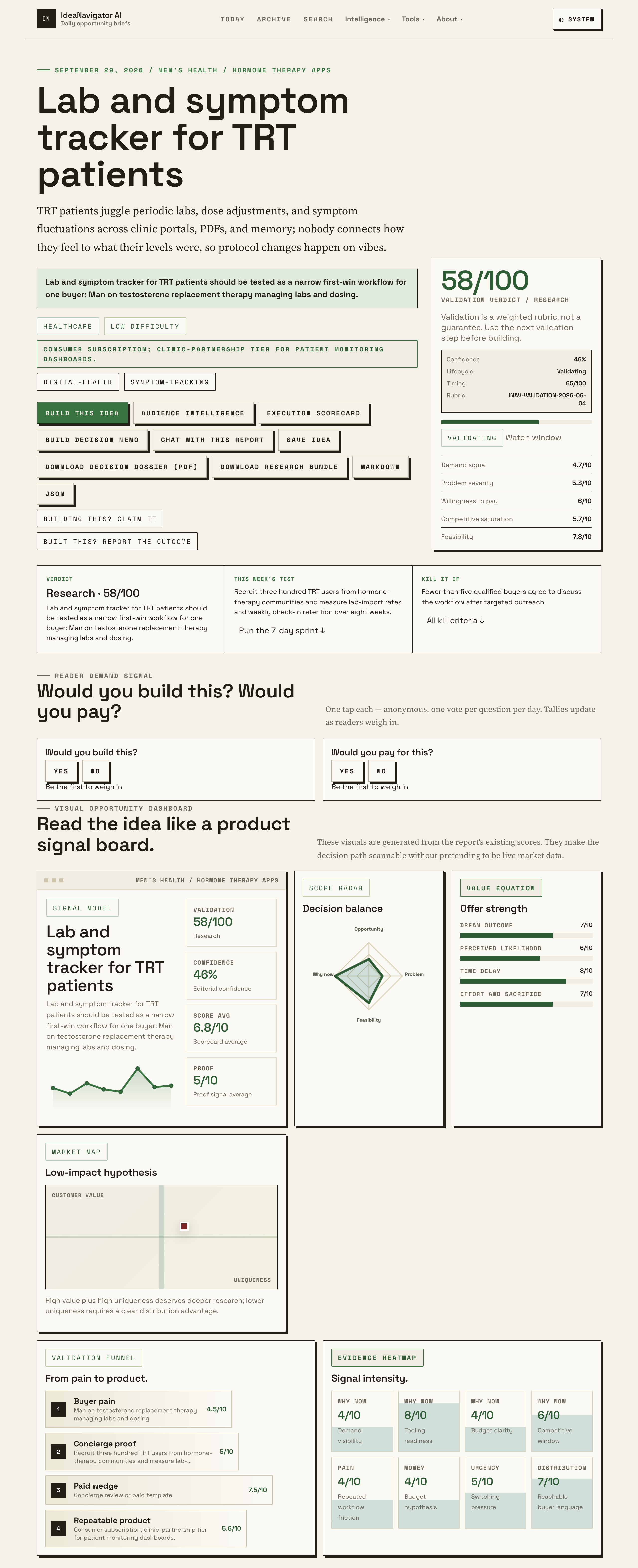
IdeaNavigator AI has outlined a product concept for a lab and symptom tracker aimed at men on testosterone replacement therapy. The proposed app would import lab PDFs, chart hormone panels against dose changes and symptom check-ins, and generate summaries for clinic visits. The concept is unvalidated; a proposed eight-week test with 300 TRT users would measure lab-import rates and weekly check-in retention.
IdeaNavigator AI has published a product concept for a lab and symptom tracker for men on testosterone replacement therapy (TRT), arguing that the idea should be tested as a narrow “first-win” workflow for a single buyer: a man managing his own labs and dosing while on TRT. The proposal is a concept at this stage — no app has been built and no user data has been collected — but it targets a gap the analysis identifies in a fast-growing patient population whose care is spread across clinic portals, PDF lab reports, and memory.
The core problem the concept addresses is fragmentation. According to the IdeaNavigator AI analysis, TRT patients juggle periodic lab tests, dose adjustments, and symptom fluctuations across disconnected clinic portals and PDF documents. The analysis states that no existing tool connects how patients feel to what their hormone levels actually were, so protocol changes end up happening “on vibes” rather than on recorded trends.
The proposed minimum viable product would have four functions: importing lab PDFs, charting hormone panels over time alongside dose changes and daily symptom check-ins, generating trend summaries patients can bring to clinic visits, and flagging values that drift outside target ranges. The concept is deliberately narrow — it is scoped to one buyer persona and one workflow rather than a broad men’s health platform.
The proposed business model has two tiers: a consumer subscription for individual patients and a clinic-partnership tier offering patient-monitoring dashboards for providers. The target market is described as men’s health and hormone therapy apps. Validation would involve recruiting 300 TRT users from hormone-therapy communities and measuring lab-import rates and weekly check-in retention over an eight-week period.
Why TRT Patients Are a Distinct Software Market
The timing argument rests on a structural shift in how TRT is prescribed. According to the analysis, TRT prescriptions and telehealth clinics have surged, creating a large population of patients who manage significant parts of their own care. Because telehealth by design fragments care across providers, the analysis argues these patients lack a single place to correlate symptoms, labs, and dose history.
If the concept works, the practical value is concrete: patients arrive at clinic visits with structured trend data instead of recollection, and out-of-range values get flagged between visits rather than discovered at the next appointment. For builders, the concept is also a case study in restraint — it defines success as serving one persona well before expanding, and it specifies measurable retention metrics (lab-import rate and weekly check-in retention) rather than vanity sign-up numbers.
The clinic-partnership tier matters commercially. A monitoring dashboard gives the product a second revenue path and aligns it with providers who have financial interest in patient adherence, rather than relying only on consumer willingness to pay for a health tracking app.
The Fragmented Workflow the Concept Targets
TRT management typically follows a cycle: blood panels every few months, dose adjustments based on those results, and ongoing symptom reporting at check-ins. Patients on telehealth platforms often work with different providers over time, and lab results arrive as PDFs or inside separate portal accounts. The IdeaNavigator AI analysis describes the current state as one where symptom data and lab data live in separate silos, so neither the patient nor the clinician can see whether a dose change actually shifted how the patient felt.
The concept sits within the broader men’s health and hormone therapy app category, which has grown alongside direct-to-consumer TRT services. The analysis positions the tracker not as a medical device or diagnostic tool but as a record-keeping and correlation layer between the patient and his clinic.
What Is Untested in the Concept
No product exists yet, and none of the proposed metrics have been measured. Lab-import rates and weekly check-in retention are targets, not results. It is not yet clear whether TRT patients will reliably import PDF lab reports or sustain daily symptom check-ins over time — health tracking apps commonly see steep check-in drop-off after the first weeks.
Other open questions include whether the consumer subscription price point can convert hormone-therapy community members into paying users, whether clinics will pay for monitoring dashboards, and how the app would handle regulated health data including privacy compliance and the boundary between trend summaries and medical advice. The analysis does not specify which hormone panels would be supported at launch, how target ranges would be defined, or what happens when a flagged value requires clinical attention.
The Eight-Week Validation Test
The stated next step is recruitment of 300 TRT users from hormone-therapy communities for an eight-week validation period. The two metrics that would determine whether the concept proceeds are lab-import rates and weekly check-in retention. If those numbers hold, the proposed build order is the PDF import pipeline first, then the correlation charts, then clinic-visit summaries and out-of-range flagging, followed by the clinic-partnership tier as a second revenue line. No timeline for any of these steps has been given.
Source: IdeaNavigator AI
Key Questions
Does a TRT lab and symptom tracker app exist yet?
No. What has been published is a product concept and validation plan by IdeaNavigator AI. No app has been built, and no user data has been collected.
What would the proposed tracker actually do?
According to the concept, it would import lab PDFs, chart hormone panels over time against dose changes and daily symptom check-ins, generate trend summaries for clinic visits, and flag values drifting outside target ranges.
Who is the target user?
One specific persona: a man on testosterone replacement therapy who is managing his own labs and dosing, often through telehealth providers, and whose records are scattered across portals and PDFs.
How would the product be validated?
The proposed plan is to recruit 300 TRT users from hormone-therapy communities and measure lab-import rates and weekly check-in retention over eight weeks.
How would it make money?
The concept proposes two revenue streams: a consumer subscription for individual patients and a clinic-partnership tier providing patient-monitoring dashboards for providers.
Source: IdeaNavigator AI
Fall Picks
fall essentials
As an affiliate, we earn on qualifying purchases.