
To enhance AV1 live streaming, you’ll need to focus on expanding hardware support across devices like smartphones and TVs, and optimize real-time encoding with better software and hardware acceleration. Industry standards for compatibility and quality benchmarks must be established to build trust, while faster hardware development—especially for AV2—can guarantee smoother shifts. Combining these efforts will lead to better, more widespread streaming experiences; you’ll discover more ways to make it happen as you continue exploring.
Key Takeaways
- Accelerate hardware support for AV1 decoding and encoding across smartphones, smart TVs, and edge devices.
- Develop affordable, high-performance ASICs and GPU transcoders optimized for real-time AV1 streaming.
- Enhance software encoders with multi-threading, adaptive algorithms, and hardware acceleration for faster live encoding.
- Establish industry standards and benchmarks to ensure compatibility, quality assurance, and streamlined workflows.
- Prepare for AV2 adoption by upgrading hardware and infrastructure to handle increased complexity and efficiency requirements.
AV1 hardware decoder for smartphones
As an affiliate, we earn on qualifying purchases.
As an affiliate, we earn on qualifying purchases.
Current Hardware Support and Limitations
As of mid-2024, hardware support for AV1 remains limited, especially on mobile devices. You’ll find that real-time AV1 encoding demands significant processing power, making it less practical compared to H.264 and H.265. Less than 10% of mobile devices can hardware-decode AV1, so playback often relies on software decoding, which can cause delays or increased battery drain. Hardware manufacturers are still developing AV2 decoders, meaning widespread support is years away. Some ASIC-based options like AMD’s MA35D and NETINT’s Quadra exist, but their output quality isn’t yet comparable to high-end HEVC transcoders. GPU transcoders are emerging but require careful evaluation before deployment. Overall, hardware limitations hinder AV1’s full potential in live streaming, especially on mobile and edge devices. hardware limitations continue to be a significant hurdle in achieving seamless AV1 streaming experiences, further emphasizing the importance of accelerated hardware development. Additionally, ongoing research in video codec hardware acceleration aims to address these challenges and facilitate broader adoption. The evolution of hardware support in the coming years is critical for unlocking AV1’s advantages across diverse platforms. Moreover, advancements in AI-driven optimization could play a role in improving real-time encoding efficiency for AV1.
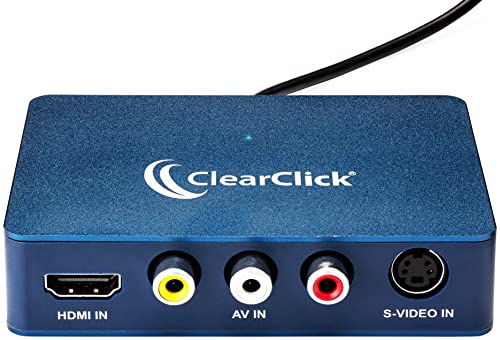
ClearClick Video to USB 1080P Audio Video Capture & Live Streaming Device – Input HDMI, AV, RCA, S-Video, VCR, VHS, Camcorder, Video8, Hi8, DVD, Gaming Systems – USB-C Plug & Play
[HDMI Capture] Record or Live Stream Audio & Video at up to 1080P from HDMI Sources up to…
As an affiliate, we earn on qualifying purchases.
As an affiliate, we earn on qualifying purchases.
Overcoming Real-Time Encoding Challenges
Overcoming real-time encoding challenges is essential for opening AV1’s potential in live streaming and low-latency applications. You face hurdles like high computational demands, limited hardware support, and subpar output quality from current transcoders. To address these, software optimizations can boost encoding speed temporarily, while hardware solutions evolve. Accelerators like ASICs and GPUs show promise but need thorough testing for quality. You must balance quality with latency, ensuring minimal delays without sacrificing clarity. Here’s a snapshot of key factors:
| Challenge | Solution |
|---|---|
| High computational load | Optimize software encoders |
| Hardware support gaps | Accelerate hardware development |
| Output quality issues | Improve transcoder algorithms |
In addition, integrating AI Security Technologies can help in developing adaptive encoding strategies that optimize performance based on real-time threat assessments and system capabilities. Furthermore, ongoing hardware advancements are crucial for achieving broader support and improved efficiency in AV1 encoding. A focus on hardware acceleration can significantly reduce encoding times and improve output quality, making live streaming more feasible. Additionally, exploring software optimization techniques can provide interim relief while hardware catches up. Moreover, addressing compatibility issues with existing streaming infrastructure can facilitate smoother adoption of AV1.

ASRock Intel Arc A380 Challenger ITX 6GB OC Graphics Card | Single Slot ITX | 2250 MHz | 6GB GDDR6 | DisplayPort 2.0 | HDMI 2.0b | 0dB Cooling | 8K Support | 500W | DirectX 12 Ultimate | PCle 4.0
SINGLE FAN DESIGN Single fan design that provides strong cooling performance that keeps your gaming system cool; It’s…
As an affiliate, we earn on qualifying purchases.
As an affiliate, we earn on qualifying purchases.
Enhancing Transcoding Quality and Efficiency
To improve transcoding quality and efficiency, you need to focus on advancing hardware accelerators and optimizing software encoders. Standardizing quality benchmarks helps you compare performance and guarantee consistent results across different setups. By addressing these points, you can achieve better real-time AV1 transcoding for live streaming. Additionally, understanding resources and tools available, such as regional legal expertise and technological advancements, can further enhance your overall streaming strategy. Implementing performance monitoring tools can also provide valuable insights into your transcoding workflows, ensuring ongoing improvements and stability. Monitoring for quality degradation during transcoding processes can help in early detection of issues and maintain streaming standards. Paying attention to projector technology can also optimize your display setup for streaming content, resulting in a more immersive viewer experience. Incorporating feedback mechanisms from viewers can help you identify areas for improvement and adapt your transcoding process accordingly.
Improving Hardware Accelerators
Enhancing hardware accelerators for AV1 transcoding requires focusing on increasing both processing efficiency and output quality. You need chips that can handle AV1’s computational demands without sacrificing speed, especially for real-time live streaming. Developing ASIC-based solutions, like AMD’s MA35D and NETINT’s Quadra, is promising but still lags in output quality compared to HEVC transcoders. Investing in GPU-based transcoders offers flexibility, but their output quality must be thoroughly evaluated before deployment. Manufacturers should optimize hardware designs to balance high compression efficiency with minimal latency. Improving hardware accelerators also involves refining decoder and encoder architectures to reduce power consumption and heat generation, enabling widespread deployment in mobile and edge devices. This focus guarantees AV1 streaming becomes faster, more reliable, and accessible across diverse platforms. Optimizing hardware architectures is essential for achieving these goals effectively. Additionally, advancements in hardware design can lead to more cost-effective solutions, encouraging broader adoption of AV1 streaming technology.
Optimizing Software Encoders
Building on efforts to improve hardware accelerators, optimizing software encoders offers a flexible and immediate way to boost AV1 transcoding quality and efficiency. By refining algorithms and leveraging multi-threading, you can considerably improve output quality and reduce encoding times. Tools like SVT-AV1 and HandBrake are continuously evolving, making real-time transcoding more feasible. To better understand these improvements, consider this table:
| Encoder Tool | Performance Gains | Notable Features |
|---|---|---|
| SVT-AV1 | Faster encoding, improved quality | Hardware acceleration support |
| HandBrake | User-friendly, compatible with AV1 | Batch encoding, presets |
| AWS Elemental | Cloud-based, scalable transcoding | Flexible deployment |
Focusing on software optimization helps you adapt quickly, delivering high-quality streams even before hardware catches up.
Standardizing Quality Benchmarks
Establishing standardized quality benchmarks is essential for accurately comparing transcoding performance across different AV1 encoders and hardware setups. Without common metrics, it’s hard to determine which solutions deliver the best balance of quality and efficiency. You need consistent criteria, like PSNR, SSIM, or VMAF, to objectively evaluate output quality. Standardization also helps identify hardware limitations and guides improvements, especially as hardware support remains limited. By adopting uniform benchmarks, you can make informed decisions about transcoding tools, ensuring ideal playback quality for live streaming. This clarity accelerates adoption, reduces trial-and-error, and ultimately fosters the development of more efficient AV1 transcoding solutions suited for real-time applications. Implementing standardized benchmarks is crucial for building trust and pushing the technology forward.

RCA 32-Inch HD Smart Google TV, Frameless LED Display with HDR10, Wi-Fi and Bluetooth, Google Assistant Built-in, Compatible with Alexa
Smart Entertainment: Unlock endless possibilities with built-in apps like Netflix, YouTube, and Prime Video, all powered by Android…
As an affiliate, we earn on qualifying purchases.
As an affiliate, we earn on qualifying purchases.
Accelerating Hardware Development for AV1 and AV2
To improve live AV1 and AV2 streaming, hardware developers need to speed up decoder deployment across devices. Building cost-effective ASICs can help expand support without sacrificing performance, while enhancing hardware encoding efficiency ensures real-time streams stay smooth. Mazda Tuning techniques can inspire innovative hardware designs that optimize streaming performance. Accelerating these developments is crucial for widespread adoption and better streaming quality. Additionally, focusing on Self Watering Plant Pots can foster innovative content production that leverages these advanced streaming technologies. Incorporating hardware acceleration techniques from the automotive tuning industry can further push the boundaries of streaming capabilities.
Accelerating Hardware Decoder Deployment
Accelerating hardware decoder deployment for AV1 and future AV2 codecs hinges on overcoming current manufacturing and development bottlenecks. You need faster progress in designing and producing dedicated chips that support AV1 decoding at scale. Manufacturing delays and limited production capacity slow down the rollout across devices, especially smartphones, smart TVs, and streaming hardware. While some chipmakers like AMD and NETINT have introduced ASIC-based solutions, output quality and decoding efficiency still lag behind high-end HEVC solutions. GPU-based decoders are available but require further evaluation to ensure they deliver seamless playback without compromising performance. To meet growing demand, hardware manufacturers must prioritize AV1 and AV2 decoder integration, streamline development cycles, and expand production capacities. This acceleration is essential for widespread adoption, especially in live streaming scenarios. Additionally, standardized testing protocols can help ensure that decoding solutions meet quality and performance benchmarks necessary for consumer acceptance. Implementing industry standards can also facilitate interoperability and reduce development time. Promoting collaborative development among industry stakeholders can further accelerate innovation and deployment timelines.
Developing Cost-Effective ASICs
Developing cost-effective ASICs for AV1 and AV2 decoding is critical to overcoming current hardware limitations and enabling widespread adoption. You need chips that balance performance with affordability, especially as demand for streaming grows. Designing ASICs tailored for AV1 and future AV2 codecs reduces reliance on expensive GPUs or software solutions, lowering overall costs. Innovation in chip architecture can improve decoding efficiency, power consumption, and integration complexity. Collaborating with hardware manufacturers to develop standardized, scalable ASIC solutions guarantees broad device compatibility and faster deployment. Additionally, leveraging economies of scale can drive down manufacturing costs, making hardware support accessible to more devices. Ultimately, affordable ASICs are essential to open the full potential of AV1 and AV2, especially for mobile, embedded, and edge applications.
Enhancing Hardware Encoding Efficiency
Advancements in ASIC design are paving the way for more efficient hardware encoding of AV1 and AV2, addressing the current performance bottlenecks faced by software-based solutions. You can now imagine:
- Custom chips accelerating encoding speeds, reducing latency for live streams.
- Specialized transcoders transforming raw data into high-quality AV1 output with less power.
- Integrated hardware modules enabling widespread AV2 support with improved efficiency.
These innovations help overcome the computational demands of AV1 and AV2, making real-time encoding more practical. As hardware manufacturers develop dedicated ASICs and transcoders, you’ll see increased adoption, better quality, and lower energy consumption. This progress is essential for scaling live streaming, especially on mobile and edge devices, where performance and efficiency are critical.
Improving Software-Based Optimization Strategies

Software-based optimization strategies are essential for bridging the performance gap in real-time AV1 encoding, especially given current hardware limitations. To maximize efficiency, focus on adaptive encoding settings, such as dynamic bitrate adjustments and optimized frame rates. Implement multi-threaded processing to leverage CPU cores effectively, reducing latency. Additionally, fine-tune encoder parameters for specific content types to balance quality and speed. Consider using hardware acceleration APIs like VA-API or NVENC where available to offload tasks. Regularly update software encoders to incorporate performance improvements and bug fixes. Here’s a quick overview:
| Optimization Technique | Benefit |
|---|---|
| Adaptive bitrate control | Better bandwidth management |
| Multi-threading | Faster encoding process |
| Content-specific tuning | Improved quality-speed balance |
| Hardware acceleration APIs | Reduced CPU load |
Expanding Device Compatibility and Deployment
Expanding device compatibility and deployment for AV1 streaming is vital to unlocking its full potential across diverse platforms. To do this, you need to focus on three key areas. First, you must improve hardware support by encouraging manufacturers to embed AV1 decoding and encoding capabilities in more devices, such as smartphones, tablets, and smart TVs. Second, software updates should enable existing devices to handle AV1 streams smoothly, especially through optimized codecs and firmware upgrades. Third, establishing strong industry standards ensures compatibility across browsers, applications, and hardware, creating a unified ecosystem. Imagine a world where your devices effortlessly stream high-quality AV1 content, from your mobile to your smart TV, all working seamlessly without compatibility glitches, unlocking efficient, high-quality live streaming everywhere.
Integrating AV1 Into Major Streaming Platforms
Major streaming platforms are increasingly adopting AV1 to enhance streaming efficiency and video quality for their users. YouTube, for example, launched AV1 support for popular live streams in 2025 and plans to expand further. Meta integrated AV1 into Messenger, Instagram, and WhatsApp to improve real-time communication under low-bandwidth conditions. Netflix reports AV1 as the second-most-streamed format, benefiting from better compression and visual quality. These platforms are actively testing AV1 in live broadcasting, encouraging wider adoption. However, integrating AV1 involves overcoming current hardware limitations, especially in real-time encoding and device decoding capabilities. You need to evaluate transcoding quality, optimize software solutions, and plan for gradual hardware support upgrades to guarantee smooth integration across their extensive content delivery networks.
Preparing for the Transition to AV2
As streaming platforms and device manufacturers gain more experience with AV1, attention is shifting toward preparing for the next generation codec, AV2. To guarantee a smooth transition, you’ll need to focus on three key areas:
- Upgrading hardware to support AV2 decoding and encoding, which involves early adoption of new transcoders and GPUs.
- Updating encoding pipelines with software optimizations that can handle AV2’s increased complexity and efficiency.
- Educating teams and partners on AV2’s benefits and requirements to align workflows and develop compatible infrastructure.
Imagine a future where your devices seamlessly decode AV2, like a highway smoothly handling faster traffic, or your servers efficiently encode 4K streams with minimal latency. Preparing now ensures you’re ready for this leap.
Frequently Asked Questions
How Will AV1 Adoption Impact Live Streaming Latency and User Experience?
You’ll notice that AV1 adoption can reduce bandwidth usage and improve video quality, boosting overall user experience. However, current hardware limitations mean real-time encoding may introduce latency, especially on lower-end devices. As hardware improves and software optimizations advance, latency will decrease, leading to smoother streams. In the meantime, you might experience slight delays or quality fluctuations, but future developments promise faster, more efficient live streaming with enhanced viewer satisfaction.
What Are the Cost Implications of Transitioning to AV1 for Broadcasters?
Switching to AV1 can be a double-edged sword for broadcasters. You’ll face upfront costs for new hardware, software upgrades, and staff training, which can strain budgets. However, long-term savings come from reduced bandwidth expenses and improved stream quality. While hardware limitations might slow progress initially, investing now positions you for future-proofing, ensuring competitive edge as AV1 gains wider adoption. It’s a gamble, but one that could pay off down the line.
How Can Content Providers Ensure Quality Consistency During AV1 Live Encoding?
To guarantee quality consistency during AV1 live encoding, you should regularly evaluate encoder performance and output quality with standardized testing. Use software optimizations to improve real-time processing and monitor bandwidth and visual artifacts closely. Stay updated on hardware advancements and consider hybrid solutions combining software and hardware transcoders. Adjust encoding settings dynamically based on content complexity and network conditions, ensuring ideal balance between quality and performance throughout the stream.
What Role Will AI and Machine Learning Play in Future Codec Optimizations?
AI and machine learning will substantially enhance future codec optimizations, helping you achieve better compression and faster encoding speeds. While some worry about increased complexity, these technologies can automate parameter tuning, improve quality, and reduce latency. You’ll see smarter encoding that adapts to content in real-time, making streams more efficient and resilient. As AI evolves, it’ll be a crucial tool to overcome hardware limitations and deliver consistently high-quality live AV1 streaming experiences.
When Can We Expect Widespread Hardware Support for AV2 in Consumer Devices?
You can expect widespread hardware support for AV2 in consumer devices around 2027 or later. Manufacturers are still developing AV2 decoders, and it will take time for adoption to become mainstream. As new chips and transcoders roll out, support will gradually grow across smartphones, smart TVs, and streaming devices. Keep an eye on hardware announcements from major brands, as their integration will accelerate once AV2 matures and proves reliable.
Conclusion
To truly unlock AV1’s potential, you need to stay informed and support hardware and software advancements. Many believe that once AV1 becomes widely supported, streaming quality will skyrocket, transforming how you experience content. If the industry accelerates development and adoption now, you might soon enjoy smoother, higher-quality streams without extra effort. Embrace the change—your support could be the catalyst that makes this revolutionary technology accessible to everyone, everywhere.