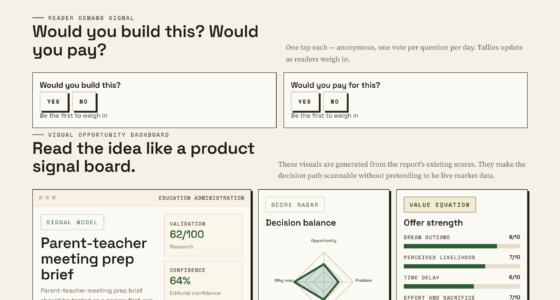

📊 Full opportunity report: Unlocking Creative And Critical Skills In Students With AI Integration on ThorstenMeyerAI.com — validation score, market gap, and execution plan.

Get the latest gadgets delivered free with Prime
- Fast, free delivery on millions of items
- Prime Video, Amazon Music and more included
- Member-only deals all year
TL;DR
OpenAI has published a report suggesting that students gain the most from ChatGPT when combined with explicit critical-thinking instruction. The findings highlight potential benefits for answer quality and broader reasoning, but lack independent verification. This could influence how AI tools are integrated into education.
OpenAI has published a report asserting that students benefit most when ChatGPT use is combined with explicit critical-thinking training, leading to improved answer quality and broader reasoning skills. This development is significant as it addresses ongoing debates about AI’s role in education and suggests a pathway for effective AI integration.
The report, titled “Better answers, broader thinking: What students gain from ChatGPT and critical-thinking training,” claims that when students are taught to question, verify, and refine AI-generated responses, they produce more accurate and well-reasoned answers. OpenAI states that AI tools and critical thinking are not substitutes but complements, and that structured instruction in questioning techniques enhances learning outcomes.
While the report’s findings are promising, they are based on self-published data, with no independent peer review or publicly available detailed methodology at this time. The publication emphasizes that the quality of AI-assisted learning depends heavily on how students are instructed to engage with the technology, rather than on the technology alone.
OpenAI’s report arrives amid ongoing debates over the impact of AI on student independence and problem-solving skills. Some educators worry that reliance on AI might diminish critical thinking, while others see potential for AI to serve as a teaching aid when integrated with appropriate pedagogical practices.
Implications for AI Integration in Education
This report could influence educational policies by shifting focus from banning or restricting AI tools like ChatGPT to adopting structured critical-thinking curricula. If validated, the findings suggest that the key to maximizing AI’s educational benefits lies in how it is used and taught, rather than in outright prohibition.
For educators, this emphasizes the importance of teaching students to critically evaluate AI outputs, fostering skills like fact-checking, logical testing, and perspective-taking. For policymakers and school administrators, it points to the potential for more nuanced integration of AI that enhances learning rather than replacing core cognitive skills.
However, since the evidence is not independently verified, the report’s conclusions should be considered preliminary. The actual impact of combining AI with explicit critical-thinking training remains to be confirmed through peer-reviewed research and broader field testing.
AI critical thinking training for students
As an affiliate, we earn on qualifying purchases.
As an affiliate, we earn on qualifying purchases.
Background on AI and Critical Thinking in Education
The debate over AI’s role in education has intensified since ChatGPT’s release in late 2022. Early concerns centered on students submitting AI-generated work without understanding it, leading some districts to ban the tool and others to revise assessment methods. Simultaneously, research has explored whether AI can serve as a tutor or learning aid rather than a shortcut, with mixed findings.
OpenAI’s previous efforts include developing dedicated educational products and partnerships, aiming to demonstrate AI’s potential to support learning. The current report continues this trend, advocating for a pedagogical approach that combines AI use with explicit instruction in critical thinking to mitigate risks and enhance benefits.
While some studies suggest that heavy reliance on AI may hinder independent problem-solving, others indicate that structured, guided use can accelerate learning. The ongoing research landscape remains divided, with no definitive consensus yet established.
“The evidence so far is promising but unverified; independent studies are needed to confirm whether combining AI with explicit instruction truly improves learning outcomes.”
— Education researcher Dr. Jane Liu
Unverified Evidence and Definitions of Critical Thinking
It remains unclear what specific methods or curricula constitute ‘critical-thinking training’ as described in the report. The evidence supporting the claims is not independently verified, and details about the studies, sample sizes, or datasets used are not publicly available. Consequently, the robustness of the conclusions is uncertain until further peer-reviewed research is conducted.
Additionally, it is not yet confirmed whether the observed improvements are directly attributable to the combination of AI and critical thinking or if other factors contributed. The lack of transparency about the methodology limits the ability to assess replicability and generalizability.
Next Steps for Validation and Implementation
Independent researchers and educational institutions are likely to scrutinize and attempt to replicate OpenAI’s findings through controlled studies. Peer-reviewed research will be essential to validate the claims and determine best practices for integrating AI with critical-thinking instruction.
Meanwhile, educators and policymakers may begin experimenting with pilot programs that incorporate explicit critical-thinking curricula alongside AI tools, monitoring outcomes to assess effectiveness. OpenAI and other stakeholders may also develop clearer guidelines and tools to support structured AI use in classrooms.
The ongoing debate and research efforts will shape future policies, with the goal of harnessing AI’s potential to enhance learning while safeguarding critical cognitive skills.
Key Questions
Does the report prove that AI improves student learning?
No, the report is based on company-published data without independent peer review. Its findings suggest potential benefits but require further validation from external research.
What exactly is ‘critical-thinking training’ according to the report?
The report does not specify detailed curricula or methods, making it unclear how critical thinking is defined or implemented within the study.
Will this change how schools use ChatGPT?
Potentially, if the findings are validated, schools might focus more on teaching students to critically evaluate AI outputs rather than banning or restricting the tool altogether.
Are there risks to relying on AI in education?
Yes, concerns include reduced independent problem-solving and over-reliance on AI, but structured instruction as suggested by the report aims to mitigate these risks.
Primary source: OpenAI · via ThorstenMeyerAI.com
Columbus Day / Indigenous Peoples' Day Picks
long weekend sales
As an affiliate, we earn on qualifying purchases.