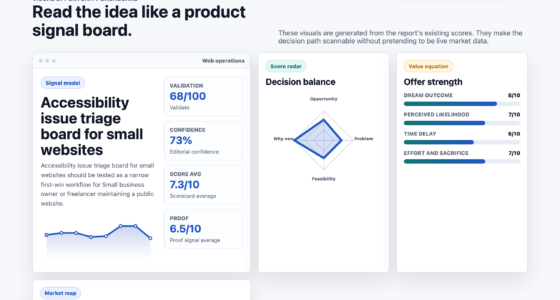

📊 Full opportunity report: Signal: The Agent Bottleneck Moved — It’s Not the Models Anymore, It’s the Plumbing on ThorstenMeyerAI.com — validation score, market gap, and execution plan.
TL;DR
The bottleneck in deploying AI agents has shifted from model capabilities to infrastructure and integration. Small operators owning their entire stack now have a strategic advantage, impacting enterprise AI spending and deployment dynamics.
Recent analysis indicates that the main bottleneck in deploying enterprise AI agents has shifted from model performance to system integration and infrastructure. This development, confirmed by multiple industry surveys and reports, suggests that the focus of AI deployment is now on connecting models to existing enterprise systems, rather than improving model capabilities. This shift has significant implications for market dynamics and competitive advantage.
Data from the Anthropic State of AI Agents 2026 report shows that 46% of teams building AI agents cite integration with existing systems as their primary challenge. This aligns with other surveys indicating that, despite rapid improvements in model capabilities, infrastructure remains the critical barrier to deployment. The trend reflects a maturation of orchestration frameworks, standardization of tool integration, and the emergence of bounded autonomy and governance frameworks that lag behind.
Market projections reveal that inference spending will surpass $150 billion in 2026, dwarfing training costs. The key insight is that ownership of the entire stack—from orchestration to inference—confers a significant advantage, especially for small operators who can bypass enterprise integration hurdles by owning their own infrastructure. A recent example is a solo operator’s successful deployment of a specialized AI product, enabled by a vertically integrated stack, demonstrating that the real friction was in system integration, not model intelligence.
The Agent Bottleneck Moved —
It’s Not the Models, It’s the Plumbing
Same-day-verified meta-trend · the one finding the conflicting surveys agree on
The survey chaos, plotted honestly
The inversion
2024–25: WHICH MODEL?
Capability was scarce, so the model was the moat. That race now resets weekly — frontier-class open weights every few weeks, from multiple labs.
2026: WHOSE PLUMBING?
Orchestration, tool access, evaluation harnesses, queues, audit trails, inference economics. Capability commoditized; infrastructure didn’t.
STEELMAN: WHY ENTERPRISES ARE SLOW
Not stupidity — their agents touch payroll, patients, and production, where cascading failures have consequences a solo builder’s stack never faces. Bounded autonomy and governance gaps are rational responses to real risk. Small operators defer that reckoning; they don’t escape it.
The signal: stop watching model benchmarks to predict who wins the agent era. Watch who owns the plumbing. The bottleneck moved there, the money is following — and the structural advantage runs, for once, toward operators small enough to own their whole stack.
Impact of Infrastructure Control on AI Deployment Strategies
This shift in bottleneck focus fundamentally alters the competitive landscape of AI deployment. Enterprises and smaller operators that control their entire infrastructure stack can deploy agents more rapidly and securely, avoiding the complex integration with legacy systems. As a result, small, vertically integrated players are gaining an advantage over larger firms that rely on third-party orchestration tools. The market for AI infrastructure and orchestration tools is expected to grow significantly, with most spending directed toward connective tissue—governance, evaluation, and inference economics—rather than model development.
This trend underscores a strategic shift: success in enterprise AI will increasingly depend on ownership and control of the plumbing, rather than just model capabilities. It also raises questions about the future role of traditional software vendors and the potential for new entrants to disrupt the market by offering integrated, end-to-end solutions.
ENTERPRISE COHERENCE in the Age of AI
As an affiliate, we earn on qualifying purchases.
As an affiliate, we earn on qualifying purchases.
From Model Capabilities to Infrastructure Maturity
Over the past year, the AI industry has seen a rapid acceleration in model capabilities, with frontier models now capable of refreshing on a weekly cycle at open-weight prices. However, despite these advances, deployment has proven complex, with many organizations stuck in experimentation phases. Multiple surveys, including Gartner’s projections and EY’s AI Pulse Survey, suggest that most companies are still grappling with integration issues, not model performance.
The trend toward maturing orchestration frameworks, standardization of tool integration, and the development of bounded autonomy reflects a broader industry recognition that infrastructure is now the limiting factor. This is a departure from the previous focus on model innovation, shifting instead to building reliable, governed, and secure systems capable of supporting autonomous agents at scale.
“Owning the entire stack allows small operators to bypass the complex integration issues that enterprise deployments face.”
— an anonymous researcher
Unresolved Questions About Infrastructure and Regulation
While the trend toward infrastructure control is clear, several uncertainties remain. It is not yet confirmed how quickly enterprise governance frameworks will adapt to support fully autonomous systems, or how regulatory developments might influence infrastructure ownership. Additionally, the precise impact on large enterprise adoption rates and the future role of third-party orchestration vendors remain to be seen.
Monitoring Infrastructure Adoption and Market Shifts
In the coming months, industry watchers will closely observe how enterprise and small operators adapt their infrastructure strategies. Key milestones include the rollout of integrated orchestration platforms, shifts in enterprise spending toward connective tissue, and regulatory responses to autonomous agents. The ongoing evolution of ownership models will likely determine which players gain a competitive edge in the next phase of AI deployment.
Key Questions
Why has infrastructure become the new bottleneck for AI deployment?
Despite rapid advances in model performance, integrating AI agents with existing enterprise systems remains complex and costly. The need for secure, reliable, and governed connections to legacy systems has become the primary challenge.
How do small operators benefit from owning their entire stack?
Owning all layers of the stack allows small operators to bypass complex enterprise integration hurdles, enabling faster deployment, lower costs, and greater control over governance and security.
What does this shift mean for large enterprises?
Large enterprises may face increased challenges in integrating third-party tools and ensuring governance, potentially slowing adoption. They might need to invest more in internal infrastructure or partner with integrated vendors.
Will this trend reduce the role of traditional software vendors?
It could, as smaller, vertically integrated players gain advantage. However, established vendors may adapt by expanding into infrastructure and orchestration solutions, blurring the lines between model providers and system integrators.
When can we expect to see significant market shifts?
Market shifts are already underway, with increased spending on infrastructure and orchestration tools. The next 12-24 months will reveal how quickly these changes influence enterprise adoption and competitive dynamics.
Source: ThorstenMeyerAI.com