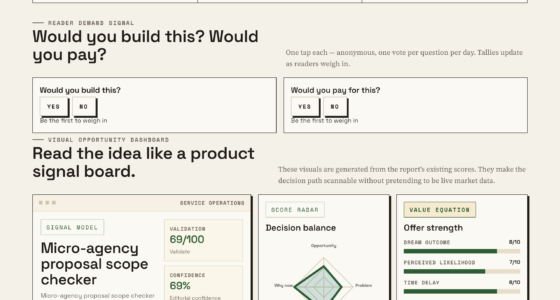
📊 Full opportunity report: AI In Marketing Procurement: Ensuring Precise Scope-of-Work Reviews on IdeaNavigator AI — validation score, market gap, and execution plan.

Get the latest gadgets delivered free with Prime
- Fast, free delivery on millions of items
- Prime Video, Amazon Music and more included
- Member-only deals all year
TL;DR

AI-driven scope-of-work reviewers are being tested for agency selection, helping companies identify vague clauses, benchmark rates, and compare proposals more effectively. This innovation aims to reduce costly misjudgments in marketing procurement.
AI-driven scope-of-work review tools are emerging as a new solution for SMBs and mid-market companies to evaluate marketing agency proposals more precisely. These tools aim to address longstanding challenges in marketing procurement, such as vague deliverables, unbenchmarked pricing, and scope language designed to permit under-delivery. The development comes amid increasing adoption of large language models (LLMs) capable of parsing complex documents and benchmarking against industry standards, offering a pattern-recognition capability similar to experienced CMOs.
The opportunity lies in creating an AI-powered scope-of-work reviewer that allows companies to upload competing proposals and receive a detailed comparison grid. This grid highlights key deliverables, project cadence, and pricing, while also flagging vague or one-sided clauses that could lead to disputes or underperformance. According to sources familiar with the initiative, the AI tool benchmarks rates against category norms, providing a data-driven basis for negotiations and decision-making.
Initially, the focus is on testing this technology within a narrow workflow for one buyer—either an SMB or mid-market company—comparing proposals from multiple agencies. The AI system is designed to extract relevant data points, generate clarifying questions, and streamline the review process, reducing reliance on manual document analysis and subjective judgment. The goal is to improve transparency, reduce costly misjudgments, and enable more strategic procurement decisions.
Market players see this as a significant step forward in marketing procurement tools, with potential for subscription-based models and per-review pricing. Validation plans include reviewing twenty live agency selections, tracking which flagged clauses lead to disputes, and assessing buyer willingness to pay for ongoing use. The approach aims to demonstrate measurable improvements in proposal evaluation accuracy and dispute reduction over time.
Impact of AI on Marketing Procurement Accuracy
This development matters because it addresses a persistent pain point in marketing procurement: the difficulty in accurately evaluating agency proposals. Misjudgments due to vague scope language or unbenchmarked pricing can lead to delays, disputes, and under-delivery, ultimately increasing costs and damaging client-agency relationships. By leveraging AI, companies can make more informed, data-driven decisions, reducing risks and improving campaign outcomes.
Furthermore, the use of AI for scope review could standardize proposal evaluations across industries, providing a consistent benchmark and reducing subjective biases. For SMBs and mid-market firms, which often lack dedicated procurement teams, this technology offers a way to level the playing field and access expertise previously available only to larger organizations with in-house CMOs or procurement specialists.
Products Worth Considering

Samsung 27 Odyssey OLED G5 (G50SF) QHD QD-OLED Gaming Monitor

Logitech MX Keys S Wireless Keyboard, Graphite

Apple AirPods Pro 3 Wireless Earbuds with Active Noise Cancellation
As an affiliate, we earn on qualifying purchases.
Background on Challenges in Marketing Proposal Evaluation
Traditionally, companies evaluating marketing proposals rely on manual review, often conducted by internal teams or external consultants. This process can be time-consuming and prone to errors, especially when proposals contain vague language or unstandardized deliverables. Without benchmarks, companies risk overpaying or accepting scope gaps that lead to unmet expectations.
Recent advances in large language models have enabled parsing and analysis of complex documents, offering the potential to automate and improve this process. Pilot programs and early testing of AI scope review tools are underway, with initial focus on identifying problematic clauses and benchmarking rates. These efforts respond to industry feedback that suggests a need for more precise, data-driven evaluation methods.
While still in early stages, the technology aims to complement traditional review processes, providing a first-pass analysis that highlights critical issues for human review, rather than replacing judgment entirely. This approach aligns with broader trends toward automation and data-driven decision-making in procurement and marketing.
Uncertainties in AI Scope Review Effectiveness
It is not yet clear how well these AI tools will perform across diverse proposal formats and industry standards at scale. The effectiveness of flagging problematic clauses and benchmarking rates remains under evaluation, with ongoing testing needed to validate accuracy and reliability. Additionally, the extent to which companies will adopt these tools and trust their outputs is still uncertain, particularly regarding complex or nuanced proposals.
Further, the impact on dispute resolution and negotiation dynamics has yet to be fully understood, and there are questions about how AI-generated clarifying questions will influence agency responses and client satisfaction.
Next Steps for AI-Driven Proposal Evaluation
The immediate next step involves expanding pilot testing to include more companies and proposal types, collecting data on flagged clauses and dispute outcomes. Developers aim to refine algorithms, improve benchmarking accuracy, and validate the tool’s ability to reduce review time and errors. Long-term, the goal is to integrate these AI tools into broader procurement platforms, enabling continuous improvement and wider adoption.
Industry observers expect further studies on user acceptance, cost-benefit analyses, and integration challenges. As the technology matures, it could become a standard part of marketing procurement workflows, especially for SMBs and mid-market firms seeking to improve proposal evaluation precision and reduce risks.
Key Questions
How does AI improve the review of marketing proposals?
AI tools can automatically extract key deliverables, compare rates against industry benchmarks, flag vague or one-sided clauses, and generate clarifying questions, making the review process faster, more consistent, and less prone to errors.
Are these AI tools reliable for complex proposals?
While early testing shows promising results, the reliability across diverse proposal formats and complex language is still being evaluated. Ongoing pilot programs aim to validate accuracy and identify limitations.
Will AI replace human reviewers entirely?
No, the current approach is to use AI as a first-pass analyzer that highlights issues for human review, rather than replacing human judgment altogether.
What is the cost of implementing AI scope review tools?
Pricing models are still being developed, but initial plans include per-review charges and subscription options for ongoing use. Cost-effectiveness will depend on the volume of proposals and the reduction in disputes and review time.
When will these tools be widely available?
Widespread adoption is expected within the next 12 to 24 months, as pilot testing progresses and developers refine the technology for broader use.
Source: IdeaNavigator AI