
Choosing the right mirrorless cameras full frame can feel overwhelming given the sheer number of options available today. The Sony Alpha 7 IV stands out as the best overall pick for most photographers, offering a perfect balance of resolution, autofocus, and video capabilities. For those prioritizing portability and ease of use, the Canon EOS R8 delivers impressive performance in a lightweight body, while the Canon EOS R6 Mark II remains a powerhouse for hybrid shooters who need speed and reliability. The primary tradeoff in this category usually involves sensor resolution versus low-light performance, or body size versus battery life. Continue reading to see how these models compare and which one aligns with your specific shooting style.

Get the latest gadgets delivered free with Prime
- Fast, free delivery on millions of items
- Prime Video, Amazon Music and more included
- Member-only deals all year
Complete the kit



Key Takeaways
- The Sony Alpha 7 IV offers the most balanced feature set for hybrid shooters, making it the safest recommendation for most users.
- Canon‘s EOS R8 proves that full-frame performance does not require a bulky body, ideal for travel and street photographers.
- Entry-level models like the Canon EOS R100 often use APS-C sensors despite marketing confusion, requiring careful verification of sensor size.
- Video capabilities have become a primary differentiator, with 4K 60p and 10-bit color depth separating mid-range from premium bodies.
- Lens ecosystem availability matters more than body specs; Canon and Sony currently offer the deepest native full-frame lens lineups.
| Canon EOS R50 Mirrorless Camera Kit with 18-45mm Lens, 4K Video, Dual Pixel AF II, Vari-Angle Touchscreen, Shoulder Bag, 64GB Card |  | Best for Beginner Video Creators | Camera type: Mirrorless | Sensor: APS-C | Included lens: 18–45mm | VIEW ON AMAZON | See Our Full Breakdown |
| Canon EOS R100 Mirrorless Camera with RF-S 18-45mm Lens Bundle |  | Best Basic Starter Bundle | Sensor: 24.1MP APS-C CMOS | Processor: DIGIC 8 | Included lens: RF-S 18–45mm f/4.5–6.3 IS STM | VIEW ON AMAZON | See Our Full Breakdown |
| Sony Alpha 7 IV Full-Frame Mirrorless Interchangeable Lens Camera |  | Best Full-Frame Hybrid | Sensor: 33MP full-frame Exmor R BSI CMOS | Image processor: BIONZ XR | Video: Up to 4K 60p, 10-bit 4:2:2 | VIEW ON AMAZON | See Our Full Breakdown |
| Canon EOS R100 Mirrorless Camera, RF Mount, 24.1 MP, 4K Video, Compact and Lightweight |  | Best Compact APS-C Body | Sensor: 24.1MP APS-C CMOS | Mount: Canon RF | Processor: DIGIC 8 | VIEW ON AMAZON | See Our Full Breakdown |
| Canon EOS RP Mirrorless Camera with RF 24-105mm f/4-7.1 IS STM Lens Kit |  | Best Compact Full-Frame Kit | Sensor: 26.2MP full-frame CMOS | Mount: Canon RF | Included lens: RF 24–105mm f/4–7.1 IS STM | VIEW ON AMAZON | See Our Full Breakdown |
| Canon EOS R8 Mirrorless Camera (Body Only) |  | Best Lightweight Full-Frame Hybrid | Sensor: 24.2 MP CMOS | Processor: DIGIC X | Autofocus: Dual Pixel CMOS AF II, 1,053 zones, subject detection | VIEW ON AMAZON | See Our Full Breakdown |
| Canon EOS R6 Mark II Mirrorless Camera (Body Only) |  | Best for Fast Action | Sensor: 24.2 MP full-frame CMOS | Image processor: DIGIC X | Continuous shooting: Up to 40 fps at 20 MP | VIEW ON AMAZON | See Our Full Breakdown |
| Sony Alpha a7 III Mirrorless Camera with 28-70mm Lens – Black |  | Best Full-Frame Starter Kit | Sensor: 24.2 MP 35mm full-frame Exmor R CMOS | ISO range: 50–204,800 | Autofocus points: 693 phase-detection and 425 contrast-detection points; 93% coverage | VIEW ON AMAZON | See Our Full Breakdown |
| Canon EOS R100 Mirrorless Camera with RF-S18-45mm F4.5-6.3 IS STM Lens Kit, 24.1MP, 4K Video, 64GB Card & Bag | 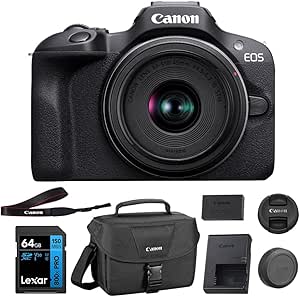 | Best Accessory-Packed Beginner Kit | Sensor: 24.1 MP APS-C CMOS | Included lens: RF-S 18–45mm f/4.5–6.3 IS STM | Video: 4K | VIEW ON AMAZON | See Our Full Breakdown |
| Canon EOS R100 Mirrorless Camera RF-S18-45mm F4.5-6.3 IS STM Lens Kit |  | Best Simple APS-C Kit Alternative | Sensor: 24.1 MP APS-C CMOS | Included lens: RF-S 18–45mm f/4.5–6.3 IS STM | Video recording: 4K at 24 fps; Full HD at 60 fps; HD at 120 fps | VIEW ON AMAZON | See Our Full Breakdown |
| Sony Alpha a7 IV Full-Frame Mirrorless Camera with 28–70mm Lens |  | Best Overall Hybrid Camera | Sensor: 33MP full-frame Exmor R back-illuminated CMOS | Image processor: BIONZ XR | Video: Up to 4K 60p, 10-bit 4:2:2 | VIEW ON AMAZON | See Our Full Breakdown |
| Canon EOS R6 Mark II Mirrorless Camera with RF 24-105mm F4-7.1 IS STM Lens |  | Best for Action and Speed | Sensor: 24.2 MP full-frame CMOS | Image processor: DIGIC X | Continuous shooting: Up to 12 fps mechanical; up to 40 fps electronic | VIEW ON AMAZON | See Our Full Breakdown |
| Canon EOS R8 Mirrorless Camera with RF 24-50mm f/4.5-6.3 IS STM Lens |  | Best Lightweight Entry Full-Frame | Sensor: 24.2 MP CMOS | Lens: RF 24-50mm f/4.5-6.3 IS STM | Display: 3.0-inch vari-angle LCD touchscreen | VIEW ON AMAZON | See Our Full Breakdown |
| mirrorless cameras full frame | Sensor | Video | Autofocus | Continuous shooting |
|---|---|---|---|---|
| Canon EOS R50 Mirrorless Camer | APS-C | 4K | Dual Pixel AF II | — |
| Canon EOS R100 Mirrorless Came | 24.1MP APS-C CMOS | 4K 24p, Full HD 60p | — | 6.5 fps |
| Sony Alpha 7 IV Full-Frame Mir | 33MP full-frame Exmor R BSI CMOS | Up to 4K 60p, 10-bit 4:2:2 | Fast hybrid AF with real-time Eye AF | Up to 10 fps |
| Canon EOS R100 Mirrorless Came | 24.1MP APS-C CMOS | 4K and Full HD 1080p | Dual Pixel CMOS AF with Eye Detection AF | 6.5 fps |
| Canon EOS RP Mirrorless Camera | 26.2MP full-frame CMOS | 4K UHD 2160p | — | — |
| Canon EOS R8 Mirrorless Camera | 24.2 MP CMOS | 4K up to 60 fps; Full HD up to 180 fps | Dual Pixel CMOS AF II, 1,053 zones, subject detection | — |
| Canon EOS R6 Mark II Mirrorles | 24.2 MP full-frame CMOS | 6K-oversampled 4K up to 60 fps; Full HD up to 180 fps | Head, face, and eye detection for people and animals | Up to 40 fps at 20 MP |
| Sony Alpha a7 III Mirrorless C | 24.2 MP 35mm full-frame Exmor R CMOS | 4K UHD | — | Up to 10 fps |
| Canon EOS R100 Mirrorless Came | 24.1 MP APS-C CMOS | 4K | — | 6.5 fps |
| Canon EOS R100 Mirrorless Came | 24.1 MP APS-C CMOS | — | Dual Pixel CMOS AF with face and eye detection | 6.5 fps |
| Sony Alpha a7 IV Full-Frame Mi | 33MP full-frame Exmor R back-illuminated CMOS | Up to 4K 60p, 10-bit 4:2:2 | Real-time Eye AF for humans, animals, and birds | Up to 10 frames per second |
| Canon EOS R6 Mark II Mirrorles | 24.2 MP full-frame CMOS | — | Dual Pixel CMOS AF II with 1,053 AF zones | Up to 12 fps mechanical; up to 40 fps electronic |
| Canon EOS R8 Mirrorless Camera | 24.2 MP CMOS | — | Dual Pixel CMOS AF II with subject detection | — |
More Details on Our Top Picks
Canon EOS R50 Mirrorless Camera Kit with 18-45mm Lens, 4K Video, Dual Pixel AF II, Vari-Angle Touchscreen, Shoulder Bag, 64GB Card
The EOS R50 is the clearest pick here for a beginner who wants a camera that makes self-recording and everyday shooting approachable. Its vari-angle touchscreen, Dual Pixel AF II, and vertical-video support help with framing and focus when creating social content, while the included 18–45mm lens covers common wide and standard views. Compared with the Sony Alpha 7 IV, though, the R50 is not a full-frame camera and lacks the listed model’s higher-end video options and in-body stabilization. That distinction matters in a roundup focused on full-frame cameras: this is an accessible APS-C alternative, not a substitute for a full-frame upgrade. The kit adds a bag and 64GB card, but advanced users may outgrow its feature set and need more storage.
Pros:- Vari-angle touchscreen makes self-framing easier for vlogs and vertical clips.
- Dual Pixel AF II supports dependable subject focus.
- Included 18–45mm lens suits everyday wide-to-standard shooting.
- Shoulder bag and 64GB card provide useful starter accessories.
Cons:- APS-C sensor does not meet the full-frame brief and offers a different image-quality and depth-of-field tradeoff.
- Feature set may feel limited to experienced photographers and videographers.
- The included 64GB card may be restrictive for extended video recording.
Best for: New vloggers and casual creators who value guided controls, a flip-out screen, and a ready-to-shoot kit more than a full-frame sensor.
Not ideal for: Photographers specifically seeking full-frame image quality, extensive professional video controls, or room to grow into an advanced camera system.
- Camera type:Mirrorless
- Sensor:APS-C
- Included lens:18–45mm
- Video:4K
- Autofocus:Dual Pixel AF II
- Screen:Vari-angle touchscreen
- Included accessories:Shoulder bag and 64GB memory card
Our verdict“Choose the R50 for beginner-friendly content creation and useful kit accessories, but choose a full-frame model such as the Sony Alpha 7 IV if sensor format is your priority.”
Canon EOS R100 Mirrorless Camera with RF-S 18-45mm Lens Bundle
This EOS R100 bundle is a straightforward entry point for someone learning photography who wants an electronic viewfinder and a standard zoom in the box. Its 24.1MP APS-C sensor and RF-S 18–45mm lens cover family photos and everyday scenes, while Wi-Fi and Bluetooth make sharing simpler. Against the EOS R50, however, this is the more basic choice: its DIGIC 8 processor and conventional 3-inch LCD are less suited to creators who want a flexible screen and newer video-focused tools. Neither model is full frame, so I would treat this as a lower-complexity starter option rather than a match for the Sony Alpha 7 IV. The lens’s f/4.5–6.3 aperture also gives less room for dim interiors or background blur than faster glass.
Pros:- 24.1MP APS-C sensor provides resolution suited to everyday still photography.
- Electronic viewfinder offers an alternative to composing on the rear LCD.
- RF-S 18–45mm lens covers common general-purpose framing.
- Wi-Fi and Bluetooth support wireless connectivity.
Cons:- APS-C sensor means it is not a full-frame option.
- The lens’s f/4.5–6.3 aperture can limit low-light shooting and subject separation.
- Basic screen and feature set are less creator-friendly than the EOS R50.
Best for: First-time photographers who want an electronic viewfinder, a standard zoom, and simple wireless sharing in an APS-C kit.
Not ideal for: Buyers seeking a full-frame camera, strong low-light flexibility, or a creator-oriented screen and advanced video controls.
- Sensor:24.1MP APS-C CMOS
- Processor:DIGIC 8
- Included lens:RF-S 18–45mm f/4.5–6.3 IS STM
- Video:4K 24p, Full HD 60p
- Continuous shooting:6.5 fps
- Viewfinder:2.36-million-dot OLED EVF
- Connectivity:Wi-Fi and Bluetooth
- Weight:4.2 pounds (as listed)
Our verdict“Pick this bundle to learn photography with an EVF and standard zoom, but step up to a full-frame model if sensor size and low-light flexibility matter most.”
Sony Alpha 7 IV Full-Frame Mirrorless Interchangeable Lens Camera
The Sony Alpha 7 IV is the strongest all-rounder in this group for buyers who need a full-frame sensor to serve both detailed stills and serious video work. Its 33MP back-illuminated sensor gives more resolution than the Canon EOS RP’s 26.2MP, while 4K 60p 10-bit recording, real-time Eye AF, and five-axis stabilization broaden its use for hybrid creators. Dual card slots also support a more flexible workflow than the simpler Canon starter kits. The tradeoff is size: at 0.99kg, it is a substantial body, and it does not include a lens in this listing. Compared with the EOS RP, the Sony offers more advanced video and higher resolution, but buyers who want a compact ready-to-shoot kit may prefer Canon’s bundled zoom.
Pros:- 33MP full-frame back-illuminated sensor supports detailed still images.
- 4K 60p 10-bit 4:2:2 recording offers substantial video flexibility.
- Real-time Eye AF and five-axis in-body stabilization support varied shooting situations.
- Dual CFexpress Type A/SD UHS-II slots provide recording-media flexibility.
Cons:- The 0.99kg body is heavier than the compact Canon EOS RP.
- This listing is body-only, so a compatible lens is required.
- No built-in flash is listed.
Best for: Hybrid photographers and videographers who want a high-resolution full-frame body, advanced 10-bit 4K recording, and dual card slots.
Not ideal for: Travelers prioritizing a light, compact kit or beginners who want an included lens and a simpler starting setup.
- Sensor:33MP full-frame Exmor R BSI CMOS
- Image processor:BIONZ XR
- Video:Up to 4K 60p, 10-bit 4:2:2
- Continuous shooting:Up to 10 fps
- Autofocus:Fast hybrid AF with real-time Eye AF
- Image stabilization:5-axis sensor-shift
- Memory slots:Dual CFexpress Type A / SD UHS-II
- Weight:0.99kg
Our verdict“Choose the Alpha 7 IV for a capable full-frame stills-and-video body, provided its weight and separate lens requirement fit your kit plans.”
Canon EOS R100 Mirrorless Camera, RF Mount, 24.1 MP, 4K Video, Compact and Lightweight
This EOS R100 listing is the compact-body choice for buyers who want interchangeable lenses and a simple camera for everyday carry. Its 24.1MP APS-C sensor, electronic viewfinder, and Eye Detection AF cover basic photography, and the built-in flash gives it an advantage over the listed EOS R100 bundle, which does not specify one. But the compact label should not obscure the main limitation: this is an APS-C camera, not full frame. Its 4K recording and 6.5 fps shooting suit casual use, while the f/4.5–6.3 aperture range can make dim scenes harder to handle with the listed lens. Against the EOS RP, it costs you full-frame capture and lens coverage, but provides a built-in flash and a lighter listed weight.
Pros:- 24.1MP sensor supports detailed everyday photographs.
- Eye Detection AF and Dual Pixel CMOS AF assist subject focusing.
- Built-in flash is useful for occasional close-range fill.
- Wi-Fi and Bluetooth provide wireless connectivity.
Cons:- APS-C sensor does not satisfy a full-frame camera requirement.
- The f/4.5–6.3 aperture range restricts low-light flexibility with the listed lens.
- Battery life may limit extended shooting sessions.
Best for: Casual photographers who want a small APS-C camera with an EVF, built-in flash, and interchangeable RF-mount lenses.
Not ideal for: Full-frame shoppers, frequent low-light shooters, or creators who need strong battery endurance for long recording sessions.
- Sensor:24.1MP APS-C CMOS
- Mount:Canon RF
- Processor:DIGIC 8
- Video:4K and Full HD 1080p
- Continuous shooting:6.5 fps
- Autofocus:Dual Pixel CMOS AF with Eye Detection AF
- Viewfinder:Electronic
- Weight:1.6 pounds (as listed)
Our verdict“Choose this R100 for compact, casual APS-C photography with a built-in flash, but pick the EOS RP if full-frame capture is the deciding factor.”
Canon EOS RP Mirrorless Camera with RF 24-105mm f/4-7.1 IS STM Lens Kit
The EOS RP kit is the most direct route in this batch to full-frame shooting with a lens included. Its 26.2MP sensor sits below the Sony Alpha 7 IV’s 33MP resolution, but the bundled RF 24–105mm lens gives the Canon a practical all-purpose range without needing to assemble a separate kit. Optical stabilization, close focusing down to 0.43 feet in macro mode, and 0.5x magnification add useful flexibility for travel, details, and everyday subjects. The compromises are clearest in dim conditions: the lens narrows to f/7.1 at the long end, and the supplied information lists 4K video without the Sony’s 10-bit 4K 60p capability. This is a compact full-frame entry point, not the stronger choice for demanding video or low-light work.
Pros:- 26.2MP full-frame sensor in a compact camera kit.
- Included 24–105mm zoom covers wide to short-telephoto framing.
- Optical stabilization is rated for up to five stops of correction.
- Macro mode reaches 0.5x magnification and 0.43-foot minimum focus.
Cons:- The lens’s f/4–7.1 maximum aperture limits light gathering, especially when zoomed in.
- Listed video capability does not match the Alpha 7 IV’s 4K 60p 10-bit recording.
- No built-in flash is listed.
Best for: Travel and everyday photographers who want a relatively compact full-frame camera and a broad zoom range in one kit.
Not ideal for: Videographers needing advanced high-frame-rate 10-bit recording or photographers who regularly shoot in low light at long focal lengths.
- Sensor:26.2MP full-frame CMOS
- Mount:Canon RF
- Included lens:RF 24–105mm f/4–7.1 IS STM
- Video:4K UHD 2160p
- Lens stabilization:Optical, up to five stops
- Macro magnification:Up to 0.5x
- Minimum focusing distance:0.66 ft standard; 0.43 ft macro
- Viewfinder magnification:0.70x
Our verdict“Choose the EOS RP kit for a compact, ready-to-shoot full-frame setup with a versatile zoom, but favor the Sony Alpha 7 IV for advanced video or higher resolution.”
Canon EOS R8 Mirrorless Camera (Body Only)
The Canon EOS R8 is a strong fit for buyers who want full-frame image quality without carrying a heavier camera body. Its 24.2 MP sensor and DIGIC X processor are paired with subject detection for people, animals, vehicles, and more, helping keep moving subjects in focus. For video, 6K-oversampled 4K up to 60 fps gives creators detailed footage, while Full HD at up to 180 fps supports slow-motion clips. Compared with the Canon EOS R6 Mark II, the R8 is the more portable choice, but the R6 Mark II offers a stronger feature set for demanding action shooting. The R8’s tradeoffs are its body-only configuration, which requires a separate lens, and a two-hour maximum recording time that may constrain long sessions.
Pros:- Lightweight, compact body is easier to carry than the EOS R6 Mark II.
- 6K-oversampled 4K recording supports detailed video up to 60 fps.
- Subject detection covers people, animals, vehicles, aircraft, trains, and horses.
- Vari-angle touchscreen and UVC/UAC support flexible framing and webcam use.
Cons:- Body-only package requires a separate compatible lens.
- Maximum recording time of two hours may interrupt longer recording sessions.
Best for: Traveling photographers and hybrid creators who want a compact full-frame body, capable subject tracking, and high-quality 4K video.
Not ideal for: Photographers who need a lens in the box or videographers recording sessions longer than the stated two-hour maximum.
- Sensor:24.2 MP CMOS
- Processor:DIGIC X
- Autofocus:Dual Pixel CMOS AF II, 1,053 zones, subject detection
- Video:4K up to 60 fps; Full HD up to 180 fps
- Display:3.0-inch vari-angle LCD touchscreen
- Viewfinder:0.39-inch OLED EVF, 2.36 million dots
- Maximum recording time:2 hours
- Streaming connectivity:UVC/UAC
Our verdict“Choose the EOS R8 if a portable full-frame body and capable 4K video matter more than the EOS R6 Mark II’s more action-focused feature set.”
Canon EOS R6 Mark II Mirrorless Camera (Body Only)
For subjects that move quickly, the Canon EOS R6 Mark II stands apart in this group with continuous shooting up to 40 fps and autofocus that detects heads, faces, and eyes for people and animals. Its 24.2 MP full-frame sensor keeps resolution aligned with the EOS R8, but the R6 Mark II pairs that image size with a higher-spec viewfinder and a feature set better suited to sustained action work. Video is another strength: it records 6K-oversampled 4K up to 60 fps and Full HD up to 180 fps. Compared with the lighter EOS R8, this body is the more capable choice for fast-moving subjects, but it is also larger and more complex. The body-only listing means a lens is a separate purchase, and new users may need time to learn its controls.
Pros:- Up to 40 fps continuous shooting suits fast action better than the EOS R8.
- Head, face, and eye detection covers people and animals.
- 6K-oversampled 4K up to 60 fps and Full HD up to 180 fps.
- 3.69-million-dot OLED viewfinder with a 120 fps refresh rate.
Cons:- Body-only package requires a separate lens.
- Larger size and weight make it less convenient for travel than the EOS R8.
- Extensive controls and features can take time for beginners to learn.
Best for: Sports, wildlife, and event photographers who prioritize rapid bursts, reliable subject detection, and a detailed electronic viewfinder.
Not ideal for: Casual users seeking a simple, lightweight travel kit or buyers who want a lens included with the camera.
- Sensor:24.2 MP full-frame CMOS
- Image processor:DIGIC X
- Continuous shooting:Up to 40 fps at 20 MP
- Autofocus:Head, face, and eye detection for people and animals
- Video:6K-oversampled 4K up to 60 fps; Full HD up to 180 fps
- Viewfinder:0.5-inch OLED, 3.69 million dots, 120 fps
- Screen:3.0-inch vari-angle LCD, 1.62 million dots
- Connectivity:5 GHz Wi-Fi, Bluetooth 5, USB Type-C
- Battery:Canon LP-E6NH; compatible with LP-E6N and LP-E6
Our verdict“Pick the EOS R6 Mark II for fast action and a fuller shooting toolkit; choose the EOS R8 instead if carrying less matters more.”
Sony Alpha a7 III Mirrorless Camera with 28-70mm Lens – Black
The Sony Alpha a7 III is the only option in this set that pairs a full-frame body with an included 28–70mm zoom lens, making it a more ready-to-shoot choice than the body-only Canon EOS R8 and EOS R6 Mark II. Its 24.2 MP back-illuminated sensor, stated 15-stop dynamic range, and 693-point hybrid autofocus give photographers room to handle varied lighting and track subjects across a broad part of the frame. It also records 4K and shoots at up to 10 fps, though that burst rate is far below the R6 Mark II’s 40 fps. The kit’s lens makes the system accessible from day one, but its f/3.5–5.6 aperture is less suited to dim settings than a brighter lens. Buyers should also weigh its 1.8 lb listed weight.
Pros:- Includes a 28–70mm zoom lens, unlike the body-only R8 and R6 Mark II listings.
- 24.2 MP back-illuminated full-frame sensor with stated 15-stop dynamic range.
- 693 phase-detection and 425 contrast-detection AF points cover 93% of the frame.
- Two memory card slots provide more flexibility for storage.
Cons:- Up to 10 fps is slower than the EOS R6 Mark II’s stated 40 fps.
- Included f/3.5–5.6 zoom has a limited maximum aperture for low-light shooting.
- Listed body-and-kit weight of 1.8 lb is less appealing for buyers focused on minimal carry weight.
Best for: Photographers entering full-frame interchangeable-lens shooting who want a general-purpose zoom included and prioritize still photography.
Not ideal for: Action specialists needing very high burst rates or video creators seeking the newer Canon models’ listed high-frame-rate recording options.
- Sensor:24.2 MP 35mm full-frame Exmor R CMOS
- ISO range:50–204,800
- Autofocus points:693 phase-detection and 425 contrast-detection points; 93% coverage
- Continuous shooting:Up to 10 fps
- Video:4K UHD
- Included lens:28–70mm f/3.5–5.6
- Memory slots:2
- Weight:1.8 lb
Our verdict“Choose the a7 III kit if you want an included standard zoom and a stills-focused full-frame starting point rather than the faster action performance of the EOS R6 Mark II.”
Canon EOS R100 Mirrorless Camera with RF-S18-45mm F4.5-6.3 IS STM Lens Kit, 24.1MP, 4K Video, 64GB Card & Bag
The Canon EOS R100 kit is the outlier in a full-frame roundup: its 24.1 MP sensor is APS-C, so it does not offer the larger sensor format of the EOS R8, EOS R6 Mark II, or Sony a7 III. I include it as a beginner-oriented alternative for buyers who value a compact kit with a lens, memory card, and shoulder bag in the box. Its 18–45mm lens covers everyday scenes, while 4K recording and 6.5 fps shooting provide a useful starting point for family photos and casual clips. Compared with the full-frame Canon bodies, it is a more complete starter package, but the kit lens’s f/4.5–6.3 aperture is a constraint in dim light. The tilting LCD is basic, and the APS-C sensor makes this a different class of camera.
Pros:- Includes an 18–45mm lens, 64GB card, and shoulder bag.
- Compact, lightweight design suits everyday carry.
- 24.1 MP APS-C sensor and 4K recording provide a straightforward entry into interchangeable-lens photography.
- Wi-Fi and Bluetooth support wireless connectivity.
Cons:- APS-C sensor does not meet the full-frame format promised by this roundup.
- The kit lens’s f/4.5–6.3 aperture can limit low-light shooting.
- Basic tilting LCD lacks the vari-angle touchscreen offered by the EOS R8.
Best for: First-time camera buyers who want an affordable-feeling, ready-to-carry package with a starter zoom, memory card, and bag, and do not require full-frame capture.
Not ideal for: Buyers specifically seeking a full-frame sensor, stronger low-light flexibility, or a more advanced screen and shooting experience.
- Sensor:24.1 MP APS-C CMOS
- Included lens:RF-S 18–45mm f/4.5–6.3 IS STM
- Video:4K
- Autofocus points:143
- Continuous shooting:6.5 fps
- Display:3-inch tilting LCD, 1920 × 1080
- Connectivity:Wi-Fi and Bluetooth
- Included accessories:64GB SD card and shoulder bag
Our verdict“Consider this EOS R100 bundle only if a complete beginner kit matters more than full-frame capture; otherwise, choose a full-frame option such as the Sony a7 III.”
Canon EOS R100 Mirrorless Camera RF-S18-45mm F4.5-6.3 IS STM Lens Kit
This Canon EOS R100 kit is a basic entry point, not a full-frame camera: its 24.1 MP sensor is APS-C. That distinction puts it outside the core format of this roundup, especially beside the Canon EOS R8, which pairs a full-frame sensor with 4K at up to 60 fps and a vari-angle touchscreen. The R100 includes the RF-S 18–45mm lens, so a new owner can start shooting without choosing glass separately. Face and eye detection, 6.5 fps bursts, and 4K at 24 fps cover everyday photography and occasional video, while Full HD options add flexibility. Its appeal is simplicity, not advanced performance; the kit lens’s f/4.5–6.3 aperture can make dim interiors harder, and the package listing does not include the extra card and bag specified in the other R100 bundle.
Pros:- Includes an RF-S 18–45mm zoom to cover common everyday subjects.
- 24.1 MP resolution and face and eye detection support general-purpose photography.
- 4K at 24 fps plus Full HD and HD high-frame-rate modes.
- Compact body is suited to casual carry.
Cons:- APS-C sensor means it is not a full-frame camera.
- The included f/4.5–6.3 lens can restrict light in dim scenes.
- Does not match the EOS R8’s 4K 60 fps video or vari-angle touchscreen.
Best for: New photographers who want a straightforward Canon APS-C camera with a standard zoom and do not need full-frame sensor performance.
Not ideal for: Buyers committed to full-frame image capture, frequent low-light shooting, or advanced video features such as the EOS R8’s 4K 60 fps recording.
- Sensor:24.1 MP APS-C CMOS
- Included lens:RF-S 18–45mm f/4.5–6.3 IS STM
- Video recording:4K at 24 fps; Full HD at 60 fps; HD at 120 fps
- Autofocus:Dual Pixel CMOS AF with face and eye detection
- Continuous shooting:6.5 fps
Our verdict“Choose this kit for a simple APS-C start with a standard zoom, but pick the EOS R8 if full-frame capture and more capable video are priorities.”
Sony Alpha a7 IV Full-Frame Mirrorless Camera with 28–70mm Lens
The Sony Alpha a7 IV stands out as the most balanced full-frame option in this lineup, offering a 33MP Exmor R sensor that provides more cropping flexibility than the 24MP sensors found in the Canon EOS R6 Mark II or EOS R8. This resolution advantage is paired with BIONZ XR processing, which delivers cleaner high-ISO images and faster readout speeds for both stills and video. While the included 28–70mm lens is a compromise with its variable aperture, the camera body itself excels in real-time Eye AF for humans, animals, and birds, making it superior for wildlife and portrait shooters compared to the Canon alternatives. However, the 1.51 kg weight makes it noticeably heavier than the compact Canon EOS R8, which might deter travel photographers seeking minimal bulk. The dual card slots and articulating screen are professional-grade features, but the kit lens limits low-light performance until you upgrade.Pros:- 33MP sensor offers superior cropping latitude compared to 24MP rivals
- 4K 60p 10-bit 4:2:2 video supports professional color grading
- Real-time Eye AF tracks humans, animals, and birds effectively
Cons:- Included 28–70mm lens has a slow variable aperture
- Heavier than compact full-frame alternatives like the Canon EOS R8
Best for: Professional hybrid shooters who need high resolution for cropping and reliable autofocus for diverse subjects.
Not ideal for: Travel photographers who prioritize lightweight gear over high megapixel counts and dual card slots.
- Sensor:33MP full-frame Exmor R back-illuminated CMOS
- Image processor:BIONZ XR
- Video:Up to 4K 60p, 10-bit 4:2:2
- Autofocus:Real-time Eye AF for humans, animals, and birds
- Continuous shooting:Up to 10 frames per second
- Memory card slots:2
- Weight:1.51 kg
Our verdict“Choose this camera if you need a versatile, high-resolution workhorse that handles both professional video and stills with equal competence.”
Canon EOS R6 Mark II Mirrorless Camera with RF 24-105mm F4-7.1 IS STM Lens
Compared to the Sony Alpha a7 IV, the Canon EOS R6 Mark II sacrifices resolution for raw speed, offering 40 fps electronic shutter capability that is ideal for capturing fast-moving subjects like sports or wildlife. The DIGIC X processor drives a robust autofocus system that detects vehicles, aircraft, and trains, areas where Sony’s bird-focused AI offers less specialization. While the 24.2 MP CMOS sensor limits cropping potential, it contributes to better high-ISO performance and smaller file sizes. The included 24-105mm lens provides a longer reach than Sony’s 28-70mm kit, though its variable f/4–7.1 aperture can struggle in dim environments. This camera is heavier than the Canon EOS R8 but offers a more substantial grip and dual UHS-II card slots, appealing to pros who need reliability during long events.Pros:- Fast 40 fps electronic continuous shooting for action sequences
- Advanced subject detection includes vehicles and trains
- Dual UHS-II card slots ensure fast data offloading
Cons:- Lower 24.2 MP resolution limits cropping compared to the Sony a7 IV
- Requires external flash for built-in flash functionality
Best for: Sports and wildlife photographers who prioritize burst rate and subject detection over high resolution.
Not ideal for: Studio or landscape photographers who need maximum detail and large print capabilities from a high-megapixel sensor.
- Sensor:24.2 MP full-frame CMOS
- Image processor:DIGIC X
- Continuous shooting:Up to 12 fps mechanical; up to 40 fps electronic
- Autofocus:Dual Pixel CMOS AF II with 1,053 AF zones
- Memory card slots:2 SD slots; UHS-II compatible
- Weight:2.2 lb
- Video resolution:4320p
Our verdict“This model is the superior choice for action-oriented shooters who value speed and subject tracking over pixel count.”
Canon EOS R8 Mirrorless Camera with RF 24-50mm f/4.5-6.3 IS STM Lens
The Canon EOS R8 strips away the physical controls and dual card slots of the Canon EOS R6 Mark II to deliver a significantly lighter and more compact body, making it an excellent travel companion. It retains the same 24.2 MP CMOS sensor and DIGIC X processor, meaning image quality and autofocus performance are nearly identical to its more expensive sibling. However, the lack of in-body image stabilization means you must rely on lens-based stabilization, which is why the included 24-50mm lens is essential for handheld video work. Compared to the Sony Alpha a7 IV, the R8 feels less substantial in the hand and lacks the robust build for heavy-duty professional use. The vari-angle touchscreen is a boon for vloggers, but the limited battery life requires carrying spares for extended shoots.Pros:- Extremely lightweight and compact for a full-frame body
- Vari-angle LCD screen facilitates vlogging and low-angle shots
- Same sensor and processor as the more expensive R6 Mark II
Cons:- No in-body image stabilization, relying entirely on lens IS
- Battery life is limited during extended video recording sessions
Best for: Travelers and vloggers who want full-frame image quality in a pocketable, lightweight package.
Not ideal for: Professional event photographers who need dual card slots for backup and robust weather sealing.
- Sensor:24.2 MP CMOS
- Lens:RF 24-50mm f/4.5-6.3 IS STM
- Display:3.0-inch vari-angle LCD touchscreen
- Viewfinder:0.39-inch OLED EVF, 2.36 million dots
- Video Recording:4K up to 60 fps, Full HD up to 180 fps
- Autofocus:Dual Pixel CMOS AF II with subject detection
Our verdict“Buy this camera if you prioritize portability and vlogging features over professional ergonomics and durability.”
How We Picked
I evaluated these cameras based on a combination of image quality, autofocus reliability, build durability, and lens ecosystem depth. Rather than focusing solely on megapixel counts, I prioritized how each camera performs in real-world scenarios such as low-light events, fast-moving subjects, and continuous video recording. This approach ensures that recommendations reflect practical usability rather than just marketing specs.
Ranking logic prioritizes versatility and longevity. Cameras that offer strong performance across both stills and video received higher rankings, while single-purpose bodies were placed lower unless they excelled dramatically in their niche. Price-to-performance ratio was also a key factor, ensuring that budget-conscious buyers have viable options without sacrificing core image quality.
Factors to Consider When Choosing Mirrorless Cameras Full Frame
Selecting a full-frame mirrorless camera involves balancing technical specifications with personal shooting habits. This guide breaks down the critical factors that should influence your decision.Sensor Resolution vs. Low-Light Performance
Higher megapixel counts allow for larger prints and more cropping flexibility, but they do not automatically mean better image quality. Sony Alpha 7 IV sits at a sweet spot of 33MP, providing enough resolution for most professional work while maintaining strong high-ISO performance. In contrast, ultra-high-resolution bodies often struggle with noise in dim environments unless paired with excellent lens optics. If you primarily shoot landscapes or studio work, higher resolution is beneficial; for event or street photography, a moderate resolution with better dynamic range is often preferable.
Autofocus Systems and Subject Recognition
Modern mirrorless cameras full frame rely heavily on AI-driven autofocus for tracking eyes, animals, and vehicles. Canon EOS R6 Mark II and Sony Alpha 7 IV lead this category with highly reliable subject detection that rarely misses focus. Older models or entry-level APS-C hybrids may lack these advanced algorithms, leading to missed shots in fast-paced situations. If you shoot sports, wildlife, or children, investing in a body with the latest AF processor is more valuable than extra megapixels.
Video Capabilities and Codec Support
For hybrid creators, video specs are non-negotiable. Look for internal 10-bit color recording and at least 4K 60p capability if you plan to edit professionally. The Sony Alpha 7 IV excels here with its S-Log3 support and overheating management, making it superior for long-form content compared to entry-level models. Many budget full-frame options still record 8-bit 4K, which limits post-production flexibility and color grading potential. Assess your video needs honestly before choosing a body that may limit your creative control.
Ergonomics and Build Quality
Full-frame bodies vary wildly in size. The Canon EOS R8 is exceptionally compact, appealing to travelers who value portability, but it lacks a second card slot and has a smaller battery. Professional-grade bodies like the Canon EOS R6 Mark II offer robust weather sealing, dual card slots, and larger batteries for all-day shoots. Your decision should depend on whether you prioritize carrying comfort or rugged reliability. Test the grip and button layout if possible, as discomfort during long sessions can hinder productivity.
Lens Ecosystem and Future Proofing
The camera body is only as good as the lenses available for it. Canon’s RF mount and Sony’s E-mount currently offer the widest selection of native full-frame glass, from affordable primes to premium zooms. Other systems may require adapters, which can introduce autofocus delays or size penalties. Before committing to a brand, verify that the lenses you want are available and within budget. A cheaper body with limited lens options often costs more long-term than a slightly pricier body with a rich ecosystem.
Frequently Asked Questions
Is a full-frame mirrorless camera better than an APS-C mirrorless camera?
Full-frame sensors generally offer better low-light performance, shallower depth of field, and wider dynamic range compared to APS-C sensors. However, APS-C bodies are often smaller, lighter, and less expensive, making them suitable for travel and beginner photographers. The Canon EOS R100 is an APS-C camera, not full-frame, despite being part of the mirrorless lineup. Choose full-frame if you prioritize image quality and bokeh; choose APS-C if you value portability and cost.
Do I need dual card slots for professional work?
Dual card slots provide redundancy, which is critical for paid events like weddings or journalism where losing images is not an option. The Canon EOS R6 Mark II includes this feature, offering peace of mind. Entry-level models like the Canon EOS R8 typically have only one slot, relying on careful card management. If you shoot professionally, the added security of dual slots is worth the premium; for hobbyists, a single slot is usually sufficient.
How does the Sony Alpha 7 IV compare to the Canon EOS R6 Mark II?
The Sony Alpha 7 IV offers higher resolution (33MP vs. 24.2MP) and superior video features, making it ideal for hybrid creators who need cropping flexibility. The Canon EOS R6 Mark II excels in ergonomics, color science, and burst shooting speed, appealing to photographers who prioritize handling and action shots. Both are excellent, but choose Sony for video and resolution, and Canon for ease of use and stills speed.
Can I use old DSLR lenses on these mirrorless cameras?
Yes, most full-frame mirrorless cameras support adapters for legacy DSLR lenses. Canon’s RF mount works with EF lenses via an adapter, while Sony’s E-mount supports A-mount and other brands through third-party adapters. This allows you to leverage existing glass collections, though autofocus speed may vary compared to native lenses. Always check adapter compatibility for your specific lens model to ensure full functionality.
Why are there multiple listings for the Canon EOS R100?
Manufacturers often bundle cameras with different lens kits or accessories, creating multiple SKUs that appear as separate products in search results. The Canon EOS R100 is an APS-C camera, not full-frame, so it does not fit the core criteria of this roundup. Be cautious when comparing specs, as bundled items like bags or extra cards do not change the camera’s performance. Always verify the sensor size and lens mount to ensure you are buying the correct system.
Conclusion
Choosing the right mirrorless cameras full frame depends largely on your primary shooting style and budget constraints. For most users, the Sony Alpha 7 IV remains the best overall choice due to its versatile feature set and strong video capabilities. If you prioritize portability and ease of use, the Canon EOS R8 offers exceptional value in a compact package. Professionals needing speed and reliability should look to the Canon EOS R6 Mark II, which balances performance with robust build quality. Beginners should avoid the Canon EOS R100 if they specifically want full-frame, as it is an APS-C model, and instead consider entry-level full-frame options from Canon or Sony. Ultimately, match the camera to your workflow, not just the spec sheet, to find the tool that will serve you best.