The best conference speakerphone for most small meetings is the Anker PowerConf Bluetooth Speakerphone, whose six-microphone array makes it a strong fit for picking up voices around a shared table. The Yealink SP92 stands out for buyers who want AI noise cancellation, while the EMEET Luna Plus Kit is a better match for rooms that need a satellite microphone. The main tradeoffs are portability versus room coverage, simple USB setup versus wireless flexibility, and a compact design versus expandability. This roundup compares 15 conference speakerphones across those needs, including several models from the same product families. Read on for the full breakdown and help matching a speakerphone to your meeting space.

Get the latest gadgets delivered free with Prime
- Fast, free delivery on millions of items
- Prime Video, Amazon Music and more included
- Member-only deals all year
Complete the kit



Key Takeaways
- The Anker PowerConf is the strongest all-round fit in this lineup for shared-table meetings, pairing six microphones with Bluetooth flexibility; buyers who need room expansion should look at the EMEET Luna Plus Kit instead.
- AI noise reduction is a differentiator, not a substitute for room planning. Yealink SP92 and NEWORK FreeChat 103 target distracting background sound, but microphone placement and room size still affect intelligibility.
- EMEET offers the clearest range of room-size options: the M1A and Luna focus on 360-degree pickup, while the M0 Plus adds daisy chaining and the Luna Plus Kit adds a satellite microphone.
- Portable models trade room reach for easy setup and transport. Jabra Speak 510 and 510 USB suit individual users and small huddles better than buyers who need expandable coverage.
- Check the duplicated listings before choosing. Anker PowerConf appears twice, as do Jabra Speak 510 variants and Yealink SP92 variants; compare the exact connection options and package contents rather than treating each listing as a distinct platform.
| Cyber Acoustics SP-2000 USB Bluetooth Speakerphone |  | Best Compact USB-and-Bluetooth Pick | Connectivity: USB-C and Bluetooth 5.0 | Microphone: 360-degree noise-cancelling; 3-meter pickup range | Battery life: Up to 12 hours at two-thirds volume | VIEW ON AMAZON | See Our Full Breakdown |
| Anker PowerConf Bluetooth Speakerphone with 6 Microphones |  | Best for Long Meetings | Model: A3301 | Microphones: 6; 360-degree array | Connectivity: Bluetooth and USB-C | VIEW ON AMAZON | See Our Full Breakdown |
| Yealink SP92 Bluetooth USB Speakerphone |  | Best for Portable AI Noise Control | Speaker size: 50 mm | Microphone pickup: 360-degree | Audio features: AI noise cancellation and full duplex | VIEW ON AMAZON | See Our Full Breakdown |
| EMEET M1A USB Conference Speakerphone with 360° Voice Pickup |  | Best Wired Pick for Small Teams | Connectivity: Wired USB-C | Included adapter: USB-C to USB-A | Microphones: 2 omnidirectional | VIEW ON AMAZON | See Our Full Breakdown |
| Anker PowerConf Bluetooth Speakerphone with 6 Microphones |  | Best for Flexible Meeting Setups | Model: A3301 | Microphones: 6; 360-degree pickup | Audio processing: AI noise reduction, echo cancellation, and automatic voice balancing | VIEW ON AMAZON | See Our Full Breakdown |
| AIRHUG 01 Bluetooth and USB Conference Speakerphone |  | Best Compact Dual-Connection Pick | Connectivity: Bluetooth, USB-C | Microphone pickup range: Up to 6 ft | Recommended group size: 4–6 people | VIEW ON AMAZON | See Our Full Breakdown |
| Jabra Speak 510 Portable Bluetooth Speakerphone |  | Best for Travel and Long Calls | Connectivity: Bluetooth, USB | Bluetooth range: 100 ft | Battery life: Up to 15 hours | VIEW ON AMAZON | See Our Full Breakdown |
| EMEET Luna Conference Speaker and Microphone with 360° Voice Pickup |  | Best for Expandable Meetings | Microphones: 3 | Voice pickup: 360° | Connectivity: USB, Bluetooth, AUX, dongle | VIEW ON AMAZON | See Our Full Breakdown |
| PolaTab Q95 Mini USB Conference Speakerphone with Microphone and USB Hub |  | Best for a Fixed USB Desk Setup | Connectivity: USB 2.0 | Microphone pickup: Omnidirectional, 360° | Voice pickup range: Up to 3 m radius | VIEW ON AMAZON | See Our Full Breakdown |
| EMEET M0 Plus Conference Speakerphone with 4 AI Mics and Daisy Chain | 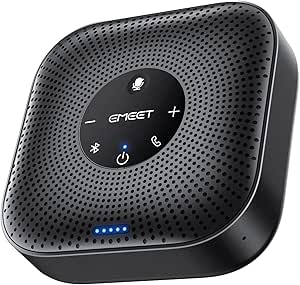 | Best for Growing Teams | Microphones: 4 AI microphones | Speaker power: 3W | Connectivity: Bluetooth 5.0, USB-C, USB-C-to-A adapter | VIEW ON AMAZON | See Our Full Breakdown |
| Jabra Speak 410 USB Speakerphone |  | Best Simple USB Pick | Connection: USB | Microphone: Built-in 360-degree omnidirectional | Audio: Wideband, HiFi | VIEW ON AMAZON | See Our Full Breakdown |
| EMEET Luna Plus Kit Conference Speakerphone with Satellite Microphone |  | Best for Larger Conference Tables | Microphones: 9, including satellite microphone | Voice pickup: 360 degrees | Recommended conference size: Up to 14 people | VIEW ON AMAZON | See Our Full Breakdown |
| Jabra Speak 510 Portable USB and Bluetooth Speakerphone, Black | | Best for Wireless Portability | Connectivity: Bluetooth, USB | Bluetooth range: 100 feet | Battery life: Up to 15 hours | VIEW ON AMAZON | See Our Full Breakdown |
| NEWORK FreeChat 103 Conference Speakerphone with Dual AI Noise-Reduction Microphones |  | Best for Compact Hybrid Setups | Microphones: 2 dual MEMS microphones | Voice pickup range: 3 meters | Speaker output: 5 W | VIEW ON AMAZON | See Our Full Breakdown |
| Yealink SP92 Conference Speakerphone with AI Noise Cancellation |  | Best for Long Meetings | Microphone pickup radius: 13 ft (4 m) | Recommended room size: 4–8 people | Connectivity: Bluetooth 5.3, USB-C | VIEW ON AMAZON | See Our Full Breakdown |
| conference speakerphone | Connectivity | Bluetooth range | Microphones | Battery life |
|---|---|---|---|---|
| Cyber Acoustics SP-2000 USB Bl | USB-C and Bluetooth 5.0 | Up to 66 feet unobstructed | — | Up to 12 hours at two-thirds volume |
| Anker PowerConf Bluetooth Spea | Bluetooth and USB-C | 10 meters | 6; 360-degree array | Up to 24 hours of call time |
| Yealink SP92 Bluetooth USB Spe | — | 30 meters | — | Up to 20 hours |
| EMEET M1A USB Conference Speak | Wired USB-C | — | 2 omnidirectional | — |
| Anker PowerConf Bluetooth Spea | Bluetooth and USB-C | 20 meters | 6; 360-degree pickup | — |
| AIRHUG 01 Bluetooth and USB Co | Bluetooth, USB-C | — | — | — |
| Jabra Speak 510 Portable Bluet | Bluetooth, USB | 100 ft | 1, with 360-degree pickup | Up to 15 hours |
| EMEET Luna Conference Speaker | USB, Bluetooth, AUX, dongle | 10 meters | 3 | — |
| PolaTab Q95 Mini USB Conferenc | USB 2.0 | — | — | — |
| EMEET M0 Plus Conference Speak | Bluetooth 5.0, USB-C, USB-C-to-A adapter | — | 4 AI microphones | 10+ hours talk time |
| Jabra Speak 410 USB Speakerpho | — | — | — | — |
| EMEET Luna Plus Kit Conference | Bluetooth 5.3, USB 2.0, included A350 dongle | — | 9, including satellite microphone | — |
| Jabra Speak 510 Portable USB a | Bluetooth, USB | 100 feet | 1 | Up to 15 hours |
| NEWORK FreeChat 103 Conference | USB-A, USB-C, Bluetooth 5.4 | 10 meters | 2 dual MEMS microphones | Up to 10 hours talk time or 14 hours music playback |
| Yealink SP92 Conference Speake | Bluetooth 5.3, USB-C | 30 m | — | Up to 20 hours |
More Details on Our Top Picks
Cyber Acoustics SP-2000 USB Bluetooth Speakerphone
The Cyber Acoustics SP-2000 suits small teams and hybrid workers who want one portable unit for a laptop and a phone. Its USB-C and Bluetooth 5.0 connections give it more flexibility than the wired-only EMEET M1A, while its 5-inch footprint and 6.3-ounce weight make it easy to move between desks. A 360-degree noise-cancelling microphone with a stated 3-meter pickup range and full-duplex audio supports natural group conversation, including interruptions. The tradeoff is endurance: its up-to-12-hour battery claim is measured at two-thirds volume, below the Anker PowerConf models’ stated 24 hours. The listed Bluetooth range also assumes unobstructed conditions, so I would choose it for a nearby personal workspace rather than a room that demands long-range wireless coverage.
Pros:- USB-C and Bluetooth 5.0 support wired computer calls and wireless smartphone use.
- 360-degree noise-cancelling microphone has a stated 3-meter pickup range.
- Full-duplex audio lets participants speak over one another naturally.
- Compact 6.3-ounce design is easy to carry between workspaces.
Cons:- Up to 12 hours of battery life is specified at two-thirds volume, less than the Anker PowerConf models’ stated call time.
- The 66-foot Bluetooth range is listed for unobstructed conditions, which may not reflect a typical office.
Best for: Hybrid workers and small groups who need a lightweight speakerphone that can switch between a computer and a smartphone.
Not ideal for: Teams running long meetings at high volume or users who need dependable Bluetooth coverage through walls.
- Connectivity:USB-C and Bluetooth 5.0
- Microphone:360-degree noise-cancelling; 3-meter pickup range
- Battery life:Up to 12 hours at two-thirds volume
- Bluetooth range:Up to 66 feet unobstructed
- Audio:Stereo, full duplex
- Dimensions and weight:5 × 5 × 2 inches; 6.3 ounces
- Compatibility:Smartphones, laptops, PC, Mac, and leading UC platforms
- Included:USB-C cable and user guide
Our verdict“Choose the SP-2000 if you want a light, flexible speakerphone for a small workspace and do not need the longest battery life.”
Anker PowerConf Bluetooth Speakerphone with 6 Microphones
For teams that spend much of the day on calls, the Anker PowerConf A3301 puts battery endurance ahead of an especially small, lightweight build. It claims up to 24 hours of call time, twice the SP-2000’s stated runtime, and its six-microphone 360-degree array is paired with voice processing to reduce background noise and balance voices. USB-C and Bluetooth provide a choice between a direct computer connection and a wireless setup; the EMEET M1A is a simpler wired alternative but lacks that flexibility. Anker also lists PowerIQ device charging, a useful extra when a phone needs power between meetings. I would treat the battery figures cautiously, though: the supplied details conflict on capacity, listing both 3,000 mAh and 6,700 mAh. Its 12-ounce weight also makes it less appealing as a frequent travel companion.
Pros:- Six microphones are arranged for 360-degree voice pickup.
- Voice processing is designed to reduce background noise and balance speaker volume.
- USB-C and Bluetooth work with smartphones, desktops, and laptops without driver installation.
- PowerIQ can charge another device.
Cons:- Supplied product details conflict on battery capacity, listing 3,000 mAh and 6,700 mAh.
- At 12 ounces, it weighs nearly twice as much as the 6.3-ounce Cyber Acoustics SP-2000.
- A four-hour charging time may be inconvenient when the battery runs down between calls.
Best for: Office teams and remote workers who run long calls and want both wireless pairing and a USB-C connection.
Not ideal for: Frequent travelers seeking the lightest option, or buyers who need consistent, unambiguous battery specifications.
- Model:A3301
- Microphones:6; 360-degree array
- Connectivity:Bluetooth and USB-C
- Bluetooth range:10 meters
- Battery life:Up to 24 hours of call time
- Battery capacity:Conflicting supplied details: 3,000 mAh and 6,700 mAh
- Charging time:4 hours
- Dimensions and weight:4.84 × 4.88 × 1.18 inches; 12 ounces
- Maximum output power:3 watts
Our verdict“Pick this PowerConf for extended meeting days and flexible connections if its conflicting battery-capacity details are not a concern.”
Yealink SP92 Bluetooth USB Speakerphone
The Yealink SP92 is a portable choice for people who move between meeting rooms and need background-noise reduction without giving up wireless or wired connection options. Its AI noise cancellation and 360-degree pickup target shared-room calls, while the 50 mm speaker and up-to-20-hour battery life make it more suited to extended use than the Cyber Acoustics SP-2000, whose stated runtime is 12 hours. The included carrying case adds practical protection for travel. There is a notable setup caveat: this version does not include a dongle, so buyers who need one for a particular computer should account for that separately. Compared with the Anker PowerConf, the SP92 lists a longer Bluetooth range but a shorter maximum call-time claim. It is also mono, not a stereo option for music playback.
Pros:- AI noise cancellation is designed to reduce background sounds on calls.
- 360-degree pickup and full-duplex audio support group conversation.
- Up to 20 hours of talk or music time exceeds the SP-2000’s stated battery life.
- Carrying case and Bluetooth or wired connections suit mobile setups.
Cons:- A dongle is not included, which may mean extra setup or an additional accessory for some computers.
- Mono output does not provide stereo playback.
- It is not water resistant.
Best for: Mobile professionals who carry a speakerphone between rooms and want AI noise cancellation, a case, and wired or Bluetooth connections.
Not ideal for: Buyers who require an included wireless dongle, water resistance, or stereo playback.
- Speaker size:50 mm
- Microphone pickup:360-degree
- Audio features:AI noise cancellation and full duplex
- Battery life:Up to 20 hours
- Connections:Bluetooth and wired
- Bluetooth range:30 meters
- Audio output:Mono
- Dimensions and weight:5 × 5 × 1.3 inches; 276 g
- Included accessories:Carrying case; dongle not included
Our verdict“Choose the SP92 if you need a portable, noise-conscious speakerphone with a case and can manage without an included dongle.”
EMEET M1A USB Conference Speakerphone with 360° Voice Pickup
The EMEET M1A is the straightforward choice for a small meeting table where a dependable computer connection matters more than wireless freedom. Its two omnidirectional microphones offer 360-degree pickup, while noise reduction, echo cancellation, voice amplification, and full-duplex audio are intended to keep conversation intelligible as people take turns or speak at once. The included USB-C-to-USB-A adapter makes it easier to connect to different computers than a cable limited to one port type. Compared with the Bluetooth-capable Cyber Acoustics SP-2000, the M1A gives up phone pairing and battery-powered placement; in exchange, there is no battery to manage during a meeting. Its listed recommended group size of five to eight people defines its lane: it is a practical tabletop option for modest groups, not a wireless solution for changing room layouts.
Pros:- Two omnidirectional microphones provide 360-degree voice pickup.
- Noise reduction and echo cancellation are designed to improve call clarity.
- Included USB-C-to-USB-A adapter helps with computers that lack a USB-C port.
- One-touch mute controls and nine volume levels make meeting adjustments simple.
Cons:- Wired USB is the only connection option; there is no Bluetooth.
- Placement depends on a cable reaching the computer, unlike the SP-2000 or Yealink SP92.
- The listed recommended group size of five to eight people may not suit larger rooms.
Best for: Small teams of five to eight people who hold meetings at a fixed table and connect the speakerphone to a computer.
Not ideal for: Hybrid workers who need smartphone pairing, wireless placement, or a speakerphone they can take away from the computer.
- Connectivity:Wired USB-C
- Included adapter:USB-C to USB-A
- Microphones:2 omnidirectional
- Voice pickup:360 degrees
- Audio features:Noise reduction, echo cancellation, voice amplification, and full duplex
- Volume levels:9
- Mounting type:Tabletop
- Recommended group size:5–8 people
Our verdict“Choose the M1A for a fixed small-team setup where plug-in simplicity matters more than wireless connectivity.”
Anker PowerConf Bluetooth Speakerphone with 6 Microphones
This black Anker PowerConf A3301 is a flexible tabletop pick for people who want six-microphone 360-degree pickup, call processing, and the choice of Bluetooth or USB-C. Its AI-powered noise reduction, echo cancellation, and automatic voice balancing are aimed at making shared-room calls easier to follow. Like the other Anker PowerConf in this roundup, it claims up to 24 hours of call time and can charge other devices; its listed 5,200 mAh capacity is more clearly specified than the other listing’s conflicting capacity figures. The data still has a runtime discrepancy, however, with additional details citing 8–10 hours. The stated 20-meter Bluetooth range also falls short of the Yealink SP92’s 30 meters. Compared with the wired EMEET M1A, this Anker offers much more placement freedom, but adds battery upkeep and is not waterproof.
Pros:- Six microphones provide 360-degree voice pickup.
- AI noise reduction, echo cancellation, and automatic voice balancing target clearer group calls.
- Bluetooth and USB-C allow wireless or direct computer connections.
- Listed 5,200 mAh battery capacity and device-charging function add utility between meetings.
Cons:- Battery details conflict: the main specification says up to 24 hours, while additional details cite 8–10 hours.
- The listed 20-meter Bluetooth range is shorter than the Yealink SP92’s stated 30 meters.
- It is not waterproof.
Best for: Teams using a shared tabletop setup who want six-microphone pickup, wireless placement, and USB-C as a backup connection.
Not ideal for: Buyers who need waterproofing or want a single, consistent battery-life specification before choosing.
- Model:A3301
- Microphones:6; 360-degree pickup
- Audio processing:AI noise reduction, echo cancellation, and automatic voice balancing
- Connectivity:Bluetooth and USB-C
- Bluetooth range:20 meters
- Battery capacity:5,200 mAh
- Call time:Up to 24 hours; additional details list 8–10 hours
- Mounting type and color:Tabletop; black
- Warranty:18 months
Our verdict“Choose this PowerConf for a flexible tabletop conference setup, but weigh its conflicting runtime details against the wired simplicity of the EMEET M1A.”
AIRHUG 01 Bluetooth and USB Conference Speakerphone
The AIRHUG 01 suits small meetings where a compact speakerphone needs to connect to both a computer and a mobile device. Its Bluetooth and USB-C connections can stay connected simultaneously, giving it more flexibility than the USB-only PolaTab Q95 Mini when people switch between devices. The 6-foot microphone pickup range and recommended group size of four to six keep its role firmly in smaller rooms; it is not a substitute for a system designed to cover a larger table. DSP echo cancellation and noise reduction are intended to improve call clarity, while the included carry bag and six-ounce body make it easy to move between workspaces. The tradeoff is limited room coverage, and the listed 25 dB signal-to-noise ratio offers less headroom on paper than the EMEET Luna’s listed 80 dB figure.
Pros:- Bluetooth and USB-C can be connected simultaneously
- DSP echo cancellation and noise reduction support clearer group calls
- Six-ounce body and included carry bag suit mobile work
- Works with a broad range of operating systems and device types
Cons:- Six-foot microphone range limits coverage in larger rooms
- Recommended for only four to six people
- The listed 25 dB signal-to-noise ratio is lower than the EMEET Luna’s listed 80 dB
Best for: Small hybrid teams of four to six people who want a lightweight speakerphone that can stay connected to a laptop and phone.
Not ideal for: Teams meeting around a long table or larger group, since the stated microphone pickup range is only six feet and the recommended group size is four to six.
- Connectivity:Bluetooth, USB-C
- Microphone pickup range:Up to 6 ft
- Recommended group size:4–6 people
- Microphone pattern:Omnidirectional
- Sampling rate:48,000 samples/sec
- Signal-to-noise ratio:25 dB
- Dimensions:3.94 x 3.94 x 0.79 in
- Weight:6 oz
- Included accessories:USB-C cable, USB-A cable, carry bag, user manual
Our verdict“Choose the AIRHUG 01 for portable, small-group calls that benefit from simultaneous Bluetooth and USB-C connections, not for broad room coverage.”
Jabra Speak 510 Portable Bluetooth Speakerphone
The Jabra Speak 510 is the straightforward travel pick for people who need a speakerphone that can move from desk to meeting room without depending on a nearby outlet. Its 15-hour battery life gives it a clear advantage over the corded PolaTab Q95 Mini, while Bluetooth and USB let it pair with either mobile devices or computers. A single 360-degree microphone is simple and practical for a small table, but it provides less microphone-array complexity than the EMEET M0 Plus with four AI microphones. That difference matters in noisier rooms or meetings where several people sit farther apart. The included case adds travel convenience, but the listed 14 kHz frequency response and single-microphone design make this a portable, uncomplicated option rather than a feature-rich room system. It is also not waterproof, so it needs ordinary care on the go.
Pros:- Up to 15 hours of battery life supports extended use away from a desk
- Bluetooth and USB cover mobile and computer connections
- 360-degree microphone pickup suits small group conversations
- Carrying case makes transport easier
Cons:- Uses a single microphone, unlike the four-mic EMEET M0 Plus
- Not waterproof
- Listed 14 kHz frequency response is narrower than some alternatives
Best for: Frequent travelers and hybrid workers who want a battery-powered speakerphone for calls at home, in shared offices, or on the road.
Not ideal for: Teams in noisy rooms or larger meeting spaces that need multiple microphones or more advanced voice processing.
- Connectivity:Bluetooth, USB
- Bluetooth range:100 ft
- Battery life:Up to 15 hours
- Microphones:1, with 360-degree pickup
- Frequency response:14 kHz
- Speaker driver size:50 mm
- Waterproof:No
- Included accessory:Carrying case
Our verdict“Pick the Jabra Speak 510 for portable calls and long battery life, but choose a multi-microphone model for challenging rooms.”
EMEET Luna Conference Speaker and Microphone with 360° Voice Pickup
The EMEET Luna stands out for teams that may need to grow beyond one speakerphone: two units can be daisy-chained to support meetings with up to 16 or more attendees. That gives it a larger-room path than the AIRHUG 01, which is recommended for four to six people, and its three microphones provide 360-degree pickup for voices around a table. USB, Bluetooth, AUX, and dongle connections also make it adaptable to different meeting setups. Noise reduction and speech enhancement are aimed at clearer calls, while the metal enclosure gives this tabletop unit a sturdier feel than the plastic-bodied EMEET M0 Plus. Expansion has a catch: the daisy-chain cable is sold separately. It also shuts off after an hour of inactivity, which may interrupt workflows if a session pauses for a while.
Pros:- Three microphones provide 360-degree voice pickup
- USB, Bluetooth, AUX, and dongle offer flexible connections
- Daisy-chain support can extend coverage for meetings of up to 16 or more attendees
- Metal enclosure suits a permanent tabletop setup
Cons:- Daisy-chain cable is sold separately
- Automatic shutoff after one hour of inactivity may interrupt paused sessions
- Expansion requires adding a second unit
Best for: Teams that hold meetings of varying sizes and want the option to connect a second speakerphone for larger groups.
Not ideal for: Buyers seeking a ready-to-expand kit in one purchase or people who need a unit to remain powered on through long idle periods.
- Microphones:3
- Voice pickup:360°
- Connectivity:USB, Bluetooth, AUX, dongle
- Bluetooth range:10 meters
- Maximum volume:85 dB
- Signal-to-noise ratio:80 dB
- Power source:USB or built-in rechargeable battery
- Enclosure material:Metal
- Daisy-chain capacity:Two units; meetings with up to 16 or more attendees
Our verdict“Choose the EMEET Luna when flexible connections and the option to expand coverage matter more than a complete daisy-chain setup out of the box.”
PolaTab Q95 Mini USB Conference Speakerphone with Microphone and USB Hub
The PolaTab Q95 Mini is a practical fit for a desk that stays wired: its 3-meter USB cable reaches across a typical workspace, while the built-in USB hub adds a connection point without requiring Bluetooth pairing. The omnidirectional microphone has a stated pickup radius of up to 3 meters, giving it broader listed reach than the AIRHUG 01‘s six-foot range. DSP echo cancellation and automatic noise suppression support calls, and a physical mute button makes it easy to stop microphone transmission quickly. However, that button does not mute the speaker, so it is not a full audio-off control. Unlike the battery-powered Jabra Speak 510, the Q95 Mini depends on a wired USB connection, which restricts placement and makes it less suited to mobile meetings. It makes the most sense as a stationary computer accessory.
Pros:- 360-degree omnidirectional pickup with a stated range of up to 3 m radius
- Long 3 m USB cable helps position it around a fixed desk
- Echo cancellation and automatic noise suppression support call clarity
- Built-in USB hub adds connectivity
Cons:- USB-only connection limits placement and mobility
- Microphone mute button does not mute the speaker
- Corded electric power ties it to a computer or USB power source
Best for: Home-office workers and small teams who keep a laptop or PC on the table and want a wired speakerphone with a long cable and built-in USB hub.
Not ideal for: Mobile workers or teams that need wireless placement, battery operation, or a single button that mutes both microphone and speaker.
- Connectivity:USB 2.0
- Microphone pickup:Omnidirectional, 360°
- Voice pickup range:Up to 3 m radius
- Cable length:3 m (9.8 ft)
- USB hub:Built-in
- Signal-to-noise ratio:70 dB
- Frequency range:20 Hz–20 kHz
- Compatibility:Windows 7–10, macOS, and popular conferencing platforms
Our verdict“Choose the Q95 Mini for a stationary USB desk setup with useful cable reach, but skip it if you need wireless freedom.”
EMEET M0 Plus Conference Speakerphone with 4 AI Mics and Daisy Chain
The EMEET M0 Plus is a strong choice for teams that want a small-table speakerphone now and a path to broader coverage later. Its four-microphone array and AI noise reduction support 360-degree pickup, while daisy-chaining a second unit raises the stated meeting capacity from up to eight people to 16. That expansion plan is more direct than the EMEET Luna‘s, whose daisy-chain cable is sold separately. USB-C and Bluetooth 5.0 also keep setup simple, and more than 10 hours of talk time suits meetings away from a USB connection. The compromise is a compact 3W speaker and plastic enclosure, which may feel less substantial than the Luna’s metal body. This is a better fit for voice-focused calls than for buyers who prioritize a larger speaker or premium construction.
Pros:- Four AI microphones provide 360-degree voice pickup
- Daisy-chain support expands stated capacity from up to 8 to 16 people
- More than 10 hours of talk time supports extended meetings
- USB-C and Bluetooth 5.0 offer straightforward wired and wireless setup
Cons:- Compact 3W speaker may be less suited to rooms where louder playback is needed
- Plastic enclosure feels less premium than the metal EMEET Luna
- Larger meetings require linking a second unit
Best for: Small and midsize teams that want four-microphone pickup, wireless or USB-C connection, and the option to expand toward 16-person meetings.
Not ideal for: Buyers who prioritize a larger speaker or metal construction, or teams that need broad coverage without linking a second unit.
- Microphones:4 AI microphones
- Speaker power:3W
- Connectivity:Bluetooth 5.0, USB-C, USB-C-to-A adapter
- Battery life:10+ hours talk time
- Capacity:Up to 8 people; up to 16 with daisy chain
- Dimensions:1.6 x 4.6 x 4.6 in
- Weight:0.26 kg
- Compatibility:Zoom, Microsoft Teams, Slack, Webex, laptops, smartphones, tablets
Our verdict“Pick the M0 Plus if your team needs a portable four-microphone system that can scale by daisy-chaining, rather than a larger-bodied speakerphone.”
Jabra Speak 410 USB Speakerphone
The Jabra Speak 410 is the straightforward choice for a desk or small meeting room where a wired connection is welcome. Its 360-degree microphone and wideband audio support shared calls, while the integrated USB cable means there is no battery to charge or wireless pairing to manage. Dedicated call, volume, and mute controls also make common adjustments easy during a meeting. Compared with the Jabra Speak 510, the 410 gives up Bluetooth and battery-powered placement, but keeps the setup simpler for people who always call from a computer. That simplicity comes with a real limit: the cable ties it to the computer or a powered hub, and the listed information does not give a room-size or pickup-distance rating. I’d choose it for reliable, compact computer calls, not for flexible seating or larger rooms.
Pros:- 360-degree microphone supports voices around the table
- Integrated USB cable makes computer connection direct
- Dedicated answer/end, volume, and mute controls
- Carrying case supports transport between desks or rooms
Cons:- Requires a USB-connected computer or powered hub
- Corded connection restricts placement
- No battery or Bluetooth option is listed
Best for: People who make regular calls from a desktop or laptop and want a portable speakerphone with simple USB setup and physical call controls.
Not ideal for: Teams that need wireless placement, phone pairing, or a larger pickup range; the integrated USB cable limits where it can sit.
- Connection:USB
- Microphone:Built-in 360-degree omnidirectional
- Audio:Wideband, HiFi
- Compatible devices:Desktop, laptop
- Controls:Answer/end call, volume, mute
- Dimensions:5.27 × 7.24 × 2.24 inches
- Weight:6.08 ounces
- Included accessory:Carrying case
Our verdict“Choose the Speak 410 for uncomplicated USB calls at a computer, but pick the Speak 510 if wireless flexibility matters.”
EMEET Luna Plus Kit Conference Speakerphone with Satellite Microphone
The EMEET Luna Plus Kit is the strongest fit here for a room that needs more than a compact tabletop unit. Its included satellite microphone joins the main speakerphone’s eight microphones for 360-degree pickup, with a recommended capacity of up to 14 people. Noise reduction and echo cancellation are aimed at keeping shared calls intelligible, while USB and Bluetooth 5.3 give organizers a choice of connection. Compared with the Yealink SP92, which is specified for rooms of four to eight, the Luna Plus Kit is designed for a larger group and can link two units for up to 25 attendees. The tradeoff is that this expansion needs a separately sold cable, and a single unit is still limited to the stated 14-person size. Its 14.4-ounce build is also less pocketable than smaller picks.
Pros:- Satellite microphone extends 360-degree voice pickup around a conference table
- Noise reduction and echo cancellation support clearer shared calls
- USB and Bluetooth 5.3 provide connection flexibility
- Up to 10 hours of call time supports meetings away from a desk outlet
Cons:- One unit is recommended for rooms of up to 14 people
- Daisy-chain cable for linking two units is sold separately
- Larger and heavier than compact options such as the Jabra Speak 510
Best for: Teams holding meetings with roughly 9–14 people that need an included satellite microphone and both wired and wireless connection options.
Not ideal for: Solo callers or small huddle rooms seeking a compact, low-complexity unit; expanding to two units requires a separate cable.
- Microphones:9, including satellite microphone
- Voice pickup:360 degrees
- Recommended conference size:Up to 14 people
- Daisy-chain capacity:Up to 25 attendees with two units
- Speaker power:5 W
- Call time:Up to 10 hours
- Connectivity:Bluetooth 5.3, USB 2.0, included A350 dongle
- Weight:14.4 ounces
Our verdict“Choose the Luna Plus Kit when a larger table needs satellite-mic coverage, and skip it if you only need a small-room speakerphone.”
Jabra Speak 510 Portable USB and Bluetooth Speakerphone, Black
The Jabra Speak 510 suits people who move between a home office, meeting room, and travel setup. It pairs Bluetooth and USB with a 360-degree microphone, a listed 15-hour battery life, and a carrying case, so calls need not stay tethered to a computer. That flexibility is the key difference from the Jabra Speak 410, which is USB-only and corded. The 510 is still a single-microphone tabletop speakerphone, however, and the supplied specs do not state a recommended room size or pickup radius. For a small shared table, its wireless convenience can matter more than a multi-microphone array; for a larger group, the EMEET Luna Plus Kit is better equipped, with multiple microphones and a satellite unit. This Jabra is a portable personal or small-meeting tool, not a room-expansion system.
Pros:- Bluetooth and USB connection options
- Listed battery life of up to 15 hours
- 360-degree microphone supports voices around the device
- Carrying case makes it easier to move between work locations
Cons:- Single microphone is less suited to broad table coverage than the EMEET Luna Plus Kit
- No recommended room size or microphone pickup distance is provided
- Not waterproof
Best for: Hybrid workers and frequent travelers who want one speakerphone that can connect wirelessly to a device or by USB to a computer.
Not ideal for: Teams with large conference tables or those needing multiple microphones and a specified wider pickup area.
- Connectivity:Bluetooth, USB
- Bluetooth range:100 feet
- Battery life:Up to 15 hours
- Microphones:1
- Audio output mode:Stereo
- Frequency response:14 kHz
- Controls:Touchpad
- Included accessories:Carrying case, battery
Our verdict“Pick the Speak 510 for portable wireless calls and computer use, but choose a multi-microphone model for larger meetings.”
NEWORK FreeChat 103 Conference Speakerphone with Dual AI Noise-Reduction Microphones
The NEWORK FreeChat 103 is a practical fit for a home office or small meeting space where device ports vary. It offers USB-A, USB-C, and Bluetooth 5.4, plus two MEMS microphones with AI noise reduction and a stated pickup range of three meters. That range gives buyers a clearer boundary than options such as the Jabra Speak 510, whose supplied specs do not specify pickup distance, though it also means the FreeChat is best kept near a small group. Its 5-watt speaker and up to 10 hours of talk time support everyday calls without making it a room-scale system. Compared with the Yealink SP92, it lists more connection formats, while the Yealink offers longer battery life and a larger stated pickup radius. The FreeChat’s main compromise is its limited reach.
Pros:- USB-A, USB-C, and Bluetooth 5.4 cover varied device setups
- Dual MEMS microphones include AI noise reduction
- Up to 10 hours of talk time supports untethered calls
- Listed compatibility includes Zoom, Microsoft Teams, and Google Meet
Cons:- Three-meter pickup range limits use to smaller groups and tables
- Two microphones provide less room coverage than the EMEET Luna Plus Kit
- Bluetooth range is listed as 10 meters
Best for: Home-office users and small teams who need a compact speakerphone that can connect to USB-A, USB-C, or Bluetooth devices.
Not ideal for: Larger conference groups or tables where participants sit beyond three meters from the speakerphone.
- Microphones:2 dual MEMS microphones
- Voice pickup range:3 meters
- Speaker output:5 W
- Battery capacity:1000 mAh
- Battery life:Up to 10 hours talk time or 14 hours music playback
- Connectivity:USB-A, USB-C, Bluetooth 5.4
- Bluetooth range:10 meters
- Warranty:2 years
Our verdict“Choose the FreeChat 103 for flexible connections in a small room, but look to the Yealink SP92 or Luna Plus Kit for greater stated coverage.”
Yealink SP92 Conference Speakerphone with AI Noise Cancellation
The Yealink SP92 is the most compelling choice in this group for people who need long battery endurance without moving up to a larger conference kit. Its up to 20-hour battery and four-meter pickup radius are specified for rooms of four to eight people, giving buyers useful guidance for a typical huddle space. AI noise cancellation, Bluetooth 5.3, and USB-C cover the core call setup, and the carrying case, cable, and USB-A adapter help with transport and older computer ports. Compared with the NEWORK FreeChat 103, the SP92 offers twice the stated maximum talk time and a longer pickup radius, while the FreeChat adds Bluetooth 5.4 and USB-A as direct connection options. The SP92’s Bluetooth dongle is optional rather than included, and it is not waterproof. It is better for regular group calls than for very large rooms.
Pros:- Up to 20 hours of battery life supports extended use between charges
- Four-meter pickup radius is specified for small conference rooms
- AI noise cancellation and an omnidirectional microphone support shared calls
- Includes a carrying case, USB-C cable, and USB-C-to-A adapter
Cons:- Bluetooth dongle is optional and not included
- Recommended room size is limited to four to eight people
- Not waterproof
Best for: Small teams meeting in four-to-eight-person rooms, especially those who need long battery life and a portable USB-C or Bluetooth setup.
Not ideal for: Large conference rooms needing satellite microphones, or buyers who require an included Bluetooth dongle or a waterproof device.
- Microphone pickup radius:13 ft (4 m)
- Recommended room size:4–8 people
- Connectivity:Bluetooth 5.3, USB-C
- Bluetooth range:30 m
- Battery life:Up to 20 hours
- Recharge time:2.5 hours
- Weight:276 g
- Included accessories:Carrying case, USB-C-to-C cable, USB-C-to-A adapter
Our verdict“Choose the SP92 for long-running calls in a small meeting room; choose the EMEET Luna Plus Kit when the table or group is larger.”

How We Picked
I ranked these conference speakerphones by how well their stated features match real meeting needs: voice pickup for a shared table, clarity in noisy spaces, connection choices, portability, and room for expansion. A six-microphone array or 360-degree pickup can help a group share one device, while Bluetooth and USB flexibility matter to people who move between a desk and meeting room. I also weighed setup simplicity and whether the design suits personal calls, small huddles, or larger shared spaces.
The order favors balanced performance and broad usefulness, not the longest feature list. Models with distinct strengths—such as AI noise cancellation, satellite microphones, USB hubs, or daisy chaining—rank higher for buyers who need those capabilities, but those features do not make them the right choice for every room. I treated repeated product names as overlapping options and gave weight to meaningful differences in connectivity and package configuration, while recognizing that listed features alone cannot establish performance in every room or on every conferencing platform.
Factors to Consider When Choosing Conference Speakerphones
Before choosing a model, start with the room and meeting pattern rather than the microphone count. A speakerphone for one person taking calls at a desk has different needs from a device placed in the center of a table with several participants. These checks can help narrow the field and avoid paying for coverage or connections your setup will not use.
Match pickup to the room, not just the headcount
Count how far the farthest speaker sits from the device, and note whether people speak from around one table or from separate areas. A compact portable unit may handle a small huddle well but leave quieter voices harder to hear in a long room. 360-degree pickup helps when participants sit around a central device, while a satellite microphone or daisy-chain option can extend coverage when one unit is not enough. A common mistake is to assume a larger microphone count automatically means better coverage; placement, room acoustics, and speaking distance matter too. If possible, place the unit centrally and keep it away from laptops, vents, and other steady noise sources. Choose for the normal meeting layout, not the rare largest gathering, unless the device can expand for those sessions.
Choose noise handling for the sounds you actually hear
AI noise cancellation and noise reduction are most relevant in home offices or shared workspaces with steady keyboard, fan, or background activity. They cannot make overlapping speech easy to follow, nor can they correct a microphone placed too far from the participants. For a quiet conference room, reliable pickup and clear playback may matter more than extra noise-processing features. Buyers sometimes focus on the word “AI” without checking whether the problem is background noise, echo, or simply people sitting too far away; those are different issues. Consider the room’s usual noise and speaking patterns before paying extra for processing features. Good placement and a quieter meeting space can improve results regardless of model.
Decide how much wireless flexibility you need
USB is a straightforward choice for a dedicated desk or room: connect the speakerphone to a computer and keep the setup consistent. Bluetooth is useful when calls move between a computer and a phone, or when a cable across the table would get in the way. Some models offer both, which gives more choice but can add setup decisions around pairing and switching devices. Before buying, check which connection types are included in the exact listing and whether your usual meeting device supports them. A frequent mismatch is choosing Bluetooth for convenience and then discovering that the device is expected to remain wired in a fixed room. Pick the connection that suits the way your meetings are actually hosted.
Treat expansion as a room-planning decision
A satellite microphone or daisy-chain feature can help when a single tabletop device cannot cover the usual seating arrangement. Expansion is most useful for recurring meetings in a larger room, where moving one small speakerphone closer to every speaker is impractical. It is less valuable for a personal workspace or a small, fixed huddle where participants can sit near the central unit. Check what the expansion package includes: a model name that mentions a kit may differ from a base unit in supplied accessories. Do not assume two similar product names offer the same microphones, cables, or expansion method. Planning for the room now can prevent buying a compact model that cannot adapt to a larger setup later.
Balance portability against controls and stability
If you carry the speakerphone between a home office and meeting rooms, a portable model can reduce setup friction and keep one familiar device available. For a permanent room installation, portability may matter less than easy access to call controls, dependable cabling, and a stable position on the table. Small devices are easier to pack, but their compact form does not automatically make them a good fit for a large group. Think about who will connect and operate the unit: a shared office benefits from simple, visible controls, while a single user may be comfortable managing Bluetooth pairing. Also consider whether the speakerphone will sit beside a laptop, phone, or display, since cable and placement needs can shape the practical setup. Prioritize the features that remove recurring hassles in your own meeting routine.
Compare exact versions and package contents
Several products in this roundup appear under duplicate or closely related listings, so the name alone may not identify the version being sold. The Jabra Speak 510 appears as a portable Bluetooth model and as a USB-and-Bluetooth listing; the Yealink SP92 also appears in variants described differently. Check the connection options, included accessories, and any stated expansion components for the exact listing before placing an order. This matters especially when comparing an EMEET base speakerphone with a Luna Plus Kit that includes a satellite microphone. A mistaken assumption about what comes in the box can leave you without a needed cable or room microphone. Treat package details as part of the product decision, not a minor listing detail.
Frequently Asked Questions
Is a Bluetooth speakerphone or a USB speakerphone a better choice for a shared meeting room?
For a room with one dedicated computer, USB is often the simpler way to keep the setup consistent and ready for scheduled calls. Bluetooth makes more sense when different people bring phones or laptops, or when you want to avoid a cable running across the table. A dual-connection model can cover both patterns, but check how it switches between devices and which version the listing includes. If the speakerphone stays installed in one place, prioritize reliable connection and simple operation over flexibility you may rarely use. For a room used by many people, a clear connection routine can matter as much as the connection itself.
Will one conference speakerphone cover a long table?
It depends on the room dimensions, seating layout, and how far participants are from the microphone—not just the number of people. A unit with 360-degree pickup can suit a group seated around a central table, but it may not reach everyone clearly at the ends of a long room. Satellite microphones or daisy chaining are more relevant when a single device cannot be placed near all speakers. Before buying, map where people sit and identify the quietest or farthest speaking position. If large-room meetings are routine, choose for that setup rather than expecting a compact portable model to cover every seat.
Do AI noise-cancellation features make a speakerphone suitable for a noisy office?
Noise-processing features can help reduce certain background sounds, which is why models such as the Yealink SP92 and NEWORK FreeChat 103 may appeal in busy spaces. They do not remove the need to place the speakerphone near the people speaking, and they cannot reliably separate several voices talking over one another. A quiet room with good placement may produce clearer calls than a noisier room with more processing features. Identify whether your main issue is steady background noise, echo, or distance before choosing a model. If the noise is persistent, also consider changing the device’s position or meeting location.
When is a satellite microphone or daisy-chain feature worth choosing?
Expansion is worth considering when meetings regularly include participants seated beyond the practical reach of one tabletop speakerphone. The EMEET Luna Plus Kit’s satellite microphone and the M0 Plus’s daisy-chain capability address different expansion approaches, so check the specific configuration before comparing them. For a small huddle, those features can add complexity without solving a real problem. Think about whether the room layout is fixed, how many people speak from a distance, and whether the added components will be used regularly. If you only need broader coverage occasionally, changing seating or moving the device may be enough.
How should I choose between a compact portable model and a larger or expandable setup?
Choose a compact speakerphone when meetings are usually one-to-one or involve a small group gathered close to a central device. Portability is useful when the same speakerphone needs to move between a desk, home office, and meeting room. A larger or expandable setup makes more sense for recurring group meetings where participants sit farther apart and cannot easily move closer. Do not choose by portability alone if the device will spend most of its time covering a fixed room. Let the usual seating distance and meeting frequency decide whether compactness or broader coverage will save more effort.
Conclusion
For most small-team meetings, I’d start with the Anker PowerConf because its six microphones and Bluetooth flexibility make it a balanced choice for shared-table use. For best value in a straightforward personal setup, compare the Jabra Speak 410 USB and Cyber Acoustics SP-2000 against the connections and controls you actually need. Beginners who want a familiar, portable option should look at the Jabra Speak 510, checking whether the specific listing includes USB, Bluetooth, or both. For a premium, larger-room setup, the EMEET Luna Plus Kit is the clearest fit when its satellite microphone addresses a real coverage gap; the M0 Plus is worth a look when daisy chaining matters. Buyers focused on background noise should compare the Yealink SP92 and NEWORK FreeChat 103, while those seeking a compact unit with an added connection feature can examine the PolaTab Q95. Match the model to your room and exact package configuration, and skip expansion features you will not use.