
For most households, Do You Really Know Your Family? is my best overall pick: its conversation prompts let different ages take part without a long rules lesson. Hedbanz is a lively choice for guessing-game fans, while CATAN suits families ready for a longer, more strategic session. The main tradeoff is between quick, easy-to-learn play and games that offer more planning but ask for greater patience, attention, or age readiness. Familiar classics such as Jenga and Connect 4 keep setup simple, though their repeat play depends more on the group’s appetite for direct competition. Read on for the full breakdown and a guide to choosing the right fit for your family.

Get the latest gadgets delivered free with Prime
- Fast, free delivery on millions of items
- Prime Video, Amazon Music and more included
- Member-only deals all year
Complete the kit



Key Takeaways
- Do You Really Know Your Family? leads for mixed-age conversation because its central activity is sharing answers rather than mastering strategy or reading a complex board.
- Hedbanz and Family Feud: Deluxe Buzzer Edition bring guessing and group performance to the table; they suit outgoing families better than players who prefer quiet, turn-by-turn planning.
- Jenga Classic and Jenga with Digital Die share a physical stacking core, but the digital die gives the newer variant a different prompt-driven feel rather than a more strategic game.
- Candy Land, Trouble, Sorry!, Guess Who?, and Connect 4 offer recognizable, approachable play, but their appeal varies with reading ability, tolerance for luck, and interest in head-to-head competition.
- CATAN is the clear choice for families seeking resource planning and longer sessions; it is a less natural fit when players need very short games or immediate rules access.
| Do You Really Know Your Family? Fun Family Game for Kids, Teens and Adults |  | Best for Family Conversation | Age range: 8+ | Players: 3–8 | Theme: Trivia | VIEW ON AMAZON | See Our Full Breakdown |
| Hasbro Jenga Game with Digital Die |  | Best for Twist-on-a-Classic Play | Brand: Hasbro Gaming | Age range: 6 years and up | Players: 1 or more | VIEW ON AMAZON | See Our Full Breakdown |
| Spin Master Games Family Feud: Deluxe Buzzer Edition |  | Best for Team Game Nights | Brand: Spin Master Games | Edition: Deluxe Buzzer Edition | Players: 3 or more | VIEW ON AMAZON | See Our Full Breakdown |
| Candy Land: Kingdom of Sweet Adventures Board Game |  | Best for Preschool Beginners | Brand: Hasbro Gaming | Players: 2–4 | Age range: 3 years (36 months)–6 years | VIEW ON AMAZON | See Our Full Breakdown |
| Hasbro Gaming Jenga Classic Wooden Block Stacking Game |  | Best for Simple, Screen-Free Play | Brand: Hasbro Gaming | Game: Jenga Classic | Material: Wood | VIEW ON AMAZON | See Our Full Breakdown |
| Spin Master Games Hedbanz Classic Edition Picture Guessing Game |  | Best for Lively Group Play | Age range: 6 years and up | Players: 2–6 | Edition: Classic Edition | VIEW ON AMAZON | See Our Full Breakdown |
| Sorry! Board Game for Kids Ages 6 and Up – Classic Hasbro Game with 4 Pawns per Player |  | Best for Playful Rivalry | Players: 2–4 | Minimum age: 6 years | Genre: Family | VIEW ON AMAZON | See Our Full Breakdown |
| Hasbro Gaming Guess Who? Plus Board Game with People and Pet Cards | 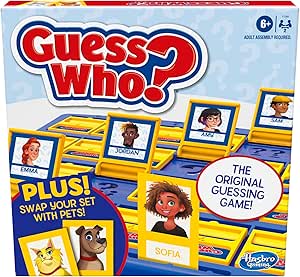 | Best for Two-Player Family Duels | Players: 2 | Recommended age: 6 years and up | Included card sets: People and pets | VIEW ON AMAZON | See Our Full Breakdown |
| Hasbro Connect 4 Game, 2025 Edition |  | Best for Quick Head-to-Head Rounds | Edition: 2025 Edition | Age range: Ages 6 and up | Players: 2 | VIEW ON AMAZON | See Our Full Breakdown |
| Hasbro Gaming Connect 4 Strategy Board Game with Blocker Discs |  | Best for Tactical Two-Player Play | Players: 2 | Recommended age: 6 years and up | Playing time: 30 minutes | VIEW ON AMAZON | See Our Full Breakdown |
| Hasbro Gaming Trouble Board Game for Ages 5 and Up |  | Best for Quick, Simple Family Rounds | Age range: 5 years and up | Players: 2–4 | Edition: Classic Edition | VIEW ON AMAZON | See Our Full Breakdown |
| CATAN Board Game, 6th Edition |  | Best for Strategic Family Game Nights | Edition: 6th Edition | Players: 3–4 | Recommended age: 10 years and up | VIEW ON AMAZON | See Our Full Breakdown |
| family board game | Players | Included components | Brand | Age range |
|---|---|---|---|---|
| Do You Really Know Your Family | 3–8 | — | — | 8+ |
| Hasbro Jenga Game with Digital | 1 or more | 54 hardwood blocks, stacking sleeve, and instructions | Hasbro Gaming | 6 years and up |
| Spin Master Games Family Feud: | 3 or more | Buzzer, question cards, host card, dry-erase scoreboard, dry-erase marker, and 2 instruction sheets | Spin Master Games | — |
| Candy Land: Kingdom of Sweet A | 2–4 | Gameboard, 4 gingerbread pawns, card deck, and instructions | Hasbro Gaming | 3 years (36 months)–6 years |
| Hasbro Gaming Jenga Classic Wo | 1 or more | 54 hardwood blocks, stacking sleeve, and instructions | Hasbro Gaming | — |
| Spin Master Games Hedbanz Clas | 2–6 | — | Spin Master Games | 6 years and up |
| Sorry! Board Game for Kids Age | 2–4 | Gameboard, 12 pawns, 45 cards, instructions | Hasbro Gaming | — |
| Hasbro Gaming Guess Who? Plus | 2 | 2 gameboards, 48 people face cards, 24 people mystery cards, 48 pets face cards, 24 pets mystery cards, 2 scorekeepers, game rules | Hasbro Gaming | — |
| Hasbro Connect 4 Game | 2 | Grid and tray, 42 discs (21 red and 21 yellow), game rules | Hasbro Gaming | Ages 6 and up |
| Hasbro Gaming Connect 4 Strate | 2 | Grid, 2 feet, slider bar, 21 red discs, 21 yellow discs, 4 blue Blocker discs, instructions | — | — |
| Hasbro Gaming Trouble Board Ga | 2–4 | Gameboard, plastic game unit with Pop-O-Matic die roller, pegs, and instructions | — | 5 years and up |
| CATAN Board Game | 3–4 | — | — | — |
More Details on Our Top Picks
Do You Really Know Your Family? Fun Family Game for Kids, Teens and Adults
Do You Really Know Your Family? turns game night into a mix of trivia about one another and silly challenges, making it a better fit for families who want conversation than for players seeking tactical competition. Its 8+ age guidance and easy-to-learn format make it more accessible to mixed-age groups than CATAN, while the questions give it a more personal focus than the physical suspense of Jenga Classic. The portable tin is convenient for packing away or taking along, though the card-based format means the fun depends on players being comfortable sharing answers and joining in. It needs at least three players, so it cannot fill the gap when only two family members are available. Cardstock may also feel less sturdy than a wooden game.
Pros:- Trivia and challenges encourage family members to talk and learn about one another.
- Simple rules make it easy to start with mixed ages.
- Suitable for a broad family age range from age 8 upward.
- Tin packaging makes the card game easy to store and carry.
Cons:- Requires at least three players.
- Cardstock may feel less durable than Jenga Classic’s hardwood blocks.
- Its indoor-use format offers less flexibility for outdoor family activities.
Best for: Families with three or more players, including kids aged 8 and up, who want prompts for conversation and shared laughs.
Not ideal for: Two-player households or families looking for strategic decisions, quiet solo play, or a board-centered game.
- Age range:8+
- Players:3–8
- Theme:Trivia
- Material:Cardstock
- Container:Tin
- Dimensions:2 × 4.7 × 6.7 inches
- Language:English
- Battery required:No
Our verdict“Choose it for a group of three or more who value personal questions and conversation more than strategy or physical gameplay.”
Hasbro Jenga Game with Digital Die
Hasbro Jenga with Digital Die keeps the familiar block-stacking tension but adds six extra challenges for families who want more variation than Jenga Classic provides. The core activity remains easy to grasp for players ages 6 and up, and the hardwood blocks make turns physical and suspenseful without a long rules explanation. Compared with Candy Land, it asks players to judge risk and steadiness rather than simply follow a color path, so it suits older children and adults better. The added digital element has a catch: accessing the die requires a phone to scan a QR code or use a web app. Families who prefer screen-free play can stick to the classic format, while those who want a structured board game may find both Jenga versions too dependent on dexterity.
Pros:- Six added challenges offer variety beyond the standard block-removal game.
- Hardwood blocks provide a tactile, dexterity-focused activity.
- The familiar core rules are accessible to players ages 6 and up.
- A stacking sleeve helps with setup and storage.
Cons:- The digital die requires a phone and access to a QR-linked web app.
- Physical dexterity and a steady hand affect play, which may not suit every family member.
- Like Jenga Classic, the main activity can feel repetitive without using the extra challenges.
Best for: Families with children ages 6 and up who enjoy physical, quick-to-explain games and want optional challenges beyond standard Jenga.
Not ideal for: Screen-free households, players who prefer a board and fixed turn structure, or families seeking a game designed specifically for preschoolers.
- Brand:Hasbro Gaming
- Age range:6 years and up
- Players:1 or more
- Blocks:54 hardwood blocks
- Digital die challenges:6
- Included components:54 hardwood blocks, stacking sleeve, and instructions
Our verdict“Pick this version if your family already likes Jenga’s physical suspense and will use the phone-linked challenges for added variety.”
Spin Master Games Family Feud: Deluxe Buzzer Edition
Family Feud: Deluxe Buzzer Edition is the strongest pick here for families who want teams, a host, and a game-show-style centerpiece. The light-and-sound buzzer, Face Off rounds, and Fast Money rounds give play a livelier group rhythm than the quieter question exchange in Do You Really Know Your Family? Its 200 cards also offer more prompts for repeat gatherings than the compact card set described for that conversation game. The format needs at least three players and works best when someone is willing to manage the questions and scoreboard, so it is less spontaneous than Jenga Classic, which can start with almost no setup. It suits outgoing groups that enjoy calling out answers; families who dislike performance or team competition may prefer a simpler shared activity.
Pros:- Buzzer with lights and sounds adds a clear game-show feel.
- Includes 150 Face Off cards and 50 Fast Money cards.
- Team format gives larger family groups a shared goal.
- Dry-erase scoreboard supports tracking rounds and scores.
Cons:- Requires at least three players.
- A host and scorekeeping add setup and coordination compared with Jenga Classic.
- The buzzer-led, competitive format may not suit players who prefer relaxed conversation.
Best for: Families of three or more who enjoy team competition, hosting, and lively group play with children ages 8 and up.
Not ideal for: Small households that often play with only two people, or families who prefer quiet, low-pressure games without a host or buzzer.
- Brand:Spin Master Games
- Edition:Deluxe Buzzer Edition
- Players:3 or more
- Recommended age:8 years and up
- Face Off cards:150
- Fast Money cards:50
- Included components:Buzzer, question cards, host card, dry-erase scoreboard, dry-erase marker, and 2 instruction sheets
Our verdict“Choose it for a sociable group of at least three that wants structured team competition and a buzzer-led game-show atmosphere.”
Candy Land: Kingdom of Sweet Adventures Board Game
Candy Land: Kingdom of Sweet Adventures is the easiest entry point in this group for very young children: players follow a colorful path by matching cards, with no reading required. That makes it a better fit for preschoolers than Do You Really Know Your Family? or Family Feud, both of which rely on language and are aimed at older children. Its roughly 15-minute playtime also suits short attention spans, and taking turns offers a simple first lesson in shared play. The tradeoff is that the game provides little strategic choice; older children may quickly want more interaction than moving toward the castle. Unlike Jenga Classic, it does not build suspense through dexterity, but its straightforward path is less likely to frustrate a new player.
Pros:- No reading is required, so young children can follow the game.
- Color matching supports basic color recognition.
- Short estimated playtime suits preschool attention spans.
- Supports two to four players and includes English and Spanish instructions.
Cons:- Limited strategic depth can reduce appeal for older children and adults.
- Small plastic pawns can be misplaced.
- The path-following format offers less physical tension and group banter than Jenga or Family Feud.
Best for: Families introducing preschoolers ages 3 and up to turn-taking and simple board-game play.
Not ideal for: Families with older children seeking strategy, meaningful choices, or replay variety that grows with players.
- Brand:Hasbro Gaming
- Players:2–4
- Age range:3 years (36 months)–6 years
- Estimated playing time:15 minutes
- Included components:Gameboard, 4 gingerbread pawns, card deck, and instructions
- Instruction languages:English and Spanish
- Model number:4700 S5
Our verdict“Choose Candy Land as a first board game for preschoolers, but look elsewhere if your family wants strategy or lasting challenge for older players.”
Hasbro Gaming Jenga Classic Wooden Block Stacking Game
Jenga Classic earns its place as the most straightforward all-ages group activity in this selection: players remove and stack 54 hardwood blocks, with no questions to read or team roles to manage. Compared with Hasbro Jenga with Digital Die, this version skips phone-linked challenges, which makes it the cleaner choice for families who want a screen-free game that starts with familiar rules. It also feels more hands-on than Candy Land’s card-driven path. The tradeoff is that the tower’s growing instability supplies nearly all the tension; families wanting prompts, team competition, or strategic variety may get more from Do You Really Know Your Family? or Family Feud. It supports solo play as well as groups, though the most social moments come when several people are watching each move.
Pros:- Simple rules make it accessible to mixed-age groups.
- Hardwood blocks create tactile, suspenseful play.
- Can be played solo or with a group.
- Stacking sleeve supports setup and storage, and the package has a carrying handle.
Cons:- The tower becomes unstable as blocks are removed, which may frustrate players who dislike dexterity challenges.
- Gameplay centers on one repeated action rather than varied rounds or question content.
- Small parts can be scattered during play and need to be gathered afterward.
Best for: Families with players ages 6 and up who want a screen-free, easy-to-explain activity for game nights and gatherings.
Not ideal for: Players looking for reading-based storytelling, team rounds, or a game with substantial strategic variety.
- Brand:Hasbro Gaming
- Game:Jenga Classic
- Material:Wood
- Block count:54
- Players:1 or more
- Recommended age:6 years and up
- Included components:54 hardwood blocks, stacking sleeve, and instructions
- Model number:53557
Our verdict“Pick Jenga Classic for simple, screen-free physical play, and choose the digital-die version instead if your family wants added challenge prompts.”
Spin Master Games Hedbanz Classic Edition Picture Guessing Game
Hedbanz gives family game night a social, spoken-word focus: players wear headbands, display a picture card, and use yes-or-no questions to guess what they are. Its rules are quick to explain, and the 2–6 player range makes it a better fit for a family group than the two-player Guess Who? Plus. The timer and badge race add a little urgency without requiring a long strategy lesson, which helps younger players join in. The tradeoff is that participation depends on taking turns asking and answering, so it may feel slower with a full group than a simultaneous activity such as Jenga. It also needs players comfortable with verbal clues and does not accommodate groups larger than six.
Pros:- Yes-or-no questions make the core rules easy for new players to grasp
- Supports two to six players, accommodating more of a family than the two-player Guess Who? Plus
- Picture cards, themed headbands, timer, and badges give the game a clear, hands-on structure
Cons:- Players take turns asking and answering, which can leave others waiting
- The two-to-six-player limit rules out larger family gatherings
Best for: Families with children six and older who want a talkative, easy-to-teach game for up to six players
Not ideal for: Families seeking quiet play, simultaneous turns, or a game for more than six players
- Age range:6 years and up
- Players:2–6
- Edition:Classic Edition
- Picture cards:69
- Headbands:6
- Scoring badges:16
- Other included components:6 headplates, 1 timer, 3 sample question cards, instructions
- Brand:Spin Master Games
Our verdict“Choose Hedbanz for an easygoing family group that enjoys verbal guessing and can play within its six-player limit.”
Sorry! Board Game for Kids Ages 6 and Up – Classic Hasbro Game with 4 Pawns per Player
Sorry! suits families who want a straightforward race with plenty of chances to disrupt an opponent. Players try to get their pawns home while card draws can send another player’s pawn back to start, making the competition more direct than the clue-based questions in Hedbanz. That mix of simple movement and sudden setbacks gives younger players a clear goal while keeping adults involved. The four-player limit makes it more suitable for a small family than Connect 4, which only supports two, but it still cannot cover a larger gathering. Its card-driven turns also leave less room for planning than a strategy game such as CATAN, and repeated sessions may start to feel familiar rather than surprising.
Pros:- Simple rules make it approachable for children aged six and up
- Supports up to four players, more than the two-player Connect 4 games in this roundup
- Card-driven setbacks create direct interaction between family members
- Includes the board, pawns, cards, and instructions needed to play
Cons:- Gameplay can feel repetitive after many sessions
- The two-to-four-player limit does not suit larger groups
- Card-driven movement offers less strategic control than a deeper game such as CATAN
Best for: Families with two to four players, including children six and older, who enjoy a simple race with playful setbacks
Not ideal for: Larger families or players who want deep strategy and substantial variation from session to session
- Players:2–4
- Minimum age:6 years
- Genre:Family
- Included components:Gameboard, 12 pawns, 45 cards, instructions
- Brand:Hasbro Gaming
- Model number:A5065
Our verdict“Pick Sorry! for a small family that prefers easy rules and lively competition over deep strategy.”
Hasbro Gaming Guess Who? Plus Board Game with People and Pet Cards
Guess Who? Plus is built for one-on-one family play: each player narrows down a mystery person or pet by asking yes-or-no questions. The people and pet card sets give families two subject choices, while the fold-up boards make it easier to put away or bring along than the larger group setup of Hedbanz. Its simple deduction loop suits a parent playing with one child, but the strict two-player format means it cannot include siblings in the same match. Compared with Connect 4, it relies on asking useful questions rather than placing discs and blocking an opponent, so it favors verbal deduction over spatial tactics. Families who want a whole-table activity should choose a game with more seats.
Pros:- Includes separate people and pet sets for variety within the same question-based format
- Fold-up gameboards support compact storage and travel
- Quick setup and simple yes-or-no rules suit adult-and-child play
- Provides more question-based deduction than the disc-placement focus of Connect 4
Cons:- Designed for exactly two players
- The two-person format leaves siblings or other family members out of each match
- The question-and-elimination format may feel repetitive to players wanting broader game variety
Best for: A parent or caregiver looking for a portable, easy-to-learn deduction game to play one-on-one with a child aged six or older
Not ideal for: Families who need a game for three or more players or want everyone to participate in the same round
- Players:2
- Recommended age:6 years and up
- Included card sets:People and pets
- Included components:2 gameboards, 48 people face cards, 24 people mystery cards, 48 pets face cards, 24 pets mystery cards, 2 scorekeepers, game rules
- Material:Plastic
- Brand:Hasbro Gaming
- Model:F1360
- Model year:2021
Our verdict“Choose Guess Who? Plus when the priority is portable, one-on-one deduction rather than a game for the whole family.”
Hasbro Connect 4 Game, 2025 Edition
Connect 4, 2025 Edition works well when two family members want a fast contest built around planning and blocking. Each player drops colored discs into a grid, aiming to make a line of four while stopping the opponent. The folding grid and built-in disc storage make cleanup and transport more convenient than the loose-piece setup of the other Connect 4 Strategy Board Game in this roundup. Score trackers support a series of rounds, giving two players a simple way to keep a match going. The main compromise is capacity: this is strictly a two-player game, unlike four-player Sorry! or group-friendly Hedbanz. Families also get less room for new tactical wrinkles than they do with the Blocker-disc version.
Pros:- Simple rules and short rounds make it easy to fit in between other activities
- Folding grid, handle, and built-in disc storage simplify carrying and cleanup
- Built-in score trackers support a series of rounds
- A direct alternative to the Blocker-disc edition for players who prefer standard rules
Cons:- Supports only two players, unlike Sorry! and Hedbanz
- Does not include the Blocker discs found in the other Connect 4 option
- Its head-to-head format is a poor fit for a whole-family group
Best for: Families who want a portable, quick two-player game for sibling matchups or adult-and-child rounds
Not ideal for: Families looking for a game everyone can play together or extra strategic variations beyond standard Connect 4
- Edition:2025 Edition
- Age range:Ages 6 and up
- Players:2
- Included components:Grid and tray, 42 discs (21 red and 21 yellow), game rules
- Round goal:First player to win 4 rounds
- Brand:Hasbro Gaming
- Model number:G1500
Our verdict“Pick this edition for portable, straightforward Connect 4 matches between two family members.”
Hasbro Gaming Connect 4 Strategy Board Game with Blocker Discs
Connect 4 with Blocker Discs adds a small but meaningful twist to the familiar task of making a line of four. Its four special blue discs let players interfere with the grid in ways the standard Connect 4, 2025 Edition does not, giving experienced family opponents more to think about than simply dropping and blocking colored discs. That extra tactical layer makes it the stronger pick for two players who already know the basic game. The tradeoff is still the same hard limit: only two players can play, so it cannot serve the larger family groups that suit Hedbanz or Sorry!. The listed playing time is 30 minutes, which may also feel like a longer commitment than families seeking quick rounds expect.
Pros:- Four blue Blocker discs add tactical choices absent from the 2025 standard edition
- Supports vertical, horizontal, and diagonal four-in-a-row wins
- Includes red and yellow discs, grid, and instructions for play
- Does not require batteries
Cons:- Designed for only two players
- Blocker discs add rules and choices that may not suit players seeking the simplest version
- Listed playing time is 30 minutes, longer than a quick-round expectation may suggest
- Small parts may pose a choking hazard
Best for: Two-player families with children aged six and older who know basic Connect 4 and want added tactical choices
Not ideal for: Families needing a three-or-more-player game, or players who prefer the simplest and quickest version of Connect 4
- Players:2
- Recommended age:6 years and up
- Playing time:30 minutes
- Included components:Grid, 2 feet, slider bar, 21 red discs, 21 yellow discs, 4 blue Blocker discs, instructions
- Dimensions:10.98 × 10.51 × 1.61 inches
- Weight:16 ounces
- Material:Plastic
- Batteries:Not required
Our verdict“Choose the Blocker-disc edition for two players who want more tactical variation than standard Connect 4 provides.”
Hasbro Gaming Trouble Board Game for Ages 5 and Up
Trouble is a straightforward pick for families who want a race game that younger children can learn quickly. Players press the Pop-O-Matic roller to roll and move pegs around the board, keeping the die contained and giving kids a tactile part to operate. Compared with Candy Land, Trouble gives players more direct ways to affect one another: a peg can be sent back to the start, which adds playful tension but can also frustrate a child who is close to finishing. The optional Power Up spaces add a small change of pace without making the classic rules harder to explain. Its main limitation is strategic depth; families seeking trading and long-term planning will get more from CATAN, while Trouble suits shorter, luck-led sessions. It supports only two to four players.
Pros:- Simple movement rules are accessible to younger players.
- Pop-O-Matic roller keeps the die contained and gives children an easy action to repeat.
- Classic rules and optional Power Up spaces offer two ways to play.
- Four pegs per player create a clear race toward the Finish zone.
Cons:- A peg can be sent back to the beginning, which may disappoint younger players.
- Play relies heavily on luck rather than planning.
- The two-to-four-player limit excludes larger family groups.
Best for: Families with children around age five who want quick-to-explain, luck-based rounds for two to four players.
Not ideal for: Families seeking meaningful strategy, larger-group play, or a game where progress cannot be sharply reversed.
- Age range:5 years and up
- Players:2–4
- Edition:Classic Edition
- Model year:2017
- Included game pieces:16 pegs
- Included components:Gameboard, plastic game unit with Pop-O-Matic die roller, pegs, and instructions
Our verdict“Choose Trouble for accessible, luck-driven races with young children; pick CATAN instead if your family wants deeper decisions and longer play.”
CATAN Board Game, 6th Edition
CATAN is the strategy pick for families ready to trade quick turns for a longer game built around choices. Players gather resources, negotiate trades, and build roads, settlements, and cities; the modular board changes the island layout between plays, giving repeat sessions different routes and priorities. Unlike Trouble, where movement and setbacks are mostly luck-led, CATAN rewards planning and offers players room to bargain with one another. That richer decision-making comes with a higher learning bar and a 60–90 minute playing time, so it is better suited to older children and adults than to a short, low-effort family round. The base game seats three to four players only. Families with five or six players need the separately sold extension, which adds another purchase and is not included here.
Pros:- Modular terrain layout varies the board between games.
- Resource gathering, trading, and building create meaningful strategic choices.
- Player interaction through trading gives turns a social dimension.
- Includes wooden player pieces, card trays, terrain tiles, and player aids.
Cons:- The 60–90 minute playing time is a substantial commitment for a family game.
- The rules and resource decisions are more demanding than Trouble or Candy Land.
- Base-game play is limited to three or four players; the five-to-six-player extension is sold separately.
Best for: Families with children aged 10 and up who enjoy trading, planning, and longer three- or four-player game nights.
Not ideal for: Families with younger children, short attention spans, or five or more players who do not want to buy a separate extension.
- Edition:6th Edition
- Players:3–4
- Recommended age:10 years and up
- Playing time:60–90 minutes
- Language:English
- Genre:Strategy
- Terrain components:19 terrain hexes and 6 sea frame pieces
- Included cards and pieces:120 cards and 96 wooden player pieces
- Other included components:18 number discs, 4 player aids, 2 bonus victory point tiles, 2 card trays, 2 dice, and rules
Our verdict“Choose CATAN when your family wants a replayable strategy game for older children and three or four players, but skip it for short sessions or larger groups without the extension.”

How We Picked
I compared these family board games by how readily different ages can join, how much explanation a first session is likely to need, and what kind of interaction the game creates. I also weighed session style: a quick physical challenge, a guessing round, a luck-driven race, direct strategy, or open-ended conversation can suit very different households. Practical fit matters too, including whether the game asks players to read, keep track of turns, handle small pieces, or stay engaged through a longer session.
The ranking favors games with broad age appeal, accessible play, and a distinctive reason to choose them, rather than treating complexity as an automatic advantage. That places the conversation-led family game first, while the familiar, low-barrier classics remain strong options for particular groups. CATAN earns a place for families who want deeper decisions, but its longer, more involved play makes it less universal. Close variants such as the two Jenga and two Connect 4 entries are separated by their specific play elements, not by assuming one replaces the other for every household.
| family board game | Brand |
|---|---|
| Do You Really Know Your Family | — |
| Hasbro Jenga Game with Digital | Hasbro Gaming |
| Spin Master Games Family Feud: | Spin Master Games |
| Candy Land: Kingdom of Sweet A | Hasbro Gaming |
| Hasbro Gaming Jenga Classic Wo | Hasbro Gaming |
| Spin Master Games Hedbanz Clas | Spin Master Games |
| Sorry! Board Game for Kids Age | Hasbro Gaming |
| Hasbro Gaming Guess Who? Plus | Hasbro Gaming |
| Hasbro Connect 4 Game | Hasbro Gaming |
| Hasbro Gaming Connect 4 Strate | — |
| Hasbro Gaming Trouble Board Ga | — |
| CATAN Board Game | — |
Factors to Consider When Choosing Family Board Games
Choosing a family game is less about finding one title everyone likes equally and more about matching the game to the people who will actually sit down together. I’d start with your group’s ages and attention span, then weigh how much competition, reading, luck, and setup your family enjoys.
Match Rules and Reading Demands to the Youngest Player
A game labeled for children may still ask for patience, reading, or turn-taking that varies widely from child to child. Check whether players must read prompts, interpret pictures, remember rules, or plan several moves ahead. A younger child who can follow a simple race may not yet enjoy a clue-heavy guessing game, while adults may want more decisions than a very basic game offers. A common mistake is to buy for the oldest player’s interests and expect the youngest to keep up unaided. Choose a game the youngest participant can meaningfully play, then look for enough humor, uncertainty, or strategy to hold older players’ attention.
Choose the Kind of Interaction Your Family Enjoys
Family games can create very different moods: some invite personal stories, some reward quick guesses, and others put players directly against one another. Conversation-based play can help a group connect, but it may feel awkward for relatives who prefer not to share personal answers. Buzzer and acting-style formats work best when players enjoy performing in front of one another; quieter groups may find that energy tiring. Abstract or tactical games keep attention on decisions instead of personal knowledge, which can be a better fit for reserved players. Before choosing, ask whether your household wants laughter and conversation, a light contest, or a focused challenge.
Be Honest About Session Length and Attention
The time a game takes is not just the printed play estimate; it also depends on how quickly players learn, make choices, and take turns. Short, repeatable rounds are useful when family schedules are uneven or younger players may leave early. Longer strategic sessions can be rewarding when everyone is ready to stay involved and make decisions throughout. Buying a complex game for occasional short gatherings can leave it on the shelf, while a very quick game may feel thin to players seeking a full evening activity. Match the expected session to the time your family can usually give, not the rare night when everyone has hours free.
Balance Luck, Skill, and Direct Competition
Luck can help children and adults compete on more even terms, but a game dominated by chance may frustrate players who want their decisions to shape the outcome. Strategy gives choices more weight, though it can magnify differences in experience and make a first game harder for newcomers. Direct take-that moves can create memorable play for some families and sore feelings for others. A useful compromise is to choose games where the rules make the source of a setback clear and where players have meaningful choices on their own turns. Think about how your family reacts to losing before prioritizing competition.
Check Components, Storage, and Table Space
Physical games need a suitable surface and a place to keep their pieces; stacking, boards, cards, pawns, and small tokens each create different storage demands. A compact box is helpful for travel, but small components can be harder for little hands to manage and easier to misplace. Games with a stable board or clear layout may work better on a crowded table than activities that need open space around players. Families with pets or younger siblings may also prefer fewer loose pieces and a setup that is easy to pause. Consider where the game will be played and stored before assuming a familiar title will fit your household routine.
Pay for Replay Variety, Not Complexity Alone
A bigger rule set does not automatically mean a game will stay interesting for your family. Replay value can come from varied prompts, changing player interactions, different strategic choices, or simply a format everyone is happy to repeat. A simple game may be a better buy if it gets played often, while a deeper title makes sense when your group enjoys learning systems and returning to them. Think about whether the activity changes from session to session or relies on the group’s enthusiasm for the same core challenge. The strongest choice is the one your household will bring out, not the one that looks most elaborate on the shelf.
Frequently Asked Questions
Which of these games works best when children and adults have very different experience levels?
Start with a game where everyone can contribute without relying on advanced strategy, extensive reading, or specialist knowledge. Do You Really Know Your Family? centers on shared answers, while simple physical or guessing formats can also lower the experience gap. If the adults in your group want tactical decisions, CATAN may be a better match for a family whose youngest players are ready for its longer, more involved play. The best choice depends on whether your group wants conversation, action, or planning. Avoid assuming that one game must satisfy every age in the same way; flexible teams or informal help can make a mixed-age session smoother.
Should I choose Jenga with the digital die or Jenga Classic?
Choose Jenga Classic if your family wants the familiar stacking challenge with minimal extra rules. The digital-die version adds a prompt-driven element, which can make turns feel less predictable but also introduces another feature to manage. Neither version is automatically better for every group: some players will enjoy the added variation, while others will prefer a straightforward test of steady hands. Consider whether your family likes surprise instructions and whether the digital component suits your play space and preferences. If you want the simplest route to a quick game, the classic format is the more direct fit.
Are the two Connect 4 games different enough to own both?
Both titles use the recognizable goal of lining up discs, so they overlap in their basic appeal. The Blocker Discs version adds a special piece that can alter the board and give players another tactical choice. That extra element may appeal to a household that already enjoys the standard game and wants a variation, but it may not justify owning both for a family seeking a range of game types. If you are choosing only one, decide whether your players prefer a clean, familiar contest or a version with an added strategic twist. For broader variety, pairing Connect 4 with a guessing or conversation game changes the evening more substantially.
Is CATAN a good first family board game?
CATAN can be a strong first choice for a family that already enjoys planning, negotiation, and longer play sessions. It is less suited to a group that wants rules everyone can absorb in a few minutes or a game that fits a brief window before bedtime. A first session may take extra explanation, so players who dislike learning through play could find it demanding. Consider the youngest player’s attention and comfort with making choices before buying it as the household’s main game. If your family is new to modern strategy games, a more immediate guessing or classic action game may be an easier starting point.
What should I choose if my family avoids arguments over winning and losing?
Look for play built around shared conversation, cooperative energy, or light guessing rather than frequent attacks on another player’s progress. Do You Really Know Your Family? focuses on what players know about one another, while guessing games can keep attention on clues and answers instead of strategic setbacks. Race and head-to-head games may still work, but consider whether luck-driven reversals or direct competition tend to cause tension in your group. You can also agree in advance that the goal is a fun session rather than a serious contest. A game’s social format often matters more than its age label when the group is sensitive about losing.
Conclusion
For the broadest mix of ages and play styles, my best overall recommendation is Do You Really Know Your Family?, especially for households that want conversation as part of game night. For a best value choice among familiar, easy-to-start formats, I’d look to Connect 4 or Jenga Classic, depending on whether your group prefers tactical turns or a physical challenge. CATAN is my best premium-style pick for strategic play, while Candy Land is the most straightforward option for beginners who need a simple race format. Choose Hedbanz for clue-based guessing, Family Feud: Deluxe Buzzer Edition for an outgoing group, and Guess Who? for focused two-player deduction. If your family wants a familiar, luck-driven race, compare Sorry! and Trouble by the kind of turn-to-turn action your players enjoy.