A weather alert radio with solar charging can keep weather updates available when power and cell service are unreliable, but solar panels are best treated as a backup rather than a quick recharge source. My best overall pick is the NOAA Weather Radio with S.A.M.E. County Alerts, which stands out for targeted alerts and a 12,000mAh battery. The FosPower A1 is a straightforward alternative with solar and hand-crank charging, while the Raynic is worth a look if you want a multi-method emergency radio. The main tradeoffs are alert specificity, battery capacity, charging options, and how much setup you are willing to manage. Read on for the full breakdown, ranking logic, and guidance on choosing a radio for your emergency plan.

Get the latest gadgets delivered free with Prime
- Fast, free delivery on millions of items
- Prime Video, Amazon Music and more included
- Member-only deals all year
Complete the kit



Key Takeaways
- S.A.M.E. county alerts set the clearest functional distinction: the dedicated 12,000mAh NOAA model can target alerts by county, unlike listings that specify NOAA reception without naming location-based alert filtering.
- Solar and hand-crank charging are backup methods, not substitutes for a charged battery: the roundup’s solar-equipped options share that limitation, so stored power and a charging routine matter more than panel presence alone.
- Battery capacity is clustered around 10,000–12,000mAh: Leaton lists 10,000mAh, while several alternatives list 12,000mAh; those figures help compare stated capacity but do not establish real-world runtime or phone-charging output.
- FosPower A1 and Raynic are easier to distinguish by their named charging features: both explicitly combine solar and hand-crank charging, while several similarly titled 12,000mAh radios offer fewer verifiable differentiators in their supplied names.
- The best fit depends on alert needs as much as charging: prioritize S.A.M.E. if local warnings matter, or choose a simpler AM/FM/NOAA radio if you mainly want an additional broadcast source and backup charging options.
| Raynic Emergency Weather Radio with Solar and Hand Crank Charging |  | Best Overall | Battery capacity: 5,000 mAh / 18,500 mWh | Radio bands: AM, FM, SW, NOAA | Charging options: Rechargeable battery, AC adapter, USB, hand crank, solar panel, or 3 AAA batteries (not included) | VIEW ON AMAZON | See Our Full Breakdown |
| Solar Emergency Radio with Hand Crank, 12000mAh Battery, NOAA/AM/FM, LED Flashlight & Phone Charger |  | Best for Solar and Phone Backup | Battery capacity: 12,000 mAh | Radio bands: NOAA, AM, FM | Solar panel area: 8,500 mm² | VIEW ON AMAZON | See Our Full Breakdown |
| Emgykit Hand Crank Radio with AM/FM/NOAA Weather Band for Emergencies |  | Best Compact Pick | Battery capacity: 2,000 mAh / 7,400 mWh | Radio bands: AM, FM, NOAA | Power sources: Hand crank, solar panel, USB Type-C | VIEW ON AMAZON | See Our Full Breakdown |
| FosPower A1 NOAA Emergency Weather Radio with Solar and Hand Crank, Orange |  | Best Lightweight Budget-Style Backup | Model: FOSPWB-2376 | Radio bands: AM, FM, WB | Power sources: Solar, hand crank, AAA batteries | VIEW ON AMAZON | See Our Full Breakdown |
| NOAA Weather Radio with S.A.M.E. County Alerts, 12,000mAh Battery, Hand Crank and Solar Power |  | Best for County-Specific Alerts | Alert system: S.A.M.E. alerts for up to 25 counties and 86 alert events | Alert modes: Voice, display, and tone | Radio bands: NOAA weather band and FM; no AM | VIEW ON AMAZON | See Our Full Breakdown |
| Leaton Hand Crank Emergency Radio with NOAA, AM/FM, and 10,000mAh Battery |  | Best Compact Pick | Battery capacity: 10,000mAh | Radio bands: AM 520–1710kHz; FM 87–108MHz; NOAA 162.400–162.550MHz | Charging methods: USB-C, solar, hand crank | VIEW ON AMAZON | See Our Full Breakdown |
| Mesqool Emergency Weather Radio with NOAA Alerts and 12,000mAh Battery |  | Best for Multiple Backup Power Sources | Battery capacity: 12,000mAh lithium battery | Radio bands: NOAA, FM, AM | Power sources: Solar panel, hand crank, USB-C input, 3 AAA batteries | VIEW ON AMAZON | See Our Full Breakdown |
| Portable NOAA Weather Radio with AM/FM, Solar and Hand Crank Charging, 12,000mAh Battery |  | Best for Outdoor Campsites | Battery capacity: 12,000mAh | Radio bands: NOAA, FM, AM | Power sources: Solar panel, hand crank, USB-C input, 3 included AAA batteries | VIEW ON AMAZON | See Our Full Breakdown |
| Emergency Weather Radio with Solar Panel and 12,000 mAh Battery | 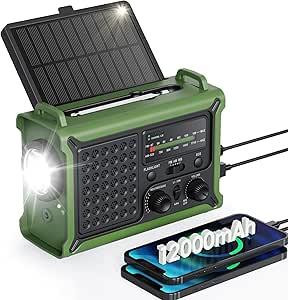 | Best for Emergency Lighting | Battery capacity: 12,000mAh | Radio bands: AM/FM/7 NOAA bands | Charging methods: USB-C, solar panel, hand crank, built-in battery, AAA batteries | VIEW ON AMAZON | See Our Full Breakdown |
| Emergency Radio with Hand Crank, Solar Charging, NOAA Weather Band, AM/FM, and 12,000mAh Battery |  | Best for Loud Emergency Signaling | Battery capacity: 12,000mAh | Radio bands: NOAA weather, AM/FM | Charging methods: Solar, hand crank, USB-C | VIEW ON AMAZON | See Our Full Breakdown |
| weather alert radio with solar charging | Radio bands | Battery capacity | Water resistance | Power sources |
|---|---|---|---|---|
| Raynic Emergency Weather Radio | AM, FM, SW, NOAA | 5,000 mAh / 18,500 mWh | IPX3 | — |
| Solar Emergency Radio with Han | NOAA, AM, FM | 12,000 mAh | Described as water resistant; rating not specified | Solar, hand crank, USB-C, AAA batteries |
| Emgykit Hand Crank Radio with | AM, FM, NOAA | 2,000 mAh / 7,400 mWh | — | Hand crank, solar panel, USB Type-C |
| FosPower A1 NOAA Emergency Wea | AM, FM, WB | — | Water resistant | Solar, hand crank, AAA batteries |
| NOAA Weather Radio with S.A.M. | NOAA weather band and FM; no AM | 12,000 mAh | — | — |
| Leaton Hand Crank Emergency Ra | AM 520–1710kHz; FM 87–108MHz; NOAA 162.400–162.550MHz | 10,000mAh | IPX6 | — |
| Mesqool Emergency Weather Radi | NOAA, FM, AM | 12,000mAh lithium battery | — | Solar panel, hand crank, USB-C input, 3 AAA batteries |
| Portable NOAA Weather Radio wi | NOAA, FM, AM | 12,000mAh | Water resistant; rating not specified | Solar panel, hand crank, USB-C input, 3 included AAA batteries |
| Emergency Weather Radio with S | AM/FM/7 NOAA bands | 12,000mAh | IPX6 | — |
| Emergency Radio with Hand Cran | NOAA weather, AM/FM | 12,000mAh | IPX6 | — |
More Details on Our Top Picks
Raynic Emergency Weather Radio with Solar and Hand Crank Charging
The Raynic earns my Best Overall spot by combining solar and hand-crank charging with more everyday listening options than the simpler emergency models here. Its AM, FM, SW, and NOAA bands give it broader radio access than the Emgykit, which lacks shortwave, while the 5,000 mAh battery offers more reserve than the compact Emgykit and FosPower A1. A USB output, flashlight, reading lamp, SOS alarm, and headphone jack make it useful as a small household outage station rather than only a weather receiver.
The tradeoff is that its battery is smaller than the 12,000 mAh options, including Product 2, so I would not choose it for repeated phone charging. It also accepts three AAA batteries, but those are not included, and its IPX3 rating is only suited to light splashes—not sustained wet conditions.
Pros:- Six listed power routes include solar, hand crank, USB, AC adapter, rechargeable battery, and optional AAA batteries.
- AM, FM, shortwave, and NOAA reception cover more broadcast types than the Emgykit or FosPower A1.
- Built-in flashlight, reading lamp, SOS alarm, and USB device output support several outage tasks.
- Headphone jack allows private listening, while the LCD makes tuning and status checks easier.
Cons:- The 5,000 mAh battery has less reserve than the 12,000 mAh models in this roundup.
- Three AAA batteries are not included, and IPX3 protection does not suit heavy exposure to water.
Best for: Households wanting one portable radio for NOAA alerts, varied broadcast bands, lighting, and occasional phone backup.
Not ideal for: Campers who need the longest phone-charging reserve or anyone expecting the radio to withstand heavy rain or immersion.
- Battery capacity:5,000 mAh / 18,500 mWh
- Radio bands:AM, FM, SW, NOAA
- Charging options:Rechargeable battery, AC adapter, USB, hand crank, solar panel, or 3 AAA batteries (not included)
- Display:LCD
- Lighting:3 W flashlight and 2.5 W reading lamp
- Connectivity:USB Type-C and 3.5 mm headphone jack
- Water resistance:IPX3
- Size and weight:6.8 × 3.7 × 2.9 in; 1.2 lb
Our verdict“Choose the Raynic for a well-rounded home emergency radio with broad band coverage, but pick a 12,000 mAh model if phone charging is a priority.”
Solar Emergency Radio with Hand Crank, 12000mAh Battery, NOAA/AM/FM, LED Flashlight & Phone Charger
I’d pick this model when solar charging and phone backup matter more than extra radio bands or specialized alert settings. Its listed 12,000 mAh battery is substantially larger than the Raynic’s 5,000 mAh reserve and the 2,000 mAh batteries in the Emgykit and FosPower A1. The 8,500 mm² solar panel is also a standout in this group, giving the radio a larger stated collection area for replenishing power when USB charging is unavailable. It covers NOAA, AM, and FM, with a flashlight and reading lamp for basic outage use.
That capacity comes with a 1.6-pound body, heavier than the Raynic and far heavier than the pocket-size Emgykit. Its water protection is described only as resistant, with no rating supplied, and a depleted battery still calls for patience with the crank or solar panel. Unlike the county-specific NOAA model, it does not list S.A.M.E. alerts.
Pros:- 12,000 mAh battery provides more device-charging reserve than the Raynic, Emgykit, or FosPower A1.
- Large listed 8,500 mm² solar panel supports solar replenishment during extended time away from an outlet.
- Includes NOAA, AM, and FM reception, plus a flashlight and reading lamp.
- USB-C input and hand-crank charging offer alternatives when the battery needs replenishing.
Cons:- At 1.6 pounds, it is less convenient to carry than the 0.51-pound Emgykit.
- Water resistance is not specified with a rating, so the protection level is hard to judge.
- If the battery is depleted, solar and manual cranking may be needed before its power-bank function is useful.
Best for: Campers and outage-prepared households seeking a large battery, a relatively large solar panel, and emergency phone charging.
Not ideal for: Buyers who need a verified waterproof rating, county-specific S.A.M.E. alerts, or a light pocket radio.
- Battery capacity:12,000 mAh
- Radio bands:NOAA, AM, FM
- Solar panel area:8,500 mm²
- Power sources:Solar, hand crank, USB-C, AAA batteries
- Connectivity:USB Type-C
- Water resistance:Described as water resistant; rating not specified
- Flashlight range:Up to 260 ft
- Size and weight:6.8 × 4.7 × 2.9 in; 1.6 lb
Our verdict“Choose this model for its large battery and solar panel if charging devices is a priority and its unspecified water protection is acceptable.”
Emgykit Hand Crank Radio with AM/FM/NOAA Weather Band for Emergencies
The Emgykit is the easiest choice here to tuck into a small go-bag: at 0.51 lb and roughly five inches long, it is markedly more portable than the 1.2-pound Raynic or 1.6-pound Product 2. It still adds solar, hand-crank, and USB-C charging, NOAA reception, a 140-lumen flashlight, and an 80 dB SOS alarm. That combination makes it a useful backup when carrying space matters more than running a full household radio station.
The compact size brings a clear limit: its 2,000 mAh battery is modest compared with the 12,000 mAh models, so phone charging is best treated as emergency reserve, not a regular power source. Its AM/FM/NOAA coverage also lacks the Raynic’s shortwave band, and the product data warns that the flashlight may not light a large area. I’d skip it as a primary device-charging hub.
Pros:- At 0.51 lb, it is much easier to carry than the Raynic or Product 2.
- Solar, hand-crank, and USB-C charging provide several ways to replenish its battery.
- 140-lumen three-LED flashlight and 80 dB SOS alarm add useful signaling and close-range lighting.
- NOAA, AM, and FM reception covers the core broadcast bands for emergency updates.
Cons:- The 2,000 mAh battery offers far less phone-charging reserve than the 12,000 mAh options.
- No shortwave band is listed, unlike the Raynic.
- The flashlight may not illuminate larger spaces, limiting its role as room lighting.
Best for: Hikers, drivers, and emergency-kit builders who want a light solar-and-crank NOAA radio with basic signaling and lighting.
Not ideal for: Households needing extended radio runtime, substantial phone charging, or broad-area illumination during a long outage.
- Battery capacity:2,000 mAh / 7,400 mWh
- Radio bands:AM, FM, NOAA
- Power sources:Hand crank, solar panel, USB Type-C
- Flashlight:Three LEDs; 140 lumens
- SOS alarm:80 dB
- Material and color:Plastic; red
- Dimensions:5.16 × 2.09 × 2.6 in
- Weight:0.51 lb
Our verdict“Choose the Emgykit when low weight and packability outrank battery capacity and whole-room lighting.”
FosPower A1 NOAA Emergency Weather Radio with Solar and Hand Crank, Orange
The FosPower A1 makes sense as a lightweight, straightforward backup for someone who wants NOAA, AM/FM, basic lighting, and more than one way to power a radio. At 310 g, it is lighter than the Raynic and Product 2, though not as compact in weight as the Emgykit. Its solar, hand-crank, and AAA battery options are useful when a rechargeable battery is unavailable, while the reading light, flashlight, and SOS alarm cover basic emergency tasks.
Its main limitation is the 2,000 mAh power bank, which is modest beside Product 2’s 12,000 mAh capacity and the other high-capacity options. It requires four AAA batteries for that power route, and those are not listed as included. I’d choose the Raynic instead for more radio bands and a headphone jack, or the Emgykit for a lighter design and USB-C charging.
Pros:- Solar, hand-crank, and AAA power options provide backup choices during outages.
- Receives NOAA weather broadcasts and AM/FM stations.
- Includes a flashlight, four-LED reading light, and SOS alarm.
- At 310 g, it is lighter than the Raynic and Product 2.
Cons:- The 2,000 mAh power bank is much smaller than the 12,000 mAh capacity in Product 2.
- Battery operation requires four AAA batteries, which are not identified as included.
- The listed power sources do not include USB-C charging, and it lacks the Raynic’s shortwave band.
Best for: Preparedness kit owners who want a simple, relatively light NOAA radio with solar and crank backup, plus optional AAA power.
Not ideal for: Users who expect frequent phone charging, need USB-C charging, or want shortwave reception.
- Model:FOSPWB-2376
- Radio bands:AM, FM, WB
- Power sources:Solar, hand crank, AAA batteries
- Power bank capacity:2,000 mAh / 7,400 mWh
- Lighting:1 W flashlight and four-LED reading light
- Water resistance:Water resistant
- Dimensions:6.2 × 2.1 × 2.9 in
- Weight:310 g
Our verdict“Choose the FosPower A1 as a light, basic NOAA backup if you do not need USB-C charging or a large phone-charging reserve.”
NOAA Weather Radio with S.A.M.E. County Alerts, 12,000mAh Battery, Hand Crank and Solar Power
This is the clearest pick for buyers who want alerts tailored to their area rather than a general weather-band receiver. Its S.A.M.E. system supports up to 25 counties and 86 alert events, with voice, display, and tone modes; the 2.4-inch color screen also gives alerts more room than the Raynic’s LCD. A 12,000 mAh battery, solar panel, hand crank, USB-C input, and AAA option make it better suited to a fixed home preparedness station than the pocket-size Emgykit.
The key compromise is that it receives NOAA and FM, but not AM, unlike the Raynic and Product 2. It is also the heaviest of these five at 1.7 pounds, and its hand-crank output is listed at up to 650 mA. I’d favor it for alert targeting, not for maximum radio-band coverage or frequent carrying.
Pros:- S.A.M.E. alerts can target up to 25 counties and 86 alert events.
- Voice, display, and tone alert modes provide different ways to receive warnings.
- 12,000 mAh battery, solar, hand crank, USB-C input, and AAA batteries support several power plans.
- USB-A and USB-C outputs, emergency lights, and a siren add utility during outages.
Cons:- AM radio is not supported, unlike the Raynic and Product 2.
- At 1.7 pounds, it is heavier than the other four radios in this batch.
- The listed hand-crank output is up to 650 mA, which may make manual replenishment slow.
Best for: Households in areas with varied local warning zones that want S.A.M.E. county alerts, a visible display, and multiple backup power options.
Not ideal for: Listeners who need AM reception or a lighter radio for frequent hiking, travel, or everyday carry.
- Alert system:S.A.M.E. alerts for up to 25 counties and 86 alert events
- Alert modes:Voice, display, and tone
- Radio bands:NOAA weather band and FM; no AM
- Battery capacity:12,000 mAh
- Power options:Solar panel, hand crank, USB-C input, rechargeable battery, and 3 AAA batteries
- Display:2.4-inch color display
- Charging outputs:USB-A and USB-C
- Size and weight:6.8 × 2.9 × 4.7 in; 1.7 lb
Our verdict“Choose this radio for county-specific warning control and a large battery, but look elsewhere if AM reception or portability matters more.”
Leaton Hand Crank Emergency Radio with NOAA, AM/FM, and 10,000mAh Battery
The Leaton makes the most sense when a small emergency kit matters more than hands-off weather monitoring. Its solar, hand-crank, and USB-C charging give it several ways to stay powered, while the flashlight, reading lamp, compass, and USB phone output make it a useful all-in-one for a short outage or campsite. Compared with the larger 12,000mAh Mesqool, it has a lower stated battery capacity but weighs less and takes up less room.
The key tradeoff is alerting: NOAA stations must be tuned manually, so this is not a radio that will wake you for a warning. Its IPX6 rating covers splashes and spray, not immersion or heavy rain, and the 5V/1A phone output is limited. I’d choose it for compact, flexible backup power, but pick an automatic-alert model if unattended warnings are the priority.
Pros:- Solar, hand-crank, and USB-C power options provide alternatives during an outage.
- Compact 1.1-pound build is easier to pack than the larger 12,000mAh options.
- Flashlight, reading lamp, compass, and USB phone output add practical emergency functions.
- Large controls are designed to be easier to operate.
Cons:- NOAA reception requires manual tuning; automatic and location-based alerts are absent.
- The 5V/1A phone output is limited, and crank-powered runtime can vary.
- IPX6 protection is for splashes and spray, not heavy rain or immersion.
Best for: Campers and apartment residents building a compact kit who want solar and crank charging plus basic lighting and manual NOAA listening.
Not ideal for: People who need automatic weather alerts, stronger phone-charging output, or a radio for exposure to heavy rain or immersion.
- Battery capacity:10,000mAh
- Radio bands:AM 520–1710kHz; FM 87–108MHz; NOAA 162.400–162.550MHz
- Charging methods:USB-C, solar, hand crank
- USB output:5V/1A
- NOAA alerts:Manual tuning; no automatic or location-based alerts
- Water resistance:IPX6
- Dimensions:6.3 x 3.5 x 3.1 in
- Weight:1.1 lbs (500g)
Our verdict“Choose the Leaton when compact size and several backup power methods matter more than automatic NOAA alerts or higher-capacity charging.”
Mesqool Emergency Weather Radio with NOAA Alerts and 12,000mAh Battery
The Mesqool is a flexible choice for buyers who want several ways to keep a radio running when outlets are unavailable. Its 12,000mAh battery is backed by solar, hand crank, USB-C, and three AAA batteries, so it offers more fallback power choices than the simpler Leaton. A flashlight, reading lamp, SOS alarm, and phone-charging function broaden its role beyond receiving NOAA, AM, and FM broadcasts.
That flexibility comes with a setup step: the maker recommends a full charge before first use, so it is not ready to rely on straight out of the box. The listing also does not specify NOAA alert behavior, water resistance, or phone-output details, which leaves less certainty than products with those specifications stated. I’d favor it over the Leaton for power-source variety, but not for buyers who need clearly documented weather-alert or weatherproofing performance.
Pros:- Solar, hand-crank, USB-C, rechargeable-battery, and AAA power options provide several fallback routes.
- 12,000mAh battery capacity exceeds the Leaton’s stated 10,000mAh.
- Includes a flashlight, reading lamp, SOS alarm, and USB phone-charging function.
- Receives NOAA, AM, and FM broadcasts.
Cons:- The manufacturer recommends fully charging the radio before first use.
- The provided specifications do not state whether NOAA alerts activate automatically.
- Water resistance and USB output details are not specified.
Best for: Households and campers who want multiple backup power choices, including replaceable AAA batteries, alongside lighting and emergency phone charging.
Not ideal for: Buyers who need documented automatic NOAA alert behavior or a stated water-resistance rating for wet outdoor use.
- Battery capacity:12,000mAh lithium battery
- Radio bands:NOAA, FM, AM
- Power sources:Solar panel, hand crank, USB-C input, 3 AAA batteries
- USB-C input:5V/2A
- Lighting:LED flashlight and reading lamp, each with two brightness levels
- Flashlight range:Up to 260 feet
- Speaker output:5 watts
- Dimensions:6.8 x 2.9 x 4.7 inches
Our verdict“Pick the Mesqool if broad backup-power flexibility matters more than clearly documented alert and weather-resistance details.”
Portable NOAA Weather Radio with AM/FM, Solar and Hand Crank Charging, 12,000mAh Battery
This yellow portable radio is a sensible fit for a campsite or go-bag where solar, crank, USB-C, and AAA power offer useful backups. It matches the Mesqool’s 12,000mAh stated capacity and adds three included AAA batteries, a flashlight, reading lamp, and SOS alarm. The listing also calls it water resistant, giving it a stated outdoor-use advantage over the Mesqool, whose supplied specifications do not list a water-resistance rating.
Those claims have limits: the degree of water protection is not quantified, and the source does not verify charging claims or battery runtime. NOAA band reception is listed, but automatic alert behavior is not specified, so I would not assume it will wake you for warnings. The Leaton, by contrast, explicitly requires manual NOAA tuning and is lighter; this model makes more sense when added power options and a water-resistant description outweigh a fully documented alert setup.
Pros:- Solar, hand crank, USB-C, built-in battery, and three included AAA batteries provide varied power options.
- Includes a flashlight, reading lamp, and SOS alarm.
- Water-resistant construction is stated for outdoor use.
- Listed flashlight range reaches up to 260 feet.
Cons:- The water-resistance level is not specified, so protection in sustained wet weather is unclear.
- Battery runtime and charging claims are not independently verified in the supplied product information.
- Automatic NOAA alert behavior is not stated.
Best for: Campers and outdoor kit builders who want a 12,000mAh radio with several power options, included AAA batteries, lighting, and a stated water-resistant design.
Not ideal for: Buyers who need a defined water-resistance rating, verified runtime figures, or confirmation of automatic NOAA alerts.
- Battery capacity:12,000mAh
- Radio bands:NOAA, FM, AM
- Power sources:Solar panel, hand crank, USB-C input, 3 included AAA batteries
- Solar panel area:8,500mm²
- Lighting:Flashlight and reading lamp, two brightness levels
- Flashlight range:Up to 260 feet
- Water resistance:Water resistant; rating not specified
- Dimensions:6.8 x 2.9 x 4.7 inches
Our verdict“Choose this model for campsite-friendly power flexibility and stated water resistance, but not if you need clearly specified alerting or wet-weather limits.”
Emergency Weather Radio with Solar Panel and 12,000 mAh Battery
The army-green radio stands out for combining a five-watt adjustable-beam flashlight with a 12-LED reading lamp, while retaining solar, crank, USB-C, built-in battery, and AAA power options. That makes it a lighting-forward alternative to the Leaton, whose smaller body is easier to pack but has a lower stated battery capacity and a more limited 5V/1A phone output. This model also lists seven NOAA bands and says it receives NOAA alerts.
The key uncertainty is how those alerts work: the description does not say whether they activate automatically or require tuning. It also gives no runtime or charging-time figures, making it harder to plan around the battery than the listed capacity alone suggests. The IPX6 claim is useful for splash exposure, but the product data does not spell out operating limits. I’d choose it for its lighting and multi-source power, not as a confirmed automatic warning system.
Pros:- Five power options include solar, hand crank, USB-C, built-in battery, and AAA batteries.
- Five-watt adjustable-beam flashlight and 12-LED reading lamp suit different lighting needs.
- Receives AM/FM and seven NOAA bands.
- Includes an SOS alarm and phone-charging function.
Cons:- NOAA alert behavior is not described as automatic or manual.
- Runtime and charging times are not specified.
- The IPX6 claim is not accompanied by detailed exposure guidance.
Best for: Emergency-kit owners who prioritize a strong adjustable flashlight, a broad reading lamp, and several backup power sources.
Not ideal for: People who need confirmed automatic NOAA alerts, published runtime estimates, or detailed guidance on water exposure.
- Battery capacity:12,000mAh
- Radio bands:AM/FM/7 NOAA bands
- Charging methods:USB-C, solar panel, hand crank, built-in battery, AAA batteries
- Solar panel:8500 mm² monocrystalline
- Flashlight:5 W adjustable-beam
- Reading lamp:12 LEDs
- Water resistance:IPX6
- Material and color:ABS; army green
Our verdict“Choose this radio when lighting versatility and backup power matter most, but seek clearer alert details if warning notification is your main reason to buy.”
Emergency Radio with Hand Crank, Solar Charging, NOAA Weather Band, AM/FM, and 12,000mAh Battery
Among these five, this model is the clearest pick for buyers who value a prominent distress signal: its 120dB SOS alarm is paired with a 5W flashlight, 12-LED reading lamp, and USB phone charging. Solar, hand-crank, and USB-C charging support the same core backup-power approach as the Leaton, but this radio lists a larger 12,000mAh battery and a broader set of lighting and signaling specifications. Its IPX6 rating also gives a defined splash-resistance claim.
That feature set does not make it a hands-off alert receiver. NOAA broadcasts require the radio to be powered on and tuned to a NOAA station, so it differs from a true automatic-alert setup. At 1.6 pounds, it is also heavier than the Leaton’s 1.1-pound body, and solar charging still depends on sunlight. I’d favor it for signaling and outage lighting, while choosing the Leaton for a lighter pack.
Pros:- 120dB SOS alarm provides a clearly specified emergency signaling feature.
- Solar, hand-crank, and USB-C charging support backup power.
- 5W flashlight, 12-LED reading lamp, and USB phone charging add outage utility.
- IPX6 water resistance is specified.
Cons:- NOAA broadcasts require the radio to be on and manually tuned to a weather station.
- At 1.6 pounds, it is heavier than the compact Leaton.
- Solar charging depends on available sunlight.
Best for: Households and outdoor users who want a loud SOS signal, substantial lighting, and phone backup from a solar- and crank-capable radio.
Not ideal for: Hikers prioritizing minimum weight or people who need NOAA warnings to trigger automatically while the radio is unattended.
- Battery capacity:12,000mAh
- Radio bands:NOAA weather, AM/FM
- Charging methods:Solar, hand crank, USB-C
- Flashlight:5W LED
- Reading lamp:12 LEDs
- SOS alarm:120dB
- Water resistance:IPX6
- Dimensions and weight:6.81 x 2.91 x 4.76 inches; 1.6 pounds
Our verdict“Pick this model for a defined loud SOS alarm and strong lighting package, but choose a lighter or automatic-alert radio for those priorities.”

How We Picked
I ranked these radios around the job implied by the search: receiving weather information and retaining basic usefulness when routine power is unavailable. I gave weight to named alert capabilities, especially whether a listing identifies S.A.M.E. county alerts; stated battery capacity; and clearly described charging methods such as solar and hand crank. I also considered whether the product name gives buyers enough information to distinguish it from lookalike radios, and whether its stated features suit a defined use case.
The S.A.M.E.-equipped 12,000mAh model leads because its named alert-filtering feature offers a meaningful advantage for buyers who want local warnings. FosPower A1 and Raynic follow as recognizable solar-and-crank options, while models with stated 10,000–12,000mAh batteries remain useful alternatives but provide less differentiation in the supplied product information. This is a feature-based comparison, not a claim of hands-on testing: buyers should confirm alert functions, charging specifications, included accessories, and operating instructions on the current listing before choosing.
| weather alert radio with solar charging | Water resistance | Power sources |
|---|---|---|
| Raynic Emergency Weather Radio | IPX3 | — |
| Solar Emergency Radio with Han | Described as water resistant; rating not specified | Solar, hand crank, USB-C, AAA batteries |
| Emgykit Hand Crank Radio with | — | Hand crank, solar panel, USB Type-C |
| FosPower A1 NOAA Emergency Wea | Water resistant | Solar, hand crank, AAA batteries |
| NOAA Weather Radio with S.A.M. | — | — |
| Leaton Hand Crank Emergency Ra | IPX6 | — |
| Mesqool Emergency Weather Radi | — | Solar panel, hand crank, USB-C input, 3 AAA batteries |
| Portable NOAA Weather Radio wi | Water resistant; rating not specified | Solar panel, hand crank, USB-C input, 3 included AAA batteries |
| Emergency Weather Radio with S | IPX6 | — |
| Emergency Radio with Hand Cran | IPX6 | — |
Factors to Consider When Choosing Weather Alert Radio With Solar Charging
Choosing a radio for emergency use takes more than comparing battery numbers. I would match alert behavior and power options to the way the radio will be stored and used, then check the details that product titles often leave out.
Decide Whether You Need County-Specific Alerts
NOAA weather-band reception and automatic alerts are not interchangeable features. If you want warnings to reach you while the radio is unattended, check whether the model supports alert standby and how alerts are enabled. S.A.M.E. county coding can narrow alerts to selected areas, which may reduce irrelevant warnings for people near county boundaries or in shared households. Do not assume a radio has S.A.M.E. just because its title says NOAA. Confirm how many counties can be programmed and whether setup instructions are clear. A basic radio may suit someone who plans to tune in manually, while alert filtering matters more for overnight or unattended monitoring.
Treat Solar and Hand-Crank Charging as Contingencies
A small built-in panel is useful when a radio can sit in daylight, but it may not replenish a large battery quickly. Hand cranking can provide emergency power when sunlight is unavailable, though it requires time and effort and may be better for short-term listening or light use. Keep the battery charged before severe weather rather than relying on either method to restore a depleted unit on demand. Check whether the radio can also charge from a wall outlet or USB, and what cable or adapter is needed. A common mistake is choosing by the number of charging methods without checking how each method works. For a home emergency kit, routine electrical charging plus solar or crank backup is usually a more practical plan than relying on sunlight alone.
Read Battery Capacity as a Comparison Point, Not a Runtime Promise
Capacity figures such as 10,000mAh and 12,000mAh provide a useful starting point, but they do not tell you how long the radio will run in your chosen mode. Display use, flashlight use, signal conditions, and phone charging can all draw on stored energy. A radio that doubles as a phone charger shares its reserve with the device you may need for calls or maps. Decide whether you want the radio to preserve power for alerts and broadcasts or to serve as a general charging bank. Look for clear information about battery type, charging input, and whether the battery is replaceable. If those details are absent, avoid treating a higher listed capacity as proof of longer practical operation.
Check Reception and Alert Setup for Your Location
Weather-band coverage depends on where you live, nearby terrain, building materials, and the reach of the broadcast signal. A radio can list NOAA reception and still struggle in a basement, a remote valley, or a heavily shielded room. Plan where the radio will sit and check whether it has an external antenna or guidance for improving reception. Before an emergency, tune it to local weather broadcasts and test alert settings rather than waiting for a warning. If you travel, find out whether county settings can be changed easily. Buyers who need one radio for home and road trips should favor simple controls and a setup process they can repeat.
Choose Emergency Extras You Will Actually Use
Flashlights, phone charging, and AM/FM reception can make a radio more useful during outages, but each extra can add controls and compete for battery power. A built-in light may help during a brief power cut, while a separate headlamp can be easier to use hands-free. Prioritize dependable radio and alert functions before adding features that sound helpful but may sit unused. Check whether the light has a steady mode or only a flashing signal, and whether charging a phone is described as an emergency function rather than a full replacement for a power bank. Keep cables and any needed adapters with the radio. Simpler controls may be a better choice for a household member who needs to operate the device under stress.
Match the Radio to Its Storage and Maintenance Plan
An emergency radio that stays in a kit for months needs periodic attention: charge its battery, check the tuning and alert setup, and inspect the charging port and cables. Set a recurring check-in date so the radio is not discovered depleted during an outage. Store it where the solar panel can receive light when practical, but do not leave it in damaging heat or direct sun for extended periods without checking the manufacturer’s guidance. A model with several charging options is more adaptable, yet it can also mean more parts and settings to keep track of. For a grab-and-go kit, size, controls, and a clear charging routine may matter more than adding every possible feature.
Frequently Asked Questions
Is a solar-charging weather radio enough to keep itself powered during a long outage?
Usually, solar charging should be treated as a way to supplement a charged battery, not as a guarantee of continuous operation. Small panels can recharge slowly, and cloudy weather or indoor placement limits what they can collect. A hand crank gives you another backup, but it takes effort and may only provide enough energy for limited use. Charge the radio before storing it and check how its manual describes solar and crank charging. If you need dependable long-duration power, include another charging source in your emergency plan.
Should I choose S.A.M.E. alerts or a radio that just receives NOAA weather broadcasts?
Choose S.A.M.E. if you want to program the radio for alerts tied to specific counties and leave it in alert standby. That feature can be useful when nearby areas receive warnings that do not apply to your location. A radio without named S.A.M.E. support may still receive NOAA broadcasts, but you may need to tune in or manage alerts differently. Check the exact alert modes and setup steps rather than relying on a product title. If you travel often, confirm that changing locations and county codes is manageable.
Can I rely on a 12,000mAh radio to charge my phone during an emergency?
It can provide a backup charge if the model supports phone output, but the capacity printed in a title does not tell you how much usable energy reaches a phone. Conversion losses, the phone’s battery size, and radio use all affect what remains. Phone charging can also reduce the reserve available for radio operation and alerts. Check the stated output and included cable details before treating it as a power bank. For essential communication, keep a separate charged battery pack if you can.
What should I check before trusting a weather radio for overnight alerts?
Confirm that the radio has an alert standby mode and can remain plugged in or otherwise powered while monitoring. Test the alert setup and reception in the room where you plan to keep it, since walls and location can affect signal strength. If you need warnings for your county, verify S.A.M.E. support and enter the correct code. Review how the radio signals an alert, including whether it uses sound, lights, or both. A brief test before severe weather can reveal setup problems while there is still time to correct them.
Which matters more for emergency use: a larger battery or more charging methods?
Neither feature is enough on its own; the better balance depends on how you will use the radio. A larger stated battery may offer more reserve, but the figure does not establish runtime or phone-charging performance. Multiple charging methods help when one source is unavailable, yet solar and hand-crank charging can be slow or effort-intensive. For a home kit, I would prioritize a charged battery, clear alert features, and a practical way to recharge from household power before an outage. For a remote kit, solar and crank backups may carry more weight, along with a routine for checking charge and reception.
Conclusion
For most buyers, I would start with the NOAA Weather Radio with S.A.M.E. County Alerts as the best overall option because county-specific alert support is the clearest advantage in this lineup. The best value in features is the FosPower A1: its named solar and hand-crank charging make its emergency-power setup easy to understand, though buyers should verify battery details and alert functions. For a best premium-style feature set, the S.A.M.E. model is also the strongest choice here; the supplied options do not establish a separate premium build or performance tier. The best choice for beginners is the FosPower A1 if a clearly described solar-and-crank setup is the priority, while a buyer who mainly wants a simple backup broadcast source should compare the Emgykit and other basic AM/FM/NOAA models by controls and alert modes. For specific needs, choose Raynic if you want a named solar-and-crank combination, Leaton if its stated 10,000mAh capacity meets your plan, or a 12,000mAh model only after confirming its alert and charging details. Whichever radio you select, test reception and alerts and keep its battery charged before you need it.
Halloween Picks
halloween
As an affiliate, we earn on qualifying purchases.