
Audio codecs like AAC, FLAC, and Opus help you compress and decompress digital audio for storage and streaming. AAC offers a good balance between sound quality and file size, making it popular for music and streaming services. FLAC preserves every detail of your original sound, perfect for archiving or high-resolution files. Opus is optimized for real-time use like voice calls, adjusting bitrate based on network conditions. Keep exploring to discover how each codec can fit your needs.
Key Takeaways
- AAC balances compression efficiency with sound quality, making it popular for streaming and digital broadcasts.
- FLAC offers lossless compression, preserving original audio fidelity but resulting in larger file sizes.
- Opus is optimized for real-time applications, dynamically adjusting bitrate for low latency and consistent quality.
- Lossless codecs like FLAC maintain all original sound details, while lossy codecs like AAC and Opus reduce data for smaller files.
- Choice of codec depends on whether priority is high audio quality or efficient storage and transmission.
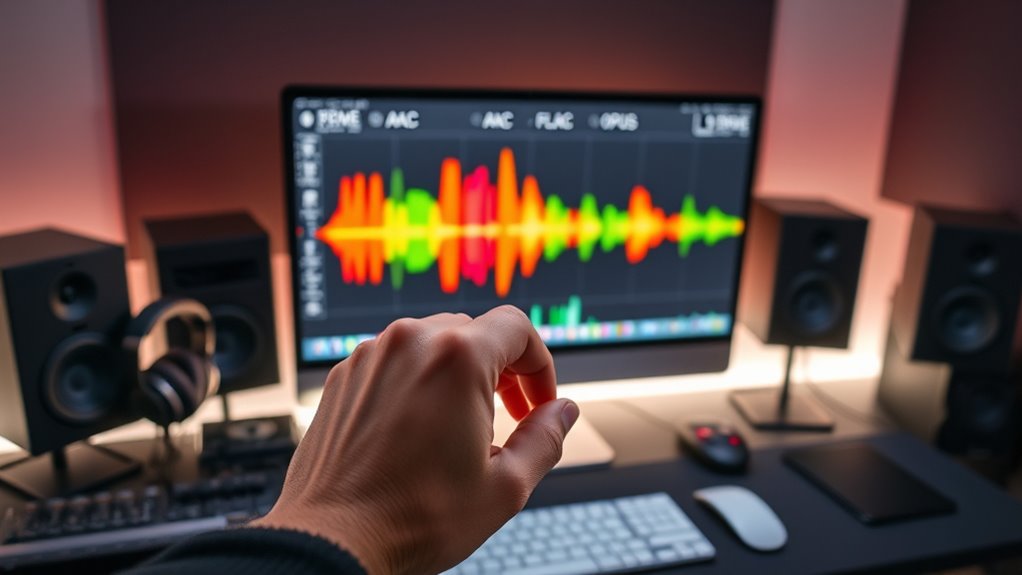
Audio codecs are essential tools that compress and decompress digital sound files, allowing you to store and transmit high-quality audio efficiently. When choosing a codec, understanding how it manages bitrate optimization is crucial. Different codecs balance audio quality and file size through various methods, with some focusing on reducing data without losing any sound details—known as lossless compression—while others prioritize smaller files at the expense of some quality. This balance determines how well your audio retains fidelity after compression, especially important when you want pristine sound or need to save storage space.
Take AAC, for example. It’s a popular codec used in streaming services and digital broadcasts because it offers a good compromise between compression efficiency and sound quality. AAC employs advanced bitrate optimization techniques to adapt to different network conditions and device capabilities, ensuring smooth playback without sacrificing too much audio fidelity. Though it uses lossy compression, AAC’s algorithms are designed to preserve clarity and detail, making it a reliable choice for music streaming, podcasts, and online content where bandwidth matters but quality still counts. Bitrate optimization is a key feature that helps AAC deliver consistent performance across various scenarios.
On the other hand, FLAC stands out for its focus on lossless compression. If you’re an audiophile or someone who values the original sound exactly as it was recorded, FLAC is your go-to codec. It compresses audio files without losing any data, so your music remains pure and true to the original recording. This lossless approach means files are larger compared to lossy codecs like AAC or MP3, but the trade-off is audio fidelity that’s indistinguishable from the source. FLAC’s efficiency in lossless compression makes it ideal for archiving music libraries or enjoying high-resolution audio without quality degradation.
Opus represents a different approach. It’s designed for real-time applications like voice calls and streaming, where low latency and adaptability are essential. Opus dynamically adjusts its bitrate based on network conditions, ensuring consistent quality without interruption. It supports both lossy compression and some level of lossless operation, but it’s mainly optimized for speech and interactive media. Its ability to optimize bitrate on the fly helps maintain intelligibility and clarity, even under challenging network scenarios.
high resolution FLAC music player
As an affiliate, we earn on qualifying purchases.
As an affiliate, we earn on qualifying purchases.
Frequently Asked Questions
How Do Audio Codecs Impact Streaming Quality and Data Usage?
Audio codecs directly impact your streaming quality and data usage through bitrate optimization and compression efficiency. When a codec offers higher compression efficiency, it reduces data consumption while maintaining sound quality, helping you save on bandwidth. Conversely, lower efficiency may require higher bitrates, increasing data use but potentially improving quality. Choosing the right codec balances these factors, ensuring smooth streaming without sacrificing audio clarity or draining your data plan.
Are There Legal Restrictions on Using Certain Audio Codecs?
You might think you’re free to use any audio codec you want, but legal restrictions and licensing issues can catch you off guard. Some codecs, like AAC and Opus, require licensing fees, meaning you need permissions to distribute or embed them legally. Ignoring these restrictions could lead to legal trouble or licensing disputes. Stay informed about the specific codec’s licensing terms to avoid unintended violations and protect your content.
Which Codecs Are Best for High-Resolution Audio Playback?
For high-resolution audio playback, you should choose codecs that offer lossless compression and broad codec compatibility. FLAC is ideal because it preserves audio quality without compression loss and is widely supported across devices. ALAC is another great lossless option, especially for Apple users. While codecs like AAC and Opus excel in compressed formats, they aren’t typically used for pure high-res playback due to lossy compression.
How Do Hardware Devices Support Different Audio Codecs?
Did you know that over 90% of smartphones support multiple audio codecs? Hardware devices support different codecs through integrated decoding chips or software, ensuring broad device compatibility. However, licensing restrictions can limit support for certain codecs like AAC and Opus, affecting what formats you can play. To get the best experience, check your device’s specifications to see which codecs it natively supports, ensuring seamless playback across your audio library.
Can I Convert Between Codecs Without Losing Quality?
Yes, you can convert between codecs without sacrificing quality if you use lossless compression formats like FLAC. To uphold codec compatibility, choose a high-quality converter that preserves the original audio data. However, converting between lossy codecs like AAC and Opus may result in some quality loss, so always opt for lossless options whenever possible. This ensures your audio remains as close to the original as possible.
Conclusion
Now that you’ve glimpsed the world of audio codecs, you’re better equipped to navigate your listening adventures. Whether you favor the charming clarity of AAC, the heartfelt purity of FLAC, or the versatile charm of Opus, each has its unique story to tell. Remember, the perfect choice is like finding a secret melody—subtle yet impactful. Trust your ears, explore freely, and let your sound experience unfold like a well-kept secret waiting to be discovered.