
If you’re looking for the best enterprise core switches for 2026, I recommend considering options like the Cisco Catalyst 9300L with PoE+, the Cisco C9500-16X-A with dual PSUs, the M4300-12X12F managed switch, NETGEAR’s 48-port managed switch, the Edge-Core 5610-52X, T-Plink’s 48-port PoE solution, and the Grandstream GWN7802P. These switches support high scalability, redundancy, security, and flexible deployment environments. Keep exploring to see how each can power and future-proof your network effectively.
Key Takeaways
- Support for high-density 10G/1G stacking and fabric extenders ensures scalable, future-proof network expansion.
- Redundant power supplies and PoE capabilities guarantee high availability and power needs for connected devices.
- Advanced security features like MACsec, TrustSec, and ACLs protect network integrity and data privacy.
- Flexible deployment options with compact, rack-mount or desktop designs suit diverse enterprise environments.
- Robust management protocols and performance monitoring tools enable proactive network oversight and stability.
Cisco Catalyst 9300L 24-Port PoE+ Network Switch
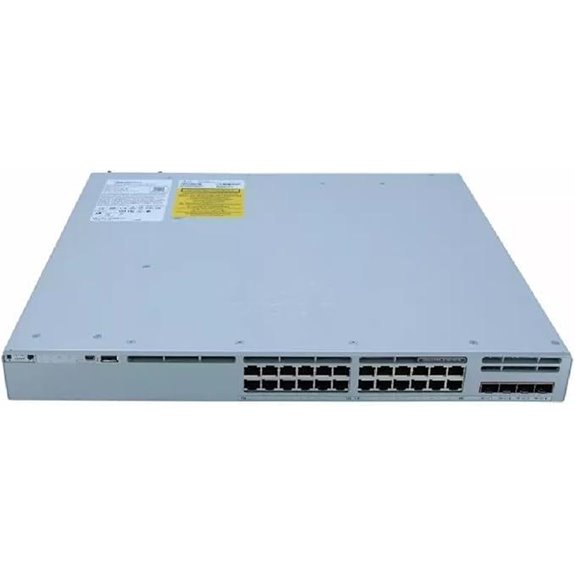
If you’re looking for a reliable switch to power your enterprise or campus network, the Cisco Catalyst 9300L 24-Port PoE+ Network Switch is an excellent choice. It offers 24 Gigabit PoE+ ports with a 740W budget, perfect for powering access points, IP phones, and cameras. With four 10Gbps SFP+ uplinks, it ensures high-speed fiber connectivity. Built on Cisco IOS XE, it supports essential Layer 2 features like VLANs, STP, and QoS, plus advanced security. Designed for scalability and reliability, it supports StackWise Virtual for unified management across up to eight units, making it ideal for diverse deployment needs.
Cisco C9500-16X-A Catalyst 9500 16-Port 10Gig Switch w/ Dual PSU (Renewed)
https://m.media-amazon.com/images/I/31y7qdbR1CL._AC_.jpg
Looking for a reliable core switch that delivers high-speed performance and robust reliability? The Cisco C9500-16X-A Catalyst 9500 offers 16 10Gb SFP+ ports, perfect for enterprise core or aggregation layers. With a switching capacity of up to 480 Gbps, it efficiently handles demanding network traffic and advanced Layer 2/3 services. Its dual hot-swappable power supplies and fans ensure maximum uptime and easy maintenance. Plus, security features like MACsec encryption and Cisco TrustSec, combined with programmable automation via IOS XE, make it a versatile choice for modern networks. This renewed switch provides enterprise-grade performance at a compelling value.
M4300-12X12F Managed Switch 12x10G SFP+ & 12x10G RJ45 – XSM4324S 100NES
https://m.media-amazon.com/images/I/51LWfDwSjoL._AC_SX679_.jpg
Are you searching for a reliable, high-performance switch designed for mid-sized enterprise edge and SMB core networks? The M4300-12X12F Managed Switch, model XSM4324S 100NES, offers 12x10GBASE-T and 12 SFP+ ports, supporting speeds up to 10G. It provides Layer 2, Layer 3, and Layer 4 services, including IPv4 and IPv6 routing, making it versatile for various network needs. Its compact design and high-temperature resilience assure durability in different environments. Released in early 2023, it’s an affordable, easy-to-manage option for expanding networks. Although support details are limited, its performance and features make it a solid choice for modern enterprise networks.
NETGEAR M4300-48X 48-Port Managed Switch
https://m.media-amazon.com/images/I/41BQWRJIlVL._AC_SX679_.jpg
The NETGEAR M4300-48X is an excellent choice for mid-sized enterprises seeking high-performance core switching with flexible, high-speed connectivity. It offers 48x10G Ethernet ports and four SFP+ slots, supporting a variety of high-bandwidth applications like wireless access, IP video, and unified communications. Its stackable design allows mixed stacking of 10G and 1G models, enabling scalable, efficient network architectures. With non-stop forwarding and hitless failover, it ensures reliable operation. Dual modular power supplies add to its robustness, while the Cloud Care’s 3-year SupportPlus warranty guarantees ongoing support. It’s a versatile, future-proof switch for growing networks.
Edge-Core Datacenter 5610-52X-O-AC-F-US: 10G Bare Metal 48 Port Switch
https://m.media-amazon.com/images/I/51w58AbYdiL._AC_SX679_.jpg
If you’re searching for a high-performance switch that seamlessly handles demanding enterprise and cloud data center workloads, the Edge-Core Datacenter 5610-52X-O-AC-F-US stands out with its 48 10 GbE SFP+ ports and 40 GbE uplinks. It supports full line-rate switching at Layer 2 and Layer 3, ensuring fast, reliable network performance. Designed for scalability and availability, it features dual power supplies, an ONIE installer for easy software management, and efficient cooling with port-to-power airflow. Whether deployed as a Top-of-Rack switch or in spine architectures, it’s built to meet the high-performance, scalable needs of modern data centers.
TP-Link 48-Port Gigabit PoE Switch with SFP
https://m.media-amazon.com/images/I/51gyLfdtg6L._AC_SX679_.jpg
Designed for network environments demanding high PoE power and versatile fiber connectivity, the TP-Link 48-Port Gigabit PoE Switch with SFP stands out as an ideal choice for growing enterprises and smart office setups. It offers 48 PoE+ ports supporting up to 384W of total power, perfect for powering cameras, access points, and VoIP devices. The four SFP slots enable flexible fiber connections for extended reach. With advanced Layer 2+ features, IPv6 support, and robust security options like ACL and RADIUS, it guarantees reliable, secure, and scalable network performance. Its efficient design makes it a versatile core switch for dynamic, high-demand environments.
Grandstream GWN7802P Managed Network Switch
https://m.media-amazon.com/images/I/31RTMabZ-CL._AC_SY300_SX300_QL70_FMwebp_.jpg
For small to medium-sized businesses seeking a reliable, managed network switch, the Grandstream GWN7802P stands out with its 16 PoE ports featuring smart power control. It offers 16 Gigabit Ethernet ports, plus 4 SFP ports for fiber connectivity, supporting dynamic PoE/PoE+ allocation per port. Designed for IPv6 and IPv4 networks, it provides secure features like ARP Inspection, IP Source Guard, and DoS protection. Its advanced QoS ensures latency-sensitive traffic such as VoIP and video gets priority. Management options include SNMP, HTTPS, and cloud platforms, making it easy to deploy, monitor, and scale. Overall, it’s a versatile switch built for enterprise needs.
Factors to Consider When Choosing an Enterprise Core Switch

When selecting an enterprise core switch, I consider key factors like port capacity and speed to guarantee it can handle your network traffic efficiently. Security features and scalability options are also vital for protecting your data and supporting future growth. Additionally, I look at power, redundancy, and management capabilities to keep your network reliable and easy to manage.
Port Capacity and Speed
Selecting an enterprise core switch requires careful attention to port capacity and speed to guarantee your network can handle current demands and future growth. You need enough ports to connect all devices without congestion, considering both present and future needs. Prioritize high-speed ports, like 10G or 40G, especially for uplinks and critical data paths, to maximize throughput. Modular port options are valuable, allowing you to expand or upgrade port speeds as your network evolves. Check if the switch supports port aggregation with LACP—this boosts bandwidth and adds redundancy. ultimately, evaluate the total port count against your growth projections. Ensuring sufficient capacity now prevents bottlenecks down the line, enabling seamless scalability and reliable performance as your network expands.
Network Security Features
Security features are a critical consideration when choosing an enterprise core switch, as they directly impact your network’s integrity and resilience. I look for switches that support advanced security measures like Dynamic ARP Inspection and DHCP Snooping to prevent common threats. Layer 3 security capabilities, such as access control lists (ACLs) and MACsec encryption, help protect data traffic at the core layer. Port security and IP source guard are essential to restrict unauthorized devices and prevent IP spoofing attacks. Secure management protocols like SSH and SNMPv3 guarantee safe remote configuration and monitoring. Additionally, integrated threat detection and network segmentation features help isolate sensitive data and identify anomalies, strengthening your overall security posture and reducing potential vulnerabilities.
Scalability Options
As network security features strengthen your core switch, it’s equally important to think about how well it can grow with your organization. Scalability options are vital for future-proofing your network. I look for switches that support stacking or virtual chassis configurations, making it easier to expand capacity without hardware overhaul. High-density ports, like 10G or 25G, are essential to meet increasing bandwidth needs. Modular designs allow adding or upgrading line cards and power supplies, providing flexibility for expansion. I also consider switches with virtual stacking or fabric extenders, enabling seamless integration of additional units. Ultimately, supporting large Layer 2 and Layer 3 routing tables ensures the switch can handle expanding network address spaces efficiently, keeping your network scalable and adaptable as your organization grows.
Power and Redundancy
Power and redundancy are critical factors when choosing an enterprise core switch because they directly impact network availability and reliability. Redundant power supplies guarantee the switch remains operational even if the primary power source fails. Dual PSU configurations allow for hot-swapping without disrupting network services, boosting uptime. Power over Ethernet (PoE) capabilities enable the switch to power connected devices, eliminating the need for extra power sources and simplifying deployment. Energy-efficient hardware and smart fan controls help lower operational costs while maintaining reliable power management. Proper planning around power and redundancy prevents network downtime and guards against hardware failures caused by power issues. Investing in switches with these features ensures your network stays resilient, available, and capable of supporting your organization’s growing demands.
Management Capabilities
When selecting an enterprise core switch, how well it can be managed often determines the overall network reliability and efficiency. A strong management system should support protocols like SNMP, CLI, and web interfaces, enabling centralized control and troubleshooting. Security features such as ACLs, port security, and user authentication are critical to protect network integrity. Scalability is also essential; the switch should support cloud management and automation for large-scale deployments. Compatibility with monitoring tools and real-time performance metrics help identify issues proactively. Additionally, management flexibility relies on features like VLAN configuration, QoS policies, and network segmentation, which allow for traffic prioritization and efficient traffic flow. Together, these capabilities ensure the switch can be effectively controlled, monitored, and secured.
Deployment Environment
Choosing the right enterprise core switch involves more than just evaluating management features; it also means considering the deployment environment. The environment determines the necessary switching capacity and port density to manage current and future traffic loads effectively. It’s essential to assess factors like temperature ranges, humidity, and physical space to guarantee reliable operation. The switch’s form factor and mounting options should match the environment—rack-mountable models for data centers or desktop units for small offices. Power supply requirements and redundancy features are crucial, especially in areas with unstable or limited power sources. Additionally, environmental security features such as physical locks and sensors may be necessary for outdoor or sensitive deployments. Properly matching the switch to its environment ensures longevity, stability, and security.
Frequently Asked Questions
What Are the Key Differences Between Layer 2 and Layer 3 Switches?
Layer 2 switches handle data within the same network segment by using MAC addresses, making them ideal for local traffic. Layer 3 switches, however, can route data between different networks using IP addresses, acting like routers. I find layer 3 switches more versatile for larger, complex networks because they combine switching and routing functions, ensuring efficient traffic management across multiple subnets.
How Does Switch Redundancy Improve Network Reliability?
Switch redundancy substantially boosts network reliability by ensuring there’s no single point of failure. When one switch fails, a redundant switch automatically takes over, maintaining seamless connectivity. I’ve seen how implementing protocols like STP or VRRP helps create backup paths, so the network stays up and running smoothly. This setup minimizes downtime, improves overall stability, and keeps your critical data flowing without interruption, even in the face of hardware issues.
What Are the Typical Power Requirements for Enterprise Core Switches?
Enterprise core switches typically require between 200 to 1,200 watts, depending on their size, capacity, and features. I’ve found that high-performance switches with advanced features tend to consume more power, often needing redundant power supplies for reliability. It’s vital to verify each switch’s specifications, including power input and efficiency ratings, to guarantee your infrastructure can support their energy needs while maintaining ideal performance and uptime.
How Do Switches Support Future Scalability and Expansion?
Switches support future scalability and expansion by offering modular designs, high port densities, and flexible architecture options. I look for models that allow easy upgrades, such as adding new modules or increasing capacity without replacing the entire device. Additionally, they support advanced features like virtualization and programmability, ensuring my network can grow seamlessly and adapt to evolving demands, saving costs and minimizing downtime as my infrastructure expands.
What Security Features Should Be Prioritized in Core Switches?
Let’s face it, your core switch should be the Fort Knox of your network. Prioritize features like robust encryption, multi-factor authentication, and integrated threat detection. You want it to detect, block, and alert you about suspicious activity faster than you can say “cyberattack.” Secure boot, regular firmware updates, and access controls are must-haves. After all, a secure core switch is the backbone of a resilient, future-proof network.
Conclusion
When choosing an enterprise core switch, you’re not just picking a piece of hardware—you’re selecting the backbone of your entire network’s future. The right switch can elevate your network to legendary status, handling traffic like a superhighway and future-proofing your infrastructure for decades. Trust me, the difference between good and great switches is like night and day; make the right choice now, and you’ll dominate your industry with a network that’s unstoppable.