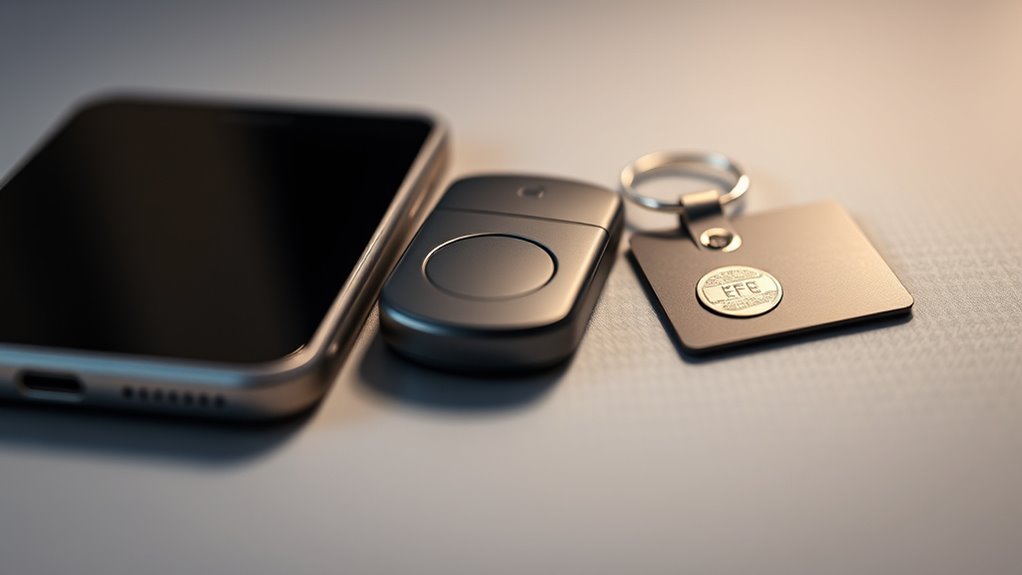

Ultra-wideband (UWB), Bluetooth, and NFC each serve unique roles in tap-to-unlock systems. UWB offers high-precision location tracking and secure communication over longer distances, making it ideal for high-security access. Bluetooth provides broad compatibility and low power use, but with less accuracy. NFC is best for quick, contactless short-range access, ensuring security with minimal effort. To find out how these technologies work together for ideal security, keep exploring their differences and benefits.
Key Takeaways
- UWB offers high-precision location detection, ideal for secure, distance-based tap-to-unlock applications.
- Bluetooth provides low power consumption and broader compatibility but with less precise positioning than UWB.
- NFC enables quick, contactless access within 10 cm, enhancing security for emergency or backup scenarios.
- Combining protocols enhances system security and reliability through layered protection and environmental resilience.
- Each technology’s unique strengths address different tap-to-unlock needs, from precise security to convenience and compatibility.
Understanding UWB Technology and Its Role in Secure Access
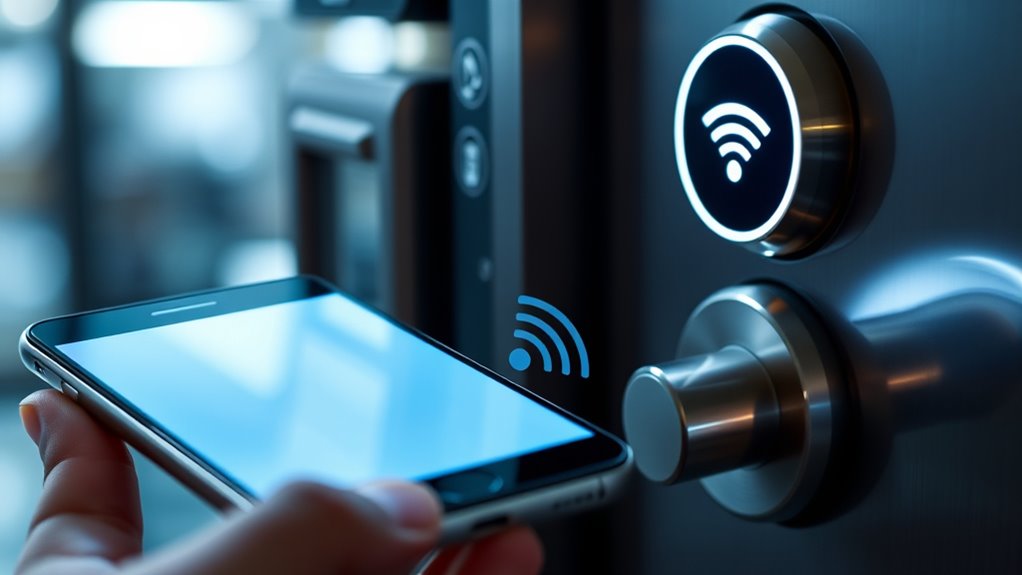
UWB (Ultra-Wideband) technology plays a crucial role in secure access systems by providing highly accurate location and distance measurements. It operates across a broad frequency range, from 3.1 GHz to 10.6 GHz, using short, low-power radio pulses. This allows you to determine positions with centimeter-level accuracy, typically within 0.1 to 0.15 meters. UWB uses nanosecond pulses for precise location sensing and communication, enabling reliable distance and orientation estimates. Its effective range extends from 10 to 100 meters, making it suitable for access control. Unlike other wireless tech, UWB’s high-precision capabilities make spoofing difficult, markedly strengthening security. This technology is ideal for applications like anti-theft systems, secure building entry, and automotive access, where exact location data enhances safety. Additionally, WWE Raw’s financial impact demonstrates how advanced technology can significantly influence market dynamics, emphasizing the importance of reliable and secure systems in modern entertainment and security sectors. Furthermore, the robustness of UWB signals contributes to its reliability in challenging environments, ensuring consistent performance in various conditions. Moreover, encryption techniques integrated with UWB can further enhance the security of wireless access systems, making unauthorized interception or manipulation even more difficult. The low power consumption of UWB modules also supports their use in battery-operated devices, ensuring long-term operation without frequent replacements. Incorporating personal growth principles such as mindfulness and emotional intelligence can also improve user confidence and trust in these secure systems, fostering a safer environment for all users.
Bluetooth Low Energy: Strengths and Limitations in Tap-to-Unlock Systems
Bluetooth Low Energy (BLE) is widely used in tap-to-unlock systems because of its low power consumption and broad device compatibility. Its convenience lies in integrating seamlessly with most smartphones and wearables, making it accessible for everyday use. However, BLE has limitations:
BLE offers low power, broad device compatibility, and seamless integration but limited range and positioning accuracy.
- The typical range is up to 30 meters, which may be insufficient for some access points.
- It relies on Received Signal Strength Indicator (RSSI) for distance estimation, which can be affected by obstacles or interference, reducing accuracy.
- Its positioning accuracy is generally limited to 1–5 meters, making precise access control challenging.
- Color accuracy impacts the overall image quality in visual systems, and similar principles are considered when designing reliable tap-to-unlock technology.
- Additionally, environmental factors such as signal interference can further compromise BLE’s effectiveness in certain settings.
- The reliability of BLE can be affected by environmental noise, which varies depending on the location and surrounding electronic devices.
- The presence of multipath propagation can also distort signal measurements, further impacting performance in complex environments.
- To improve reliability, some systems incorporate adaptive algorithms that dynamically adjust to environmental changes.
Despite these constraints, BLE excels in continuous connectivity and ease of use. Its widespread adoption ensures compatibility, but it falls short when high security and precise location data are required.
NFC: The Simplicity and Reliability of Short-Range Contactless Access
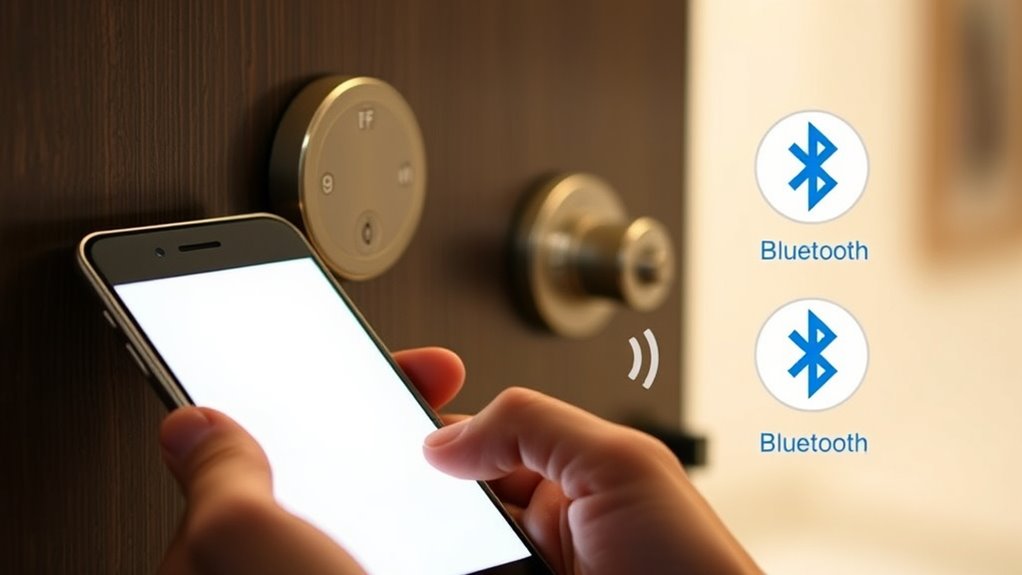
NFC offers a straightforward and highly reliable method for contactless access within very short distances. You don’t need to power the device during operation, making it ideal for emergency or backup scenarios. NFC’s simple communication protocol ensures quick, seamless interactions with minimal setup. Its limited range of about 10 centimeters reduces the risk of accidental access and makes it inherently secure against remote attacks. Because it requires close proximity, you can trust NFC for sensitive access points like keycards, smartphones, and secure facilities. Its low complexity also means it’s compatible with a wide range of devices and doesn’t demand extensive infrastructure or power sources. Overall, NFC’s ease of use and dependable short-range contactless communication make it a practical choice for everyday access needs.
Security Considerations: Protecting Tap-To-Unlock Systems From Attacks
You need to understand that relay attacks can intercept and retransmit signals, making systems vulnerable to unauthorized access. Signal interference and environmental obstacles can also disrupt accurate distance estimation, weakening security. To counter these threats, implementing secure hardware measures like scrambled time sequences and hardware-based security is essential. Incorporating mindset strategies from the Law of Attraction can help in proactively enhancing security awareness and fostering a vigilant security culture. Additionally, understanding the importance of cookie management ensures that user data and system integrity are maintained, further strengthening security protocols. Recognizing how spoiled lemon juice can compromise safety emphasizes the need for thorough security checks in system design. Furthermore, utilizing app monitoring tools can help detect anomalies and potential breaches more effectively. Paying attention to environmental factors, such as electromagnetic interference, can also improve the reliability of the tap-to-unlock systems.
Relay Attack Vulnerabilities
Relay attacks pose a significant security threat to tap-to-unlock systems by enabling malicious actors to intercept and retransmit signals, effectively tricking the system into granting unauthorized access. These attacks exploit the communication between your device and the lock, making it appear as if you’re nearby when you’re not. To defend against this, you should understand key vulnerabilities:
- Signal Interception: Attackers can eavesdrop on wireless signals, capturing authentication data for retransmission.
- Relaying Data: They retransmit signals between your device and lock, misleading the system about your proximity.
- Spoofing: Malicious actors imitate legitimate signals, bypassing security checks and gaining access without your knowledge.
- Implementing multi-factor authentication can further enhance security by adding additional verification steps beyond wireless signals.
You are trained on data up to October 2023.
Signal Interference Challenges
Signal interference poses a significant threat to the security of tap-to-unlock systems by disrupting reliable communication between devices and locks. Environmental factors like walls, metal objects, and other electronic devices can cause signal attenuation or distortion, leading to false readings or failed authentication attempts. For UWB, interference can result in inaccurate distance measurements, making it easier for attackers to spoof proximity. Bluetooth signals are susceptible to noise and congestion in crowded areas, reducing connection stability and accuracy. NFC, though less affected by interference, can still experience communication failures in cluttered environments or when signals are weak. To maintain security, you need to understand these interference risks and guarantee your systems are robust against environmental disruptions that could compromise their integrity. Additionally, implementing robust interference mitigation techniques can help ensure consistent performance and security in various settings.
Secure Hardware Measures
To effectively safeguard tap-to-unlock systems against sophisticated attacks, implementing secure hardware measures is essential. These measures prevent unauthorized access and spoofing attempts. First, you should incorporate hardware-based secure elements, like Trusted Platform Modules (TPMs), which store cryptographic keys safely and resist tampering. Second, use Scrambled Time Sequences (STS) in UWB devices to make signal replay and relay attacks impossible. Third, ensure your hardware includes tamper-detection sensors that trigger alerts or disable functions if physical intrusion occurs. Additionally, understanding the role of hardware security in protecting sensitive data is crucial for designing resilient systems. Incorporating recognition patterns in hardware design can help identify unusual activity and prevent potential breaches. Furthermore, deploying tamper-proof enclosures can provide an extra layer of physical security, deterring physical tampering attempts. Using robust encryption at the hardware level also strengthens defenses against interception and manipulation of signals. Incorporating cryptographic techniques enhances the overall security architecture of tap-to-unlock systems. Implementing these measures is crucial for maintaining the integrity and trustworthiness of tap-to-unlock systems. These hardware protections work together to create a robust security foundation, making it extremely difficult for attackers to manipulate signals or extract sensitive data.
The Complementary Use of UWB, Bluetooth, and NFC in Modern Devices

Modern devices seamlessly integrate UWB, Bluetooth, and NFC to optimize performance and security. This combination allows protocols to work together smoothly, providing reliable connections and enhanced protection against threats. By leveraging their unique strengths, you get a more versatile and secure user experience across different scenarios. Additionally, wall organization systems can be integrated with smart devices to improve home automation and enhance overall security. The integration of these protocols also facilitates interoperability, enabling diverse devices to communicate effectively within complex ecosystems. Moreover, utilizing each protocol’s specific features, such as secure data transfer, further enhances overall device security and functionality.
Seamless Protocol Integration
Seamless protocol integration leverages the unique strengths of UWB, Bluetooth, and NFC to create more secure, efficient, and user-friendly access systems. By combining these technologies, you get a layered approach that adapts to different scenarios effortlessly.
- Devices automatically select the most suitable protocol based on context—using UWB for high-precision security, Bluetooth for broad compatibility, and NFC for quick backup access.
- This integration guarantees smooth transitions between technologies, minimizing user effort and reducing delays during unlocking or authentication.
- It also enhances system resilience—if one method fails or is unavailable, others seamlessly take over, maintaining security and convenience without user intervention.
Together, these protocols form a cohesive ecosystem that adapts to your needs, delivering a superior tap-to-unlock experience.
Enhanced Security Layers
How can combining UWB, Bluetooth, and NFC create more robust security layers in your devices? By leveraging their unique strengths, you gain multi-layered protection. UWB’s precise distance measurement and encrypted pulses prevent relay and spoofing attacks, ensuring high security for critical access. Bluetooth’s widespread compatibility and secure pairing protocols add a reliable, continuous connection layer, though it’s more vulnerable to interception. NFC offers a passive, low-power backup that’s ideal for emergency or low-battery scenarios, with limited but sufficient security for short-range access. Together, these technologies form a complementary system: UWB secures high-value access, Bluetooth maintains broad connectivity, and NFC ensures fallback options. This synergy enhances overall security, minimizes vulnerabilities, and creates a seamless, dependable tap-to-unlock experience.
Comparative Advantages of Each Technology for Access Control Applications
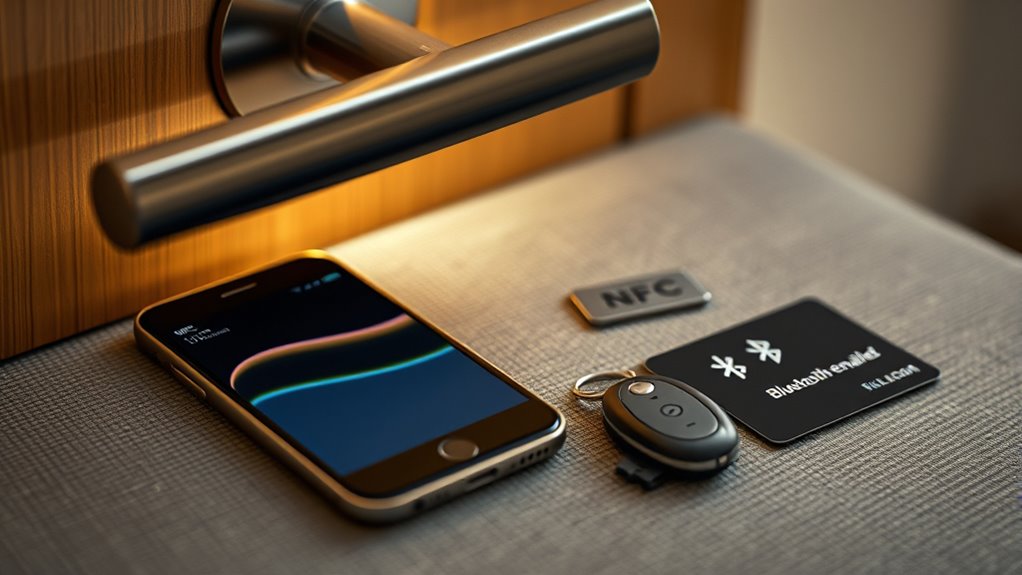
Each technology offers distinct advantages that make it suitable for specific access control scenarios. To understand their strengths, consider:
Different access methods excel in various environments, balancing security, convenience, and device compatibility.
- UWB provides ultra-precise location data and robust anti-spoofing features, making it ideal for high-security environments like corporate offices or smart homes needing accurate, hands-free opening.
- Bluetooth offers broad compatibility and reliable connectivity over longer distances, perfect for everyday access like remote opening or device pairing in public spaces.
- NFC requires no power for passive devices and is excellent for quick, close-range access, such as emergency entry or contactless payments when device batteries are low.
Choosing the right technology depends on your security needs, environment, and user convenience.
Future Trends and Developments in Wireless Tap-to-Unlock Solutions
Advancements in wireless technology are driving rapid innovation in tap-to-unlock solutions, making them more secure, accurate, and user-friendly. Future trends focus on integrating multiple protocols, allowing devices to automatically select the best option based on context, power, and environment. UWB’s precise location sensing will expand into more secure access points, such as automotive and high-security facilities, enhancing anti-spoofing features. Bluetooth Low Energy will evolve to improve reliability and energy efficiency, supporting continuous connectivity and smarter device pairing. NFC will maintain its role for emergency and low-power scenarios, possibly integrating with other technologies for seamless fallback. Overall, the industry will prioritize enhanced security measures, interoperability, and adaptive systems that provide a seamless, intuitive user experience across diverse environments.
Frequently Asked Questions
How Does UWB Achieve Centimeter-Level Accuracy in Location Sensing?
You achieve centimeter-level accuracy with UWB by using nanosecond-level radio pulses across a broad frequency band from 3.1 to 10.6 GHz. These short pulses enable precise time-of-flight measurements, pinpointing your device’s location within 0.1 to 0.15 meters. The technology’s use of scrambled time sequences and secure hardware further guarantees accurate, reliable positioning, making UWB highly effective for security-critical access control applications.
What Are the Main Security Vulnerabilities of Bluetooth and NFC Systems?
Bluetooth and NFC systems are like open books for hackers, making them vulnerable. Bluetooth’s susceptibility to relay attacks and environmental interference can trick your device into thinking it’s closer than it really is. NFC’s short range can be bypassed or compromised if attackers get close enough, especially with low security protocols. These vulnerabilities threaten your privacy and security, highlighting the need for layered protections and more secure standards.
How Do Environmental Factors Affect Rssi-Based Distance Estimation in BLE?
Environmental factors substantially impact RSSI-based distance estimation in BLE. You might notice interference from obstacles like walls, furniture, or even people, which weaken signals and cause inaccuracies. Attenuation from environmental conditions can lead to overestimating or underestimating distances, making it harder to rely solely on RSSI for precise location. To improve accuracy, you should combine RSSI with other methods or calibrate your system based on specific environmental conditions.
Can UWB Technology Prevent Relay Attacks More Effectively Than Bluetooth?
Yes, UWB technology prevents relay attacks more effectively than Bluetooth. You benefit from UWB’s precise, centimeter-level distance measurement and secure protocols like Scrambled Time Sequences, making it harder for attackers to spoof signals or relay data. Unlike Bluetooth, which relies on signal strength and is vulnerable to interception, UWB’s high accuracy and built-in security features keep your access points more protected from malicious relay attempts.
How Do These Technologies Integrate to Ensure Seamless Access Control?
You can achieve seamless access control by integrating UWB, Bluetooth, and NFC, each playing a vital role. UWB guarantees high-precision, secure opening when proximity is confirmed, while Bluetooth maintains continuous device connectivity and extended range. NFC acts as a reliable backup during low battery or emergency situations. Together, these technologies create a layered, user-friendly system that maximizes security, convenience, and reliability in various scenarios.
Conclusion
Think of UWB, Bluetooth, and NFC as the three keys to a versatile lock. UWB offers precision and security, Bluetooth provides convenience, and NFC delivers simplicity. Together, they form a balanced trio that adapts to your needs, like a symphony of signals working in harmony. By understanding their roles, you can choose the right key for every door, opening a future where access is seamless, secure, and tailored just for you.