
Spatial audio creates a realistic, three-dimensional sound environment by using immersive technology and special recording techniques. It mimics how your ears perceive sound from all directions, capturing cues like timing, volume, and direction. Technologies like binaural recording and dummy head setups help reproduce life-like soundscapes. This enhances the realism and emotional impact of experiences in VR, games, and music. Keep exploring to discover how these techniques work and transform your listening experience.
Key Takeaways
- Spatial audio creates a 3D sound environment by simulating how sound interacts with the head and ears.
- Binaural recording uses two microphones to mimic human ears, capturing realistic spatial cues.
- It relies on differences in sound timing and volume between ears to help locate sound sources.
- These cues enable the brain to perceive depth, direction, and distance of sounds.
- Spatial audio is widely used in VR, gaming, and immersive music to enhance realism and engagement.
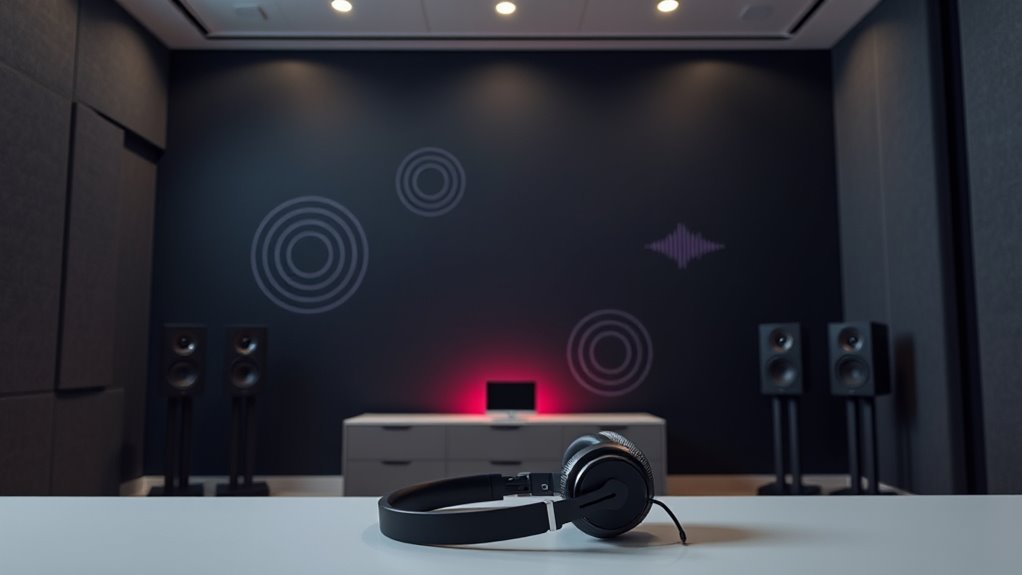
Spatial audio is transforming the way you experience sound by creating a three-dimensional listening environment. This technology immerses you in audio that feels as if it surrounds you from all directions, making everything you hear more realistic and engaging. At the core of this experience is binaural recording, a technique that captures sound using two microphones positioned to mimic human ears. When you listen through headphones, binaural recordings deliver an authentic sense of space, positioning, and depth, making it seem like the sound is happening right in your environment. This method takes advantage of how your brain processes differences in timing, volume, and direction between your ears, which is vital for 3D sound localization.
Spatial audio creates immersive, realistic soundscapes using binaural recording that mimics how our ears perceive space and depth.
3D sound localization is the ability to identify where sounds originate in space—whether they’re coming from above, below, or behind you. Binaural recording plays an indispensable role here because it preserves these spatial cues during the recording process. When you listen to binaural content, your brain interprets subtle differences in sound signals, such as the slight delay or volume disparity between your ears, to accurately locate the source of each sound. This gives you a highly realistic sense of depth and direction, making audio experiences more immersive. For example, if a bird chirps from behind your left ear, you’ll perceive it precisely there, rather than as a flat sound coming from a single point.
The magic of spatial audio hinges on how effectively it replicates natural hearing. Binaural recordings are crafted by placing microphones in a dummy head or using specialized equipment that mimics the shape and size of human ears. This setup captures the complex interactions of sound waves with the head and ears, including subtle cues that guide your perception of space. When you listen, these cues are processed by your brain to create a convincing 3D soundscape. This technology is increasingly used in virtual reality, gaming, and immersive music experiences, where precise sound localization enhances realism and emotional impact. Additionally, the quality of audio fidelity can significantly influence how convincing and immersive the spatial experience feels.
Understanding these principles helps you appreciate how spatial audio transforms ordinary listening into an immersive event. Binaural recording ensures that each sound is accurately positioned in space, while 3D sound localization allows your brain to interpret these cues naturally. As a result, your audio experience becomes more lifelike, engaging, and emotionally resonant—whether you’re exploring a virtual world, enjoying a concert, or simply listening to a podcast. Spatial audio leverages the natural anatomy of your ears and brain, making it a powerful tool for creating truly immersive sound environments.

Symphonized Premium Airtube Headphones EMF Earbuds, 3D Sound, Microphone Volume Control, 8mm Bass Drivers Granting High Audio Quality 3.5mm Audio Jack
PREMIUM EMF TECHNOLOGY – These EMF earbuds combine crisp sound with built-in signal protection, offering innovative back to…
As an affiliate, we earn on qualifying purchases.
As an affiliate, we earn on qualifying purchases.
Frequently Asked Questions
How Does Spatial Audio Differ From Traditional Stereo Sound?
Spatial audio differs from traditional stereo sound by creating a surround sound experience that makes you feel like you’re inside the scene. It uses advanced technology to position audio cues around you, providing an immersive experience. Unlike stereo, which only offers two channels, spatial audio maps sound in three-dimensional space, so you can perceive the direction and distance of sounds accurately, enhancing your overall listening experience.
What Devices Are Compatible With Spatial Audio Technology?
You can enjoy spatial audio on a variety of devices, including Apple’s latest iPhones, iPads, and Macs, as well as compatible AirPods and Beats headphones. Many newer smart TVs, gaming consoles like PlayStation and Xbox, and some streaming devices also support spatial audio. Make certain your device’s firmware is up-to-date and check for audio format support, such as Dolby Atmos or DTS:X, to guarantee compatibility and ideal sound experience.
Can Spatial Audio Improve Gaming Experiences?
Yes, spatial audio can markedly enhance your gaming experience by creating immersive environments. It improves sound localization, allowing you to pinpoint the direction of in-game sounds like footsteps or gunfire. This heightened awareness gives you a competitive edge and makes gameplay more realistic. You might think it’s just a small upgrade, but the immersive soundscapes and precise localization truly transform how you experience and interact with your games.
Is Spatial Audio Suitable for Hearing Impairments?
Spatial audio can be suitable for hearing impairments, especially if your hearing aids have advanced accessibility features. You can experience enhanced sound localization and clearer directional cues, making it easier to understand your environment. Make sure your hearing aids support spatial audio technology and enable these features. This setup helps you enjoy a more immersive experience, whether gaming, watching movies, or listening to music, with improved spatial awareness and sound clarity.
How Does Head-Tracking Enhance Spatial Audio?
Head-tracking considerably enhances your immersive experience by aligning sound with your head movement. When you turn your head, the system adjusts the spatial audio, making it feel like sounds are coming from fixed points in the environment. This coincidence of head movement and sound positioning creates a more realistic, engaging experience, helping you feel truly immersed and in control of the audio landscape around you.

HyperX Cloud III – Wired Gaming Headset, PC, PS5, Xbox Series X|S, Angled 53mm Drivers, DTS Spatial Audio, Memory Foam, Durable Frame, Ultra-Clear 10mm Mic, USB-C, USB-A, 3.5mm – Black
Comfort is King: Comfort’s in the Cloud III’s DNA. Built for gamers who can’t have an uncomfortable headset…
As an affiliate, we earn on qualifying purchases.
As an affiliate, we earn on qualifying purchases.
Conclusion
Now that you understand the basics of spatial audio, you’re like a painter with a new palette, ready to create immersive soundscapes. Spatial audio transforms your listening experience, making sounds feel like they’re coming from all around you. With this knowledge, you can enhance your projects and enjoy music, movies, or games more deeply. Explore and experiment—think of it as opening a whole new dimension of sound that surrounds you like an invisible bubble.

OneOdio A71D Wired Over-Ear Headphones, Studio Monitor Headsets, Hi-Res DJ Stereo Headphone with Foldable Design, 3.5/6.35MM Plug for AMP Recording Podcast Mixing PC Guitar – Black
Studio-Grade Sound – 40mm drivers deliver deep bass, clear mids, and crisp highs for DJing, studio recording, mixing,…
As an affiliate, we earn on qualifying purchases.
As an affiliate, we earn on qualifying purchases.

Meta Quest 3 512GB | VR Headset — Thirty Percent Sharper Resolution — 2X Graphical Processing Power — Virtual Reality Without Wires — Access to 40+ Games with a 3-Month Trial of Meta Horizon+ Included
NEARLY 30% LEAP IN RESOLUTION — Experience every thrill in breathtaking detail with sharp graphics and stunning 4K…
As an affiliate, we earn on qualifying purchases.
As an affiliate, we earn on qualifying purchases.