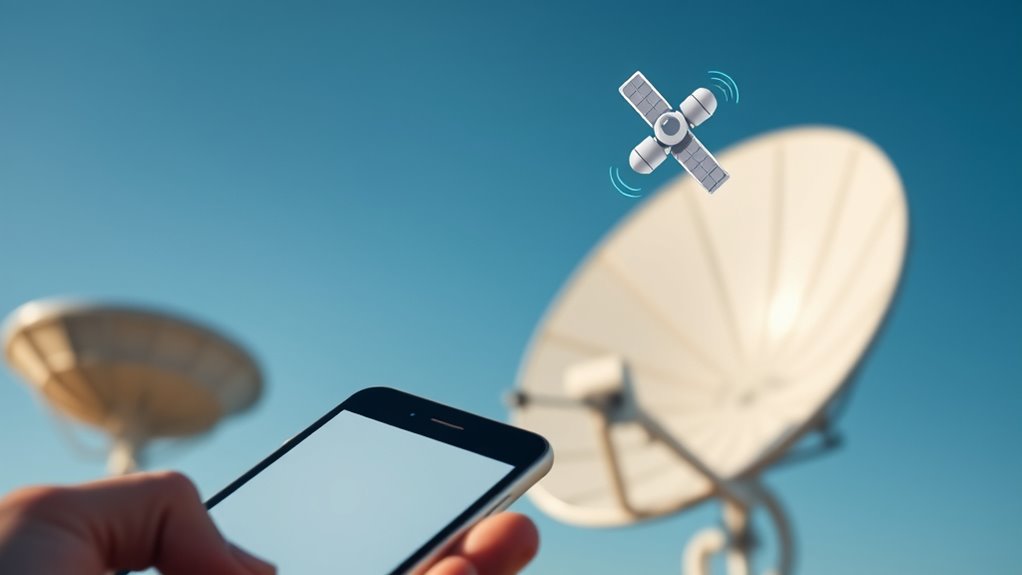

Satellite messaging on phones uses Non-Terrestrial Networks (NTNs) and direct-to-device technology to connect directly to satellites, bypassing traditional cell towers. This allows you to send and receive messages even in remote or disaster-affected areas. Different orbit types, such as LEO, MEO, and GEO, impact signal latency and coverage, working with specialized frequency bands and standards like 3GPP Release 17. If you want to explore how this technology keeps you connected anywhere, keep exploring further.
Key Takeaways
- NTNs extend phone connectivity globally using satellites in LEO, MEO, or GEO orbits, especially in remote or disaster areas.
- Direct-to-device satellite messaging allows phones to communicate directly with satellites without ground stations.
- Satellite signals operate on high-frequency bands like Ka and L-band, integrated into 3GPP standards for compatibility.
- Satellite messaging offers low latency for real-time alerts and broad coverage across oceans, mountains, and rural regions.
- Infrastructure includes satellites, airborne platforms, ground gateways, and advanced network design for reliable service.

BlueCosmo Inmarsat IsatPhone 2.1 Satellite Phone Kit & 500 Unit Prepaid SIM (365 Days) – Global Coverage – Voice, SMS, GPS Tracking, Emergency SOS
GLOBAL COVERAGE: NO ROAMING CHARGES – make and receive voice calls, SMS, track your position with GPS from…
As an affiliate, we earn on qualifying purchases.
As an affiliate, we earn on qualifying purchases.
Understanding Non-Terrestrial Networks (NTNs)

Non-Terrestrial Networks (NTNs) expand wireless connectivity beyond traditional infrastructure by utilizing spaceborne and airborne platforms such as satellites, High Altitude Platform Stations (HAPS), and Unmanned Aerial Vehicles (UAVs). These networks enable communication in remote, rural, maritime, and disaster-affected areas where terrestrial towers can’t reach. By integrating with 3GPP standards, NTNs ensure compatibility with existing 5G networks, allowing seamless interoperability. They support direct-to-device satellite messaging, so your phone can connect directly to satellites without relying solely on ground stations. NTNs consist of various satellite orbits—Low Earth Orbit (LEO), Medium Earth Orbit (MEO), and Geostationary Orbit (GEO)—each offering different coverage and latency benefits. This advanced infrastructure forms the backbone of future 6G networks, providing ubiquitous, resilient connectivity worldwide. Non-Terrestrial Networks are increasingly important for expanding global coverage and bridging the digital divide, especially as satellite communication continues to evolve rapidly to meet growing demands. Additionally, advancements in global connectivity are essential for ensuring reliable communication in emergency and remote scenarios, making NTNs a crucial part of future communication ecosystems. Moreover, the development of digital transformation initiatives relies heavily on the widespread deployment of these networks to enable new technological innovations. A deeper understanding of satellite orbits reveals how different configurations optimize coverage and latency for various applications.

3GPP-based Non-Terrestrial Networks in 5G and 6G: Expanding the Frontiers of Wireless Communications
As an affiliate, we earn on qualifying purchases.
As an affiliate, we earn on qualifying purchases.
How Satellite Messaging Works on Mobile Devices

Satellite messaging on mobile devices works by using the NTN infrastructure to relay your messages between your phone and orbiting satellites. When you send a message, your phone transmits signals via the service link to a satellite in Low Earth Orbit (LEO) or another orbit type. The satellite then forwards the message through its feeder link to a ground station or NTN gateway. From there, the message is routed through terrestrial networks to reach its recipient. In direct-to-device systems, the satellite can communicate directly with your phone without relying on ground stations, enabling messaging even in remote areas. This entire process happens in seconds, ensuring your messages are delivered reliably across vast distances, regardless of terrestrial infrastructure limitations. This technology is especially valuable for remote regions where traditional power sources and network infrastructure are limited or unavailable, highlighting its importance in sustainable and resilient communication networks. Additionally, the use of direct-to-device systems can significantly reduce latency and improve the speed of message delivery in challenging environments. The ability to operate independently of ground infrastructure enhances the robustness of communication, making it a vital component of future global connectivity solutions. Incorporating advanced signal relay techniques further enhances the efficiency and reliability of satellite messaging systems.

Spot Gen 4 Satellite GPS Messenger | Handheld Portable GPS Messenger for Hiking, Camping, Outdoor Activities | Globalstar Satellite Network Coverage | Subscription Applicable
MEANT FOR ADVENTURE: Spot Gen4 provides critical, life-saving line of communication when you travel beyond cell towers; Let…
As an affiliate, we earn on qualifying purchases.
As an affiliate, we earn on qualifying purchases.
Orbit Types and Their Impact on Connectivity

Have you ever wondered how different orbit types influence your satellite connectivity? The orbit determines how satellites move relative to Earth, affecting coverage, latency, and signal stability. Low Earth Orbit (LEO) satellites, orbiting at 1,200–2,000 km, provide low latency and high data rates, making them ideal for real-time messaging. Medium Earth Orbit (MEO) satellites, at 10,000–20,000 km, balance coverage and delay, suitable for broader coverage with moderate responsiveness. Geostationary Orbit (GEO) satellites, around 36,000 km, stay fixed over a point, offering wide coverage but higher latency, which can impact message delivery speed. Your connectivity’s speed and reliability depend heavily on the orbit type, as each presents unique advantages and limitations for satellite messaging. Understanding satellite orbits is essential for appreciating how different systems deliver consistent and efficient communication. Regular maintenance and cleanliness of equipment can also influence overall performance and signal quality, especially in high-traffic environments. Maintaining proper equipment upkeep is crucial to ensure optimal signal strength and reduce potential disruptions. Additionally, advances in predictive analytics can help optimize satellite operations by forecasting potential issues before they affect service.

ACR Bivy Stick Satellite Communicator – Two-Way Global SMS, GPS Tracker, Off-Grid Communication, SOS Emergency Beacon, Satellite Messenger & Location Sharing – iOS/Android App
Global Iridium Satellite Coverage: Stay connected anywhere on Earth with 100% global Iridium satellite coverage for two-way SMS,…
As an affiliate, we earn on qualifying purchases.
As an affiliate, we earn on qualifying purchases.
Key Components of NTN Infrastructure

To understand NTN infrastructure, you need to look at the satellite and airborne platforms that enable communication beyond traditional networks. These platforms work together with ground network infrastructure, including gateways and base stations, to relay messages effectively. Recognizing how these components connect and operate helps you grasp how satellite messaging on phones becomes possible. Additionally, understanding Juice Cleanse and Detox concepts can shed light on how nutrients and signals are processed and transmitted efficiently within these complex systems. Incorporating anti-aging effects from eye patches demonstrates how targeted interventions can enhance overall system performance and longevity. Moreover, the satellite network architecture plays a crucial role in ensuring reliable and widespread coverage for NTN services, which is essential for maintaining maximized coverage and seamless connectivity.
Satellite and Airborne Platforms
Airborne and spaceborne platforms form the backbone of Non-Terrestrial Networks (NTNs), enabling wireless communication beyond traditional terrestrial infrastructure. Satellites, including LEO, MEO, and GEO types, provide broad coverage and connectivity. LEO satellites, orbiting at 1,200–2,000 km, offer low latency and high data rates, ideal for real-time messaging. MEO satellites balance coverage and latency, operating at 10,000–20,000 km. GEO satellites, positioned at about 36,000 km, deliver wide coverage but with higher latency. Airborne platforms like High Altitude Platform Stations (HAPS) and unmanned aerial vehicles (UAVs) add flexibility, filling coverage gaps and supporting temporary or emergency services. These platforms work together, forming a resilient, scalable infrastructure that guarantees connectivity even in remote, maritime, or disaster zones. As AI technology advances, these systems can be further optimized for enhanced security and reliability AI vulnerabilities, and advancements in satellite constellation design are continually improving network performance and resilience.
Ground Network Infrastructure
Ground network infrastructure forms the backbone of Non-Terrestrial Networks, connecting satellites, airborne platforms, and user devices to guarantee seamless communication. It includes key components that enable signal routing, processing, and interoperability. Ground stations act as gateways, linking NTN signals to terrestrial networks. User devices communicate with satellites via service links, managed through ground-based antennas and processing centers. Inter-satellite links (ISL) coordinate satellite data transfer, while beamforming optimizes coverage. The infrastructure’s success depends on precise coordination and robust hardware. Here’s an overview of essential components: ground network infrastructure is critical for ensuring reliable connectivity and efficient data transfer across the entire NTN system. Ensuring resilient hardware and robust protocols is vital for maintaining network reliability in dynamic environments. Proper signal management is essential to adapt to changing conditions and maintain continuous service. Additionally, interoperability protocols facilitate seamless integration between different systems and technologies, enhancing overall network performance.
Frequency Bands and Standards for Satellite Communication
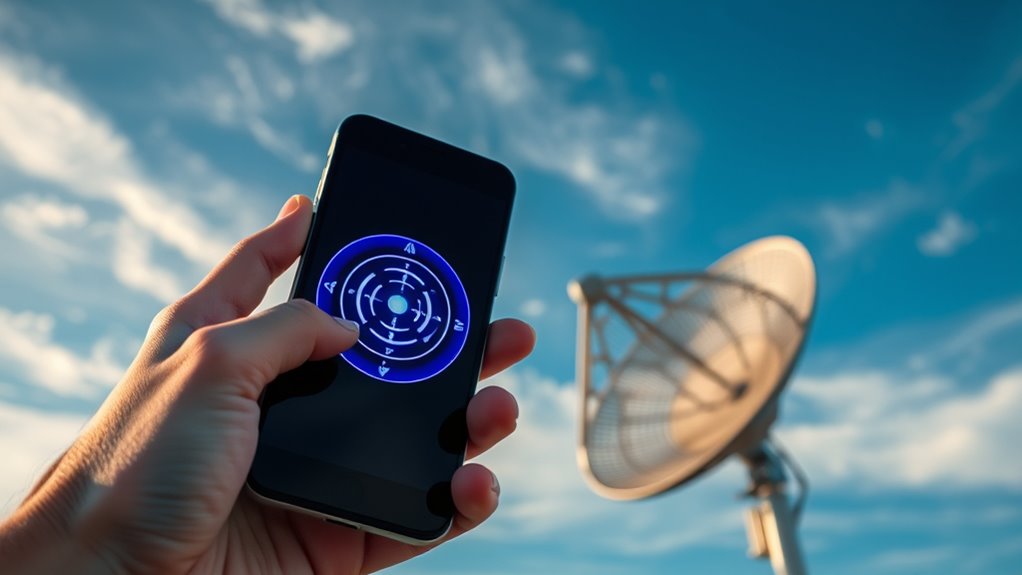
You need to understand how satellite frequencies are allocated so your device can communicate effectively with satellites. The 3GPP standards have evolved to define specific bands for NTN, especially above 6 GHz, to support direct-to-device messaging. Staying updated on these standards helps guarantee your phone can connect reliably across different satellite networks.
Satellite Frequency Allocations
Have you ever wondered which frequency bands enable satellite communication for mobile devices? These bands are vital because they determine how effectively devices connect with satellites. Typically, satellite communication uses higher frequency bands above 6 GHz, including the Ka-band (26.5–40 GHz), Ku-band (12–18 GHz), and L-band (1–2 GHz). Each offers different advantages: Ka-band provides higher data rates but is more susceptible to weather interference, while L-band offers better reliability in adverse conditions. Standards set by 3GPP, especially in Release 17, specify the use of these bands for direct-to-device satellite messaging. Regulatory bodies allocate these frequencies worldwide, balancing capacity, coverage, and interference management to guarantee seamless communication between phones and satellites.
3GPP Standards Evolution
The evolution of 3GPP standards has considerably shaped the development of satellite communication for mobile devices, particularly through the adoption of specific frequency bands. These standards, especially in TS 38.101-5, define NR bands suitable for NTN use, focusing on higher frequency ranges above 6 GHz. This shift permits efficient satellite-to-device links, supporting direct messaging capabilities. With each release, 3GPP introduces enhancements to improve interoperability, spectrum management, and technical performance. Standardization efforts also address challenges like signal propagation and regulatory compliance. By integrating NTN frequency bands into the 5G ecosystem, 3GPP ensures seamless operation between terrestrial and satellite networks. This evolution is critical for enabling reliable, global satellite messaging services on your device, especially in remote or underserved areas.
Advantages of Using NTNs for Messaging

Using Non-Terrestrial Networks (NTNs) for messaging offers significant advantages, especially in areas where traditional cellular infrastructure is unavailable or unreliable. You can stay connected in remote regions, maritime zones, and disaster-stricken areas where cell towers don’t reach. NTNs provide coverage beyond the limits of terrestrial networks, ensuring your messages get through regardless of location. They also increase network resilience, offering a reliable backup during outages or emergencies. For industries like aviation, maritime, and IoT, NTNs enable direct device-to-satellite communication, expanding possibilities for real-time updates and asset tracking. Additionally, NTNs support critical services in underserved communities, bridging connectivity gaps. Overall, they make messaging more accessible, dependable, and versatile, even in the most challenging environments.
Practical Use Cases and Applications

Satellite messaging on phones is transforming how you stay connected in challenging environments. It’s essential for remote areas, disaster zones, and maritime regions where traditional networks fail. You can send critical alerts during emergencies when infrastructure is down, ensuring help arrives quickly. It also supports IoT devices in agriculture, logistics, and wildlife monitoring, enabling real-time updates without terrestrial coverage. Additionally, satellite messaging helps travelers, adventurers, and ships stay in touch across vast oceans or rugged terrains, where cell towers don’t reach. Imagine:
Satellite messaging keeps you connected in remote areas, disaster zones, and across oceans—ensuring safety and real-time updates everywhere.
- Emergency alerts during natural disasters in remote communities
- Tracking assets or livestock across isolated farms or wilderness
- Maintaining communication on international voyages or mountain expeditions
These practical applications keep you connected, safe, and informed no matter where you are.
Challenges and Future Developments in NTN Messaging

Despite the promising benefits of NTN messaging, several challenges hinder its widespread adoption and reliability. One major issue is latency, especially with GEO satellites, which can delay message delivery and affect real-time communication. Interoperability also remains complex, as different satellite systems and frequencies need seamless integration with terrestrial networks, requiring ongoing standardization. Coverage gaps and signal handovers pose additional hurdles, particularly in dynamic environments like moving vehicles or remote regions. Power consumption on devices can increase due to continuous satellite connectivity, impacting battery life. Looking ahead, future developments aim to address these challenges through advanced beamforming, low Earth orbit (LEO) constellations, and improved protocols. These innovations promise faster, more reliable satellite messaging, expanding its role across diverse applications and environments.
How to Access Satellite Messaging Services

Wondering how to access satellite messaging services on your phone? First, verify your device supports direct-to-device NTN connections and that you have an active satellite service plan. Next, turn on your phone’s satellite messaging feature, which might require installing a specific app or updating your firmware. You’ll also need a clear view of the sky, free from obstructions like tall buildings or dense foliage, to establish a reliable connection.
- Visualize your phone connecting seamlessly to a satellite overhead, with signals bouncing through space, bypassing terrestrial towers.
- Imagine your screen showing a satellite icon indicating connection readiness.
- Picture sending a message, which travels directly to a satellite, then relays to its destination, even in remote areas.
Frequently Asked Questions
How Secure Are Satellite Messages Transmitted via NTN Infrastructure?
Satellite messages transmitted via NTN infrastructure are quite secure, but the level depends on the encryption methods used. You should know that most systems employ strong encryption standards, like AES, to protect your data during transmission. However, no system is completely immune to hacking or interception. To stay safe, verify your device and service providers follow the latest security protocols and updates, and use secure authentication methods whenever possible.
Can Existing Smartphones Be Upgraded to Support Satellite Messaging?
Yes, existing smartphones can be upgraded to support satellite messaging, but it’s not automatic. You’ll need a compatible hardware upgrade or a new device designed for NTN connectivity, which is still emerging. Manufacturers are developing software updates and modules to enable satellite links, but availability varies. Stay alert—these upgrades could transform your connectivity in remote areas or during emergencies, making you truly unstoppable when traditional networks fail.
What Are the Latency Differences Between LEO, MEO, and GEO Satellites?
You’ll notice that LEO satellites have the lowest latency, usually around 20-40 milliseconds, making them great for real-time applications. MEO satellites have moderate latency, typically 100-150 milliseconds, balancing coverage and speed. GEO satellites have the highest latency, often 250 milliseconds or more, due to their distance from Earth. This means responses take longer, which can affect activities like voice calls or gaming.
How Does Satellite Messaging Impact Battery Life on Mobile Devices?
Imagine your phone’s battery as a tired marathon runner, and satellite messaging as that relentless hill they just can’t avoid. When your device connects directly to satellites, it works harder, draining your battery faster. Transmitting signals over distant space or managing complex satellite links requires more power. So, yes, satellite messaging can turn your phone into a ravenous beast, devouring your battery life quicker than usual.
Are There Regulatory Restrictions on Satellite Messaging Globally?
You should know that regulatory restrictions on satellite messaging vary worldwide. Some countries have strict rules on spectrum use, licensing, and security, which can limit or delay deployment. Others require approvals for satellite frequencies and services. You need to stay informed about local regulations and compliance requirements, especially if you’re deploying or using satellite messaging in different regions. Always check with authorities to guarantee you meet all legal standards.
Conclusion
As you explore satellite messaging, think of NTNs as the bridge connecting you across the sky’s vast ocean. They’re opening new horizons for communication, turning distant islands into nearby neighbors. While challenges remain, the future promises smoother, more reliable links that make you feel closer to the world, no matter where you are. Embrace this technology, and watch how it transforms your connection from a fragile thread into a lifeline woven through the stars.