

On-device translation keeps your language data processed locally on your device, which greatly enhances privacy by reducing data exposure and preventing breaches. However, offline models may lack the accuracy and language coverage of cloud-based services, and limited storage can restrict updates. Cloud services can offer better quality but pose risks like data interception and breaches. To understand how to balance privacy and translation quality effectively, explore further insights below.
Key Takeaways
- On-device translation keeps data local, reducing exposure risks but may offer less accurate and comprehensive results than cloud-based services.
- Processing data offline enhances privacy compliance and minimizes breach risks, but limited models may struggle with complex language nuances.
- Cloud services provide higher translation accuracy and updates but involve greater data transmission, increasing privacy and security vulnerabilities.
- Balancing privacy and performance involves choosing tools with transparent policies, encryption, and strict access controls for sensitive content.
- Offline translation prioritizes privacy but may sacrifice contextual understanding and support for less common languages.

Paekole Real-Time AI Translation Earbuds, 198 Language Translator Earbuds, Audifonos Traductores Inglés Español, 3-in-1 Translating Earbuds for Business, Travel, Language Learning, Bronze Black
1️⃣ Real-Time AI Translation Earbuds – Up to 198 Languages Communicate instantly with AI-powered real-time translator earbuds designed…
As an affiliate, we earn on qualifying purchases.
As an affiliate, we earn on qualifying purchases.
The Fundamentals of On-Device Translation

On-device translation processes language data directly on your device, rather than sending it to remote servers. This means your translations happen locally, which minimizes data transmission and reduces the risk of interception. You won’t need an internet connection for basic translation functions, making it ideal for offline use. Devices like smartphones and smart gadgets can handle this process, using built-in language models that are optimized for your hardware. These models analyze and generate translations on the spot, offering quick results without relying on external servers. While this method enhances privacy and reduces exposure to potential hacking, it may have limitations in translation accuracy compared to cloud-based options. Nonetheless, it provides a secure, convenient way to communicate across languages directly from your device, similar to how support hours for entertainment venues can vary based on the season and location. Additionally, ongoing advancements in on-device AI are helping improve the quality and capabilities of local translation tools. As the technology continues to evolve, privacy benefits become more significant, encouraging wider adoption of on-device solutions. Moreover, the integration of secure processing techniques ensures that sensitive data remains protected during translation.

AI Language Translator Device, 2026 Upgraded VORMOR Translator No WiFi Needed, Support ChatGPT, Instant Two-Way 150 Languages Translation, Offline/Photo Translation for Business Travel
【AI Translator Supporting 150 Languages】Vormor instant translator adopts the latest technology, ultra-fast and accurate translation, the response time…
As an affiliate, we earn on qualifying purchases.
As an affiliate, we earn on qualifying purchases.
Privacy Benefits of Local Processing

When you process translations on your device, your data stays local, which helps prevent it from being exposed to external networks. This approach reduces the risk of breaches and unauthorized access, keeping your information more secure. Plus, it aligns with privacy laws like GDPR and CCPA, giving you peace of mind about how your data is handled. Necessary cookies ensure the basic functionality of the site, supporting a secure browsing experience. Additionally, on-device tuning methods can be employed to optimize device performance without compromising data privacy. The use of AI in education technologies exemplifies how local processing can enhance personalized learning while safeguarding sensitive information. Moreover, local data storage is crucial for maintaining control over sensitive information and minimizing reliance on cloud-based services. Implementing data encryption further strengthens privacy by protecting stored information from potential threats.
Data Remains On-Device
Because your data stays on your device, it’s less vulnerable to external threats and unauthorized access. You don’t have to worry about your personal or sensitive information being stored on remote servers that could be targeted by hackers or malicious actors. When your data remains locally, it’s protected by your device’s security features, such as encryption and passcodes. This reduces the risk of data breaches that often occur through cloud storage or third-party service providers. Additionally, your information isn’t shared with external entities, so you maintain greater control over your privacy. Data sovereignty is preserved when data stays on-device, preventing unintended dissemination. This approach minimizes exposure to unauthorized data collection or scraping. Moreover, keeping data on-device aligns with AI security best practices for safeguarding sensitive information. Ensuring privacy controls are in place further enhances user trust and data protection. Implementing local data management can help in maintaining these privacy standards. Furthermore, it supports secure data processing by limiting points of vulnerability during translation tasks. Overall, keeping data on-device ensures your privacy is preserved and your sensitive information stays secure, giving you peace of mind during translation tasks.
Reduces External Exposure
By processing translation data locally, you considerably restrict your device’s exposure to external threats. This approach ensures sensitive information doesn’t travel over the internet, reducing the risk of interception and unauthorized access. Since data stays on your device, it’s less vulnerable to hacking, data scraping, or breaches involving third-party servers. You also avoid exposing your content to malicious actors targeting cloud services. Additionally, local processing minimizes the chance of data leaks during transmission, providing peace of mind when handling confidential information. Implementing privacy-preserving techniques can similarly reduce reliance on external sources, promoting a more self-sufficient approach to health. Furthermore, local processing reduces the need for constant internet connectivity, which can be advantageous in areas with unreliable networks. It also helps maintain device performance by conserving bandwidth and reducing processing loads on external servers. – Limits data transmission over networks, reducing interception risks – Prevents third-party access to sensitive content – Decreases exposure to cloud infrastructure vulnerabilities. Moreover, adopting secure processing methods can further strengthen your privacy defenses.
Enhances Privacy Compliance
Processing translation data locally helps you stay compliant with privacy regulations like GDPR and CCPA by keeping sensitive information on your device. This approach guarantees that personal or confidential data isn’t transmitted to external servers, reducing the risk of violations. Because your data remains on your device, you have greater control over what’s shared and can prevent unintended disclosures. On-device translation also aligns with regulatory requirements that demand data minimization and user privacy safeguards. By avoiding cloud processing, you reduce exposure to third-party access, data scraping, or breaches. This proactive privacy stance not only helps you meet legal obligations but also builds trust with users and clients who value data security. Additionally, dog names can serve as memorable and personalized identifiers that enhance user engagement. Implementing local processing fosters a creative practice of innovative privacy solutions that prioritize user trust and data integrity. Moreover, privacy compliance is easier to achieve when sensitive data remains on the device, simplifying audits and assessments. For example, local data handling minimizes the potential for data leaks or mishandling during transmission. Incorporating secure data storage techniques further strengthens data protection efforts while maintaining compliance. Overall, local processing simplifies compliance while safeguarding sensitive information.
privacy-focused translation gadget
As an affiliate, we earn on qualifying purchases.
As an affiliate, we earn on qualifying purchases.
Limitations and Challenges of Offline Models

Offline models often struggle with translation accuracy because they use limited language data and processing power. You may find that some languages or idiomatic expressions aren’t well covered, resulting in less reliable results. Additionally, storage constraints restrict the size of language packs, further limiting coverage and updates. Headphone compatibility can also be a concern when trying to use certain devices with offline translation tools.
Reduced Translation Accuracy
While on-device translation offers privacy benefits, it often comes with the tradeoff of reduced accuracy compared to cloud-based systems. Limited processing power and smaller language models mean your translations might miss nuances or produce awkward phrasing. You may notice errors in idiomatic expressions, context, or complex sentence structures. Offline models struggle to adapt to new slang or specialized terminology without frequent updates. This can lead to misunderstandings, especially in professional or nuanced conversations.
- Smaller models limit contextual understanding and idiomatic translation.
- Reduced ability to handle rare or complex language constructs.
- Frequent updates are necessary but require internet access, risking exposure.
Balancing privacy with precision remains challenging, as offline systems prioritize data security over the exhaustive accuracy of cloud solutions.
Limited Language Coverage
Despite their advantages in privacy, offline translation models face significant hurdles in providing extensive language coverage. You often find that only a limited number of languages are supported, usually the most common ones. This is because developing accurate models for every language requires substantial data and processing power, which can’t be stored or run efficiently on a device. As a result, you might struggle to translate less popular or regional languages offline. This creates gaps in your ability to communicate across diverse linguistic contexts. Additionally, maintaining and updating language packs for all supported languages consumes storage space and requires periodic internet access. Consequently, you may have to compromise between privacy and all-encompassing language support, especially when traveling or working in multilingual environments.
![DeskFX Free Audio Effects & Audio Enhancer Software [PC Download]](https://m.media-amazon.com/images/I/41fXbDohyuS._SL500_.jpg)
DeskFX Free Audio Effects & Audio Enhancer Software [PC Download]
Transform audio playing via your speakers and headphones
As an affiliate, we earn on qualifying purchases.
As an affiliate, we earn on qualifying purchases.
Risks Associated With Cloud-Based Translation Services
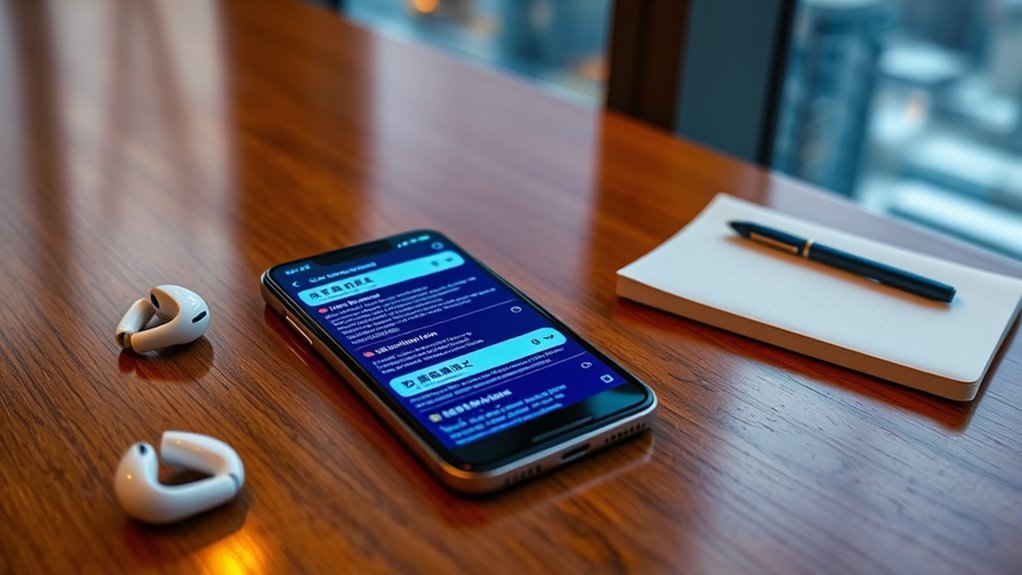
Cloud-based translation services pose significant security risks because they transmit your data over the internet to remote servers, increasing the chances of interception or unauthorized access. When you use these services, your sensitive information could be stored, reused, or analyzed by providers, raising privacy concerns. Breaches in cloud infrastructure could expose confidential documents, emails, or business communications. Additionally, many free tools have weak security protocols, heightening the risk of data leakage. Service providers might also use your data for targeted advertising or model training without your consent, compromising privacy. To protect your information, you should consider on-device translation options.
Using cloud translation risks data breaches and privacy violations; consider on-device options for better security.
- Data interception risks due to transmission over unsecured networks
- Unauthorized access from cloud breaches or insider threats
- Unclear compliance with privacy laws and data handling policies
Real-World Incidents Highlighting Data Breaches
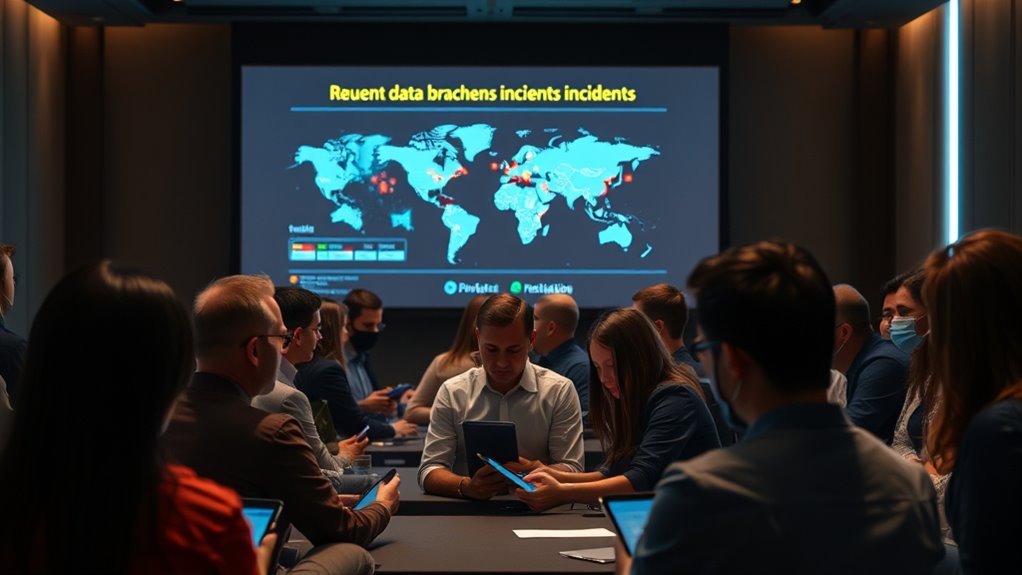
Real-world incidents have demonstrated how translation-related data breaches can expose sensitive information. For example, Translate.com’s breach leaked confidential documents like contracts and performance reports, risking privacy. Similarly, organizations such as Statoil faced exposure of sensitive data due to insecure translation tools. Law firms and healthcare providers also suffered privacy violations after using cloud services for confidential documents. Employee use of free translation tools led to accidental leaks of trade secrets and internal emails. Over 4 billion records were exposed in early 2019, some involving translation data breaches, illustrating widespread vulnerabilities. To understand the risks, consider this comparison:
| Incident Type | Data Exposed | Consequences | Vulnerability | Security Measure |
|---|---|---|---|---|
| Translate.com breach | Confidential docs | Privacy loss | Weak security | On-device translation |
| Statoil incident | Sensitive company data | Reputation damage | Insecure tools | End-to-end encryption |
| Healthcare breach | Patient info | Legal penalties | Cloud vulnerabilities | Regular security audits |
| Employee leaks | Trade secrets | Competitive harm | Unverified apps | Use trusted platforms |
| 2019 data leak | 4B records | Data misuse | Poor data controls | Strict access policies |
Strategies for Ensuring Secure and Private Translation
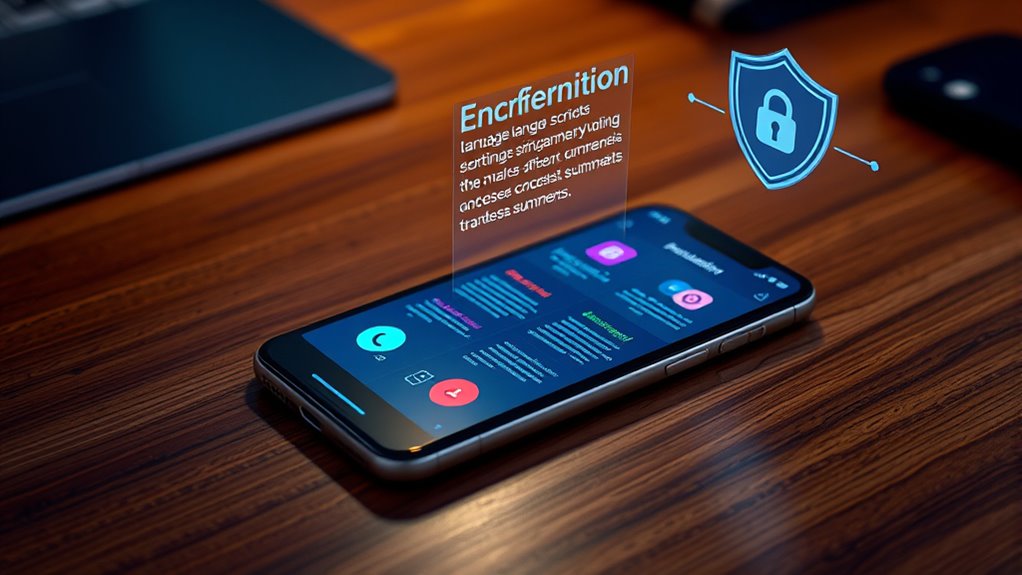
To protect sensitive information from data breaches, adopting effective strategies for secure and private translation is essential. First, prioritize on-device translation whenever possible, as it keeps data local and minimizes external risks. Second, select translation tools with transparent privacy policies, compliance certifications like GDPR, and strong encryption protocols. Third, regularly update your translation apps and devices to patch vulnerabilities and enhance security. Additionally, limit data sharing permissions within the apps and avoid using free or unverified services for confidential content. These practices help safeguard your information from interception, unauthorized access, and data misuse, ensuring your translations remain private and secure. By applying these strategies, you reduce exposure and maintain control over sensitive data during translation processes.
Balancing Convenience and Privacy in Language Tools
Balancing convenience and privacy in language tools requires careful consideration of the tradeoffs involved. On-device translation offers privacy by keeping data local, but may sacrifice some translation quality and features. Cloud-based options deliver faster, more accurate results but expose your data to security risks and potential breaches. To visualize this, consider the following:
| Convenience | Privacy |
|---|---|
| Quick, real-time translations | Data stays on your device |
| Access to advanced features | Minimal external data sharing |
| No internet needed for basics | Reduced risk of hacking |
| Easy updates through internet | Control over sensitive info |
| Seamless multi-language support | Compliance with privacy laws |
Choose based on your needs: prioritize speed and features or safeguard sensitive information.
Frequently Asked Questions
Can On-Device Translation Handle All Languages Effectively?
On-device translation can’t handle all languages effectively yet. It performs well with popular languages like English, Spanish, and French, but struggles with less common or complex dialects due to limited processing power and smaller language models. You might find some translations less accurate or incomplete, especially for rare languages. For exhaustive coverage, cloud-based services still offer better support, though they come with higher privacy risks.
How Often Do Offline Translation Models Need Updating?
Did you know that most offline translation models need updates every few months? You should update your on-device translation models around every 3 to 6 months. Regular updates improve accuracy, expand language coverage, and fix bugs. If you skip updates, your translations might become less reliable or miss new slang and terminology. Keep your device connected periodically to download these updates, ensuring your translations stay current and effective.
Are There Any Costs Associated With On-Device Translation Tools?
Yes, there are costs associated with on-device translation tools. You may need to purchase or subscribe to the app or service, especially for premium features or extensive language packs. Additionally, downloading updates or new language packs consumes storage space and data. Sometimes, upgrading your device’s hardware or software is necessary to run the latest versions smoothly, which can also incur expenses. Overall, while on-device translation enhances privacy, it may involve some financial investment.
What Are the Limitations of Real-Time Speech Translation Offline?
Offline real-time speech translation faces limitations like reduced accuracy compared to cloud-based services, as local devices have less processing power and smaller language models. You might experience delays or less natural translations, especially with complex phrases or accents. Additionally, advanced features such as real-time speech recognition or multiple language support may be unavailable offline. Updates or bug fixes often require internet access, which can temporarily interrupt or limit your translation capabilities.
How Do I Verify a Translation App’s Privacy Compliance?
You verify a translation app’s privacy compliance by checking its privacy policy for clear statements on data handling, storage, and sharing. Look for certifications like GDPR or ISO 27001, and research user reviews or expert reports. Confirm the app processes data locally or securely encrypts transmissions. Regularly update the app, and avoid free or unverified services. If unsure, contact the provider directly to confirm their privacy practices and compliance standards.
Conclusion
Ultimately, choosing between on-device and cloud translation is like walking a tightrope—you weigh privacy against convenience. On-device processing keeps your data close, like a guarded secret, but faces limitations. Cloud services offer ease but can expose sensitive info. By understanding these tradeoffs, you can navigate this digital tightrope with confidence, balancing your need for privacy with the desire for seamless translations. Remember, in this digital age, safeguarding your data is the anchor that keeps you steady.