
TL;DR
Mistral is betting on European sovereignty, control, and open weights to carve out a niche. Critics argue it may lag in reasoning and scale, but its growth shows a different game that prioritizes enterprise trust over leaderboard dominance.
When you hear about Mistral, you might wonder if they’re leading a new wave or just trying to hold on. Their recent summit painted a picture of a company shifting gears—no longer just building models, but offering the whole AI stack. The real question: are they innovating in strategy, or just playing catch-up in a game others are already winning?
If you care about AI independence, control, and European enterprise needs, this story hits close to home. We’ll explore what Mistral is really up to, whether it’s a smart move or a sign of trouble, and what it means for the future of AI in Europe and beyond.
Different game, or already lost?
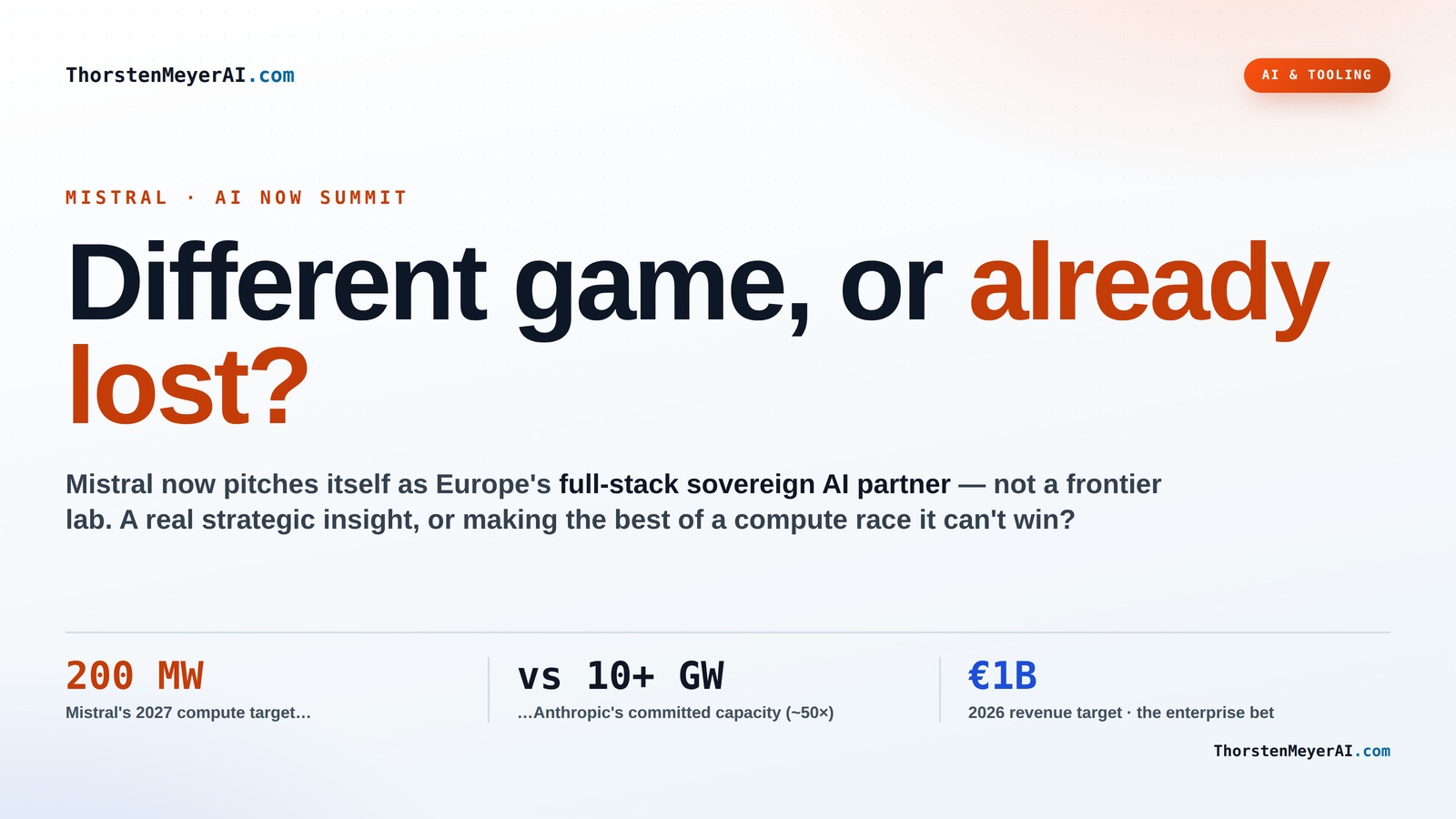
Mistral now pitches itself as Europe’s full-stack AI provider — compute, models, platform, consultancy — not a frontier-model lab. Is that a real strategic insight, or making the best of a race it can’t win? Both readings fit the same facts.
From model lab to full-stack provider
The clearest signal from the summit wasn’t a model — it was a posture. Heavy on enterprise logos and partnerships (ASML, BNP Paribas, Alexa+), light on new-model announcements. That absence is exactly what skeptics seized on.
Compute
40MW Paris DC + Sweden build · 200MW target by 2027
Models
Open & custom · efficient · you own and run them
Platform
Forge for custom models · Vibe for Work agent
Consultancy
Sales teams, integrators, EU provenance & support
Small & focused, or large & general?
Mistral bets on specialized small models. The claim isn’t that they win a reasoning leaderboard — they don’t. It’s that on the metrics that matter in production agent systems, a purpose-built small model wins. Flip the metric to see the case reverse.
Small specialized vs large general — by what you measure
In token-heavy agentic apps making hundreds of calls, speed/energy/cost compound. Toggle the metric.
Narrow models doing real work
Each is one model doing one thing efficiently — the tangible version of the strategy. Strong on their own terms; the open question is whether the bundle beats a free Chinese open-weight download.
On-prem KYC compliance
Mistral models run inside the bank’s walls for know-your-customer checks. Sensitive financial data never leaves. (BNP was Mistral’s first customer, 2023.)
Voxtral multilingual voice
A focused voice model powering Alexa+ across Europe — speed and efficiency over raw size.
Robostral industrial robotics
Plus a “physics AI” push (via the Emmi acquisition) into aerospace, automotive & semiconductor design and simulation.
Document AI / OCR at scale
Large-scale text extraction — the unglamorous, high-volume enterprise work small models excel at.
The strategy is downstream of the compute gap
Once you see the raw numbers, “why is Mistral behind?” answers itself — and the specialized-small-model strategy starts looking partly like a smart adaptation to a binding constraint, not a pure philosophical choice.
Compute & capital · Mistral vs a frontier leader, this same week
Not a knock — it’s the constraint that forces the efficiency-first, sovereignty-wedge strategy. Adapting intelligently to your position is what good strategy is.
“I want them to win, but I’m worried”
That ambivalence is the most accurate read of where Mistral sits. The enterprise pivot gets read two opposite ways — and both deserve airing.
On-prem, real sales teams, the Koyeb deployment acquisition, EU provenance — exactly what regulated enterprises want, and stickier than consumer mindshare. Targeting €1B revenue in 2026 with 1,000 staff, up from 15 people and one customer in 2023. US closed-API labs structurally can’t match the sovereignty axis.
“Software consultancy with a data center,” not a foundation-model moat. Enterprise B2B is where European startups go when they can’t win consumer or world-scale SaaS. Why pay Mistral on-prem when you could run Qwen free? One paying Le Chat Pro user said the quality gap with frontier labs is now hard to ignore.
Key Takeaways
- Mistral’s sovereignty focus appeals to European regulated sectors that prioritize control over data and models.
- Open weights give customers flexibility and transparency, reducing dependence on U.S. cloud giants.
- Small, specialized models can outperform larger ones in speed and cost, crucial for enterprise applications.
- Despite lagging in reasoning benchmarks, Mistral’s growth shows a market valuing trust, sovereignty, and control.
- Choosing Mistral means prioritizing strategic independence over raw AI performance, especially in Europe.
As an affiliate, we earn on qualifying purchases.
Why Mistral’s Sovereignty Focus Might Be a Game Changer
Mistral’s biggest pitch is about sovereignty—control over data, models, and infrastructure. Unlike U.S. giants like OpenAI, which lock customers into closed APIs, Mistral offers downloadable, fine-tunable weights that sit inside your own secure environment. Think of a European bank running Mistral models on-prem, keeping sensitive data in-house while still accessing powerful AI.
This approach appeals especially to regulated sectors—finance, defense, government—that need transparency and control. For example, BNP Paribas uses Mistral models for KYC compliance without leaking customer info outside their walls. It’s a clear sign that, for some customers, sovereignty isn’t just a buzzword—it's a must-have.
Yet, critics wonder: is this enough to compete on performance? Or is it just a niche solution for a shrinking segment? The core implication here is that sovereignty might limit the scale and rapid innovation that comes with cloud-based models. While offering control, it can also mean slower updates and less access to the cutting-edge training techniques that large labs develop. The tradeoff is between trust and agility, and the future success depends on how well Mistral balances these competing needs.

Open Weights and Customization: Why They Matter More Than Ever
Mistral’s early success came from releasing open weights like the 7B models and Mixtral 8x7B. These aren’t just downloads—they’re a statement about democratizing AI access and control. By providing open weights, Mistral allows organizations to customize, optimize, and deploy models in their own secure environments, which can be a game-changer in regulated markets where compliance and data privacy are paramount.
This openness fosters a deeper level of trust. Customers are not just consumers; they become co-owners of the model, capable of tuning it to specific needs without relying on external providers. This reduces dependency on U.S. or Chinese cloud giants, giving organizations sovereignty over their AI assets. The implication is that open weights are not just a technical choice—they are a political and strategic stance, signaling independence in a landscape dominated by proprietary, API-driven models.
However, critics point out that open weights might not match the performance of models trained with massive compute resources. The tradeoff is between customization and raw capability. The question for Mistral—and its customers—is whether open weights can close this gap as models evolve. Success here could reshape the competitive landscape, emphasizing control and transparency over sheer scale.

The Small Model Focus: Fast, Cheap, Focused
Mistral champions small, purpose-built models over massive general-purpose giants. These models are designed for specific tasks—like multilingual voice recognition or document summarization—where speed, efficiency, and cost matter more than raw scale. The strategic advantage is that smaller models require less compute, are easier to deploy on-premises, and can be updated and maintained more rapidly, which is essential for enterprise environments with strict latency and privacy requirements.
For example, their Voxtral model powers Alexa+ in Europe, handling multilingual voice tasks swiftly and cheaply. This focus on niche, high-performance models enables enterprises to tailor AI to their exact needs, avoiding the pitfalls of one-size-fits-all solutions that often come with larger models.
Furthermore, this approach challenges the assumption that bigger is always better. By focusing on targeted tasks, Mistral can deliver higher accuracy and reliability in specific domains, which is often more valuable for enterprise applications than chasing state-of-the-art benchmarks. This strategy emphasizes practical utility and operational efficiency, which are crucial for real-world AI deployment.

Is Mistral Falling Behind or Playing a Different Game?
The core debate is whether Mistral is genuinely innovative or simply trying to survive. Read more about technology trends. Critics point out that Mistral’s models lag behind in reasoning, context size, and benchmark performance compared to giants like OpenAI or Google. For example, their models struggle with complex reasoning tasks or longer context windows, which are increasingly necessary for advanced applications such as legal analysis or scientific research. This can limit their ability to compete in cutting-edge AI applications that demand high-level cognition and understanding.
On the other hand, Mistral argues that their focus on sovereignty, customization, and enterprise needs creates a different, more sustainable game. They prioritize trust, compliance, and control—values that resonate strongly in regulated sectors. This strategic choice might mean sacrificing some performance benchmarks but gaining customer loyalty and market stability. The tradeoff here is between chasing the highest leaderboard scores and building a resilient, trusted ecosystem that can adapt to evolving regulations and enterprise demands.
Ultimately, whether this is a sign of being behind or simply a different strategic path depends on what the industry values more—benchmarks or trust. Long-term success may hinge on how well Mistral can bridge the performance gap while maintaining its core commitments to sovereignty and enterprise focus.

What the Market Really Wants: Control or Benchmark Wins?
European enterprises increasingly ask: where are the model weights hosted? Who controls updates? How do we document compliance? For many, the answer is control—over data, over models, over upgrades. Mistral’s value proposition resonates here because it addresses these fundamental concerns, emphasizing local deployment and transparency. This focus can lead to stronger relationships with clients who prioritize security, compliance, and independence over raw performance metrics.
However, the broader AI race is still heavily driven by performance. Giants like OpenAI and Google push the boundaries of reasoning, language understanding, and scale, which often translate into better results in benchmarks and real-world applications. The question becomes: can sovereignty-focused firms like Mistral keep pace in this high-stakes environment? The tradeoff involves balancing the desire for control with the need for cutting-edge capabilities. For regulated sectors, this might mean accepting slightly lower accuracy in exchange for higher trust and compliance.
The implication is that the market’s priorities are shifting—trust and control are becoming as vital as performance, especially in sensitive industries. Mistral’s approach caters to this evolving landscape, but long-term success will depend on how well they can innovate without sacrificing their core value of sovereignty.

Is Mistral Growing Fast or Just Rhetorically Positioned?
Despite smaller size and less hype, Mistral’s growth is impressive. Their models are adopted by key European institutions, and their recent summit showcased big enterprise logos. They’ve announced ambitious plans—€1.2 billion in new data centers, 200MW of compute by 2027—aiming to build a robust infrastructure to support sovereignty-focused AI deployment. This indicates a strategic long-term vision to establish a self-reliant European AI ecosystem.
However, skeptics point out that Mistral still trails in reasoning benchmarks and context lengths, which are critical for advanced AI applications. Their models may not yet match the capabilities of the largest labs, raising concerns about whether they can truly compete on the global AI stage. The question is whether their growth is sustainable or primarily rhetorical—focused on positioning rather than immediate technical dominance.
The key insight is that growth driven by enterprise trust, local regulation compliance, and sovereignty might be more valuable in the European context than raw benchmark scores. If Mistral can continue to build a reliable, trusted ecosystem, it could secure a dominant niche even without leading on all technical fronts.

Should You Bet on Mistral or Write It Off?
If your priority is cutting-edge reasoning and the largest models, Mistral might seem lagging. But if control, compliance, and sovereignty matter more, they’re a serious contender. Their open weights and European focus make them appealing for regulated sectors.
Think of Mistral as a chess move—more about positioning than checkmate. Their game is different, and that might be enough for a long-term win. Their strategy aims to build a trusted, sovereign infrastructure that can withstand geopolitical and regulatory pressures, which could be a more durable foundation than chasing performance alone.
In the end, the best move depends on what you value: raw power or strategic independence. For organizations prioritizing security, compliance, and local control, Mistral’s approach could be more aligned with their long-term needs than the race for the highest benchmark scores.
Frequently Asked Questions
What does ‘sovereign’ mean in Mistral’s case?
In Mistral’s context, ‘sovereign’ means giving customers control over their models and data. They can run models on-premises, tweak weights, and avoid dependence on external cloud providers, aligning with European data regulations.How is Mistral different from OpenAI and Google?
Mistral focuses on open weights, local deployment, and sovereignty, while OpenAI and Google predominantly offer API-based access. Mistral’s models are designed for organizations that want control over their AI infrastructure.Is Mistral actually winning in Europe, or just well-positioned rhetorically?
Mistral is gaining traction with European governments, banks, and enterprises. While not leading in reasoning benchmarks, its focus on sovereignty and open models makes it a trusted partner in the region.Are open-weight models still strategically important in 2026?
Yes. They provide transparency, control, and customization that are critical for regulated sectors. As trust and sovereignty become key, open weights remain a strategic advantage.Is Mistral falling behind on reasoning, coding, or context length?
In raw reasoning and large context sizes, yes. Critics say Mistral models lag behind giants like OpenAI, but their focus on enterprise needs and control offers a different, valuable kind of strength.Conclusion
In the end, Mistral is playing a different game—one that values control, sovereignty, and enterprise trust over leaderboard wins. That’s a powerful position in Europe, where regulation and independence shape the market.
If you care about data sovereignty, Mistral’s approach might be exactly what you need—whether it’s a long-term game or a new frontier. Remember: in AI, sometimes playing a different game is the smartest strategy of all.