
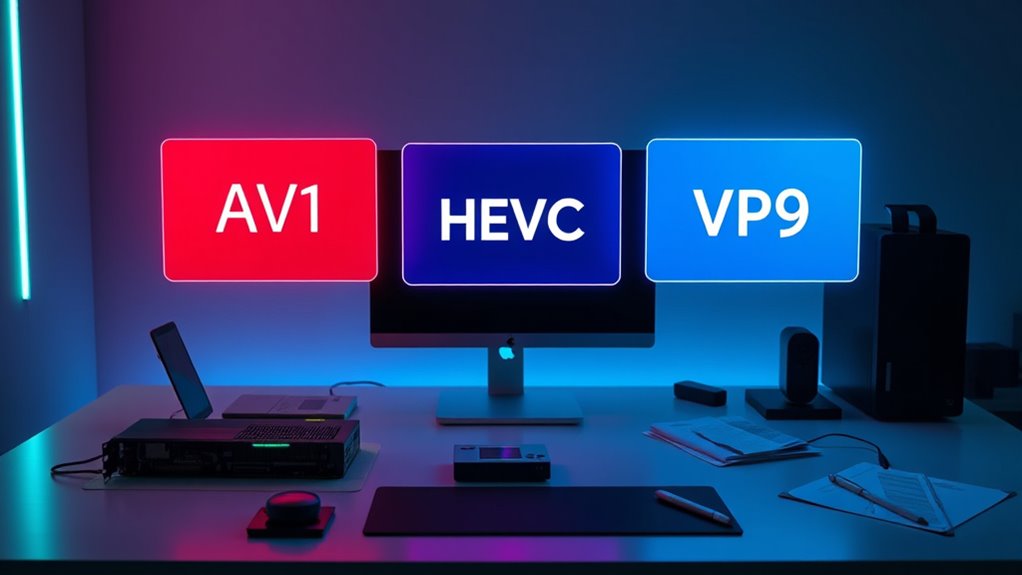
By 2025, your devices are likely to decode AV1, HEVC, and VP9, each offering different benefits. AV1 delivers the best compression efficiency and image quality, but hardware support varies. HEVC remains common, especially in smartphones and TVs, despite licensing costs. VP9 still plays a role on platforms like YouTube. Understanding how each codec performs on your devices can help you optimize your streaming experience—there’s more to discover if you keep exploring.
Key Takeaways
- AV1 offers superior compression and quality, increasingly supported by new devices, but hardware decoding isn’t yet universal in 2025.
- HEVC remains widely supported across smartphones, TVs, and computers, especially on high-end devices, despite licensing costs.
- VP9 continues to dominate on platforms like YouTube and Android devices where AV1 hardware support is still developing.
- Hardware support for AV1 is expanding, but older devices may still rely on software decoding, affecting performance and battery life.
- In 2025, devices are likely to decode all three codecs, with AV1 gaining ground as hardware support improves for efficient streaming.
Compression and Video Quality in 2025
By 2025, AV1 has solidified its position as the leading codec for compression efficiency and video quality. You’ll notice that AV1 delivers up to 30% better compression than VP9 and up to 50% more efficient than H.264 at the same visual quality. This means you get sharper, more detailed videos without increasing bandwidth. AV1’s advanced block partitioning (up to 128×128 pixels) and prediction techniques allow it to preserve fine details and reduce artifacts, especially at lower bitrates. Advanced compression algorithms contribute to AV1’s superior performance and enable it to adapt to diverse streaming scenarios. While HEVC still excels in 4K and HDR content, AV1’s native support for HDR and wide color gamut enhances overall image quality. As a result, AV1 consistently offers superior clarity, color depth, and fewer compression artifacts compared to VP9 and H.264, making it ideal for high-quality streaming in 2025. Additionally, hardware decoding capabilities are increasingly optimized for AV1, ensuring smoother playback on a wider range of devices.
Licensing, Hardware Support, and Compatibility
When choosing a video codec, understanding licensing, hardware support, and compatibility is essential. AV1 is open-source and royalty-free, making it appealing for platforms and developers seeking cost-effective solutions. However, hardware support for AV1 is growing but not universal; recent GPUs from AMD, Nvidia, Intel, Apple, and Qualcomm support hardware decoding, yet some devices rely on software decoding, which is more demanding. hardware acceleration plays a significant role in decoding efficiency and power consumption during playback. The effectiveness of hardware acceleration depends on the specific hardware decoding capabilities of a device, which can vary widely. Compatibility with legacy devices remains a concern for some users, potentially limiting the reach of newer codecs. HEVC enjoys widespread hardware support across smartphones, TVs, and computers, especially on Apple devices and modern displays, but it requires licensing fees, which can limit adoption. VP9 is supported on many Android devices and some desktop GPUs, with browser support strong in Chrome, Firefox, and Edge. Compatibility varies based on device age and hardware capabilities, influencing playback performance and efficiency. Additionally, compatibility considerations are crucial for ensuring smooth playback across diverse devices and platforms.
Usage Trends and Device Capabilities
As device capabilities and platform support evolve, the adoption of different codecs continues to shift. You’ll find AV1 gaining traction on newer smart TVs, smartphones, and browsers, but full hardware support isn’t universal yet. Many recent GPUs from AMD, Nvidia, Intel, Apple, and Qualcomm support AV1 decoding, making it more accessible on high-end devices. HEVC remains widely supported across most modern smartphones, TVs, and computers, ensuring seamless playback on many devices. VP9 is still prevalent on YouTube and Android devices, especially where AV1 isn’t yet supported. Browser support for AV1 is growing strong, but older hardware may rely on software decoding, which can impact performance. Overall, device capabilities are steadily catching up, favoring AV1’s expanding role in streaming and multimedia consumption. Increasingly, support for pressure relief is crucial for smoother playback, especially on devices with limited hardware decoding capabilities. Furthermore, staying informed about video codec support helps consumers make better choices aligned with their device capabilities and viewing preferences. As support for hardware acceleration continues to improve, users can expect more efficient playback and reduced battery consumption on compatible devices. Additionally, ongoing development in adaptive streaming technologies ensures a better viewing experience across diverse network conditions. Moreover, the integration of error resilience features in newer codecs enhances playback quality over unstable network connections.
Frequently Asked Questions
Will Older Devices Support AV1 Hardware Decoding in 2025?
Older devices may not support AV1 hardware decoding in 2025. You might find that some older smartphones, TVs, and computers lack the necessary hardware acceleration, relying instead on software decoding, which can slow performance and increase battery use. While newer devices from major manufacturers are adding AV1 support, it’s important to check your device’s specifications to see if it’s compatible. Upgrading hardware might be needed for seamless AV1 playback.
How Does Av1’s Encoding Speed Compare to HEVC and VP9?
You’ll find AV1’s encoding speed is slower, more CPU-intensive, and more resource-heavy than HEVC and VP9. While HEVC encodes faster with moderate CPU demands, VP9 strikes a balance with quicker encoding and lower demands. AV1’s advanced compression techniques come at a cost, making the encoding process take longer, especially on older hardware. If speed matters, HEVC and VP9 offer more efficient options, but AV1 delivers superior quality at the expense of time.
Are There Any Major Streaming Platforms Exclusively Using AV1 in 2025?
In 2025, several major streaming platforms are exclusively using AV1 for their content delivery. Netflix, YouTube, and Amazon Prime Video prioritize AV1 because of its superior compression and royalty-free licensing, making it ideal for high-quality, low-bandwidth streaming worldwide. By choosing AV1, they guarantee broader accessibility, cost savings, and future-proofing, especially for 4K and 8K content. These platforms are leading the shift toward AV1’s widespread adoption.
What Are the Main Differences in HDR Support Among These Codecs?
Think of HDR support as a palette of colors, where AV1 is a vibrant artist with native HDR and Wide Color Gamut, painting scenes with rich detail. HEVC also excels, especially in high-quality 4K and HDR content, but lacks AV1’s seamless integration. VP9 offers limited HDR capabilities, making it less ideal for immersive visuals. Your device’s choice depends on how vividly you want your content to pop.
Will Licensing Costs Affect the Adoption of HEVC in the Future?
Licensing costs will likely slow HEVC’s adoption in the future, especially for smaller companies and open platforms. You might find it more challenging to use HEVC without paying licensing fees, which can increase production costs. As AV1 becomes more popular due to its royalty-free status and high efficiency, you’ll probably see a shift away from HEVC, especially in streaming and web applications, favoring open, cost-effective codecs.
Conclusion
By 2025, you’ll find AV1, HEVC, and VP9 each playing their part in your device’s playback. While AV1 leads with better compression and future-proofing, HEVC remains popular on many devices, and VP9 still holds its ground. It’s a balancing act, but knowing which codec your device supports helps you stay ahead of the curve. Remember, in this tech race, it’s best to keep your eyes open and adapt before you’re left in the dust.