
USB4 Version 2.0 offers impressive speeds up to 80 Gbps symmetric and 120 Gbps asymmetric, enabling faster data transfers and streaming. Many existing USB-C cables with PAM3 support can handle these speeds, but not all do, so check cable specifications. Both passive and active cables are supported, with newer cables needed for full performance. To discover how these advances can benefit your devices and the latest cabling options, keep exploring further.
Key Takeaways
- USB4 v2.0 offers up to 80 Gbps symmetric and 120 Gbps asymmetric speeds, supporting high-bandwidth data transfers.
- Existing USB-C passive cables with PAM3 support can achieve 80 Gbps, but not all cables are compatible; verification is needed.
- New active cables may be required for full 80 Gbps performance, with industry certification processes evolving for compliance.
- Compatibility is maintained with older cables, though optimal speeds often need upgraded cables supporting PAM3 and higher bandwidth.
- Market adoption is expected in 2025, emphasizing the importance of high-quality cabling and device support for maximum performance.
Enhanced Data Transfer Speeds With USB4 V2.0
USB4 Version 2.0 substantially enhances data transfer speeds, allowing you to experience much faster connectivity. With speeds reaching up to 80 Gbps symmetrically, you’ll notice quicker file transfers and smoother data streaming. For even greater performance, it supports asymmetric configurations of up to 120 Gbps in one direction, ideal for high-bandwidth tasks like 8K video editing or large data backups. This is achieved through advanced PAM3 encoding and dual-lane operation, effectively doubling the previous USB4 40 Gbps standard. You’ll benefit from reduced latency and increased throughput, making your high-performance applications more efficient. Whether you’re transferring massive files or running demanding peripherals, USB4 v2.0 guarantees your setup is future-proof, delivering the speed you need for today’s most intensive digital tasks. Upgrading your data transfer technology can further optimize your device performance and ensure compatibility with emerging standards. Additionally, the integration of creative practice principles encourages ongoing innovation in hardware design, ensuring future standards meet evolving user needs. The implementation of advanced encoding methods further enhances overall efficiency and reliability in high-speed data transmission. Incorporating contrast ratio considerations can also improve visual feedback on compatible displays, supporting more accurate diagnostics and performance tuning. Considering tuning options from the automotive world highlights the importance of optimized performance and reliability in high-speed data systems.
Compatibility of Existing and New Cables for 80 Gbps
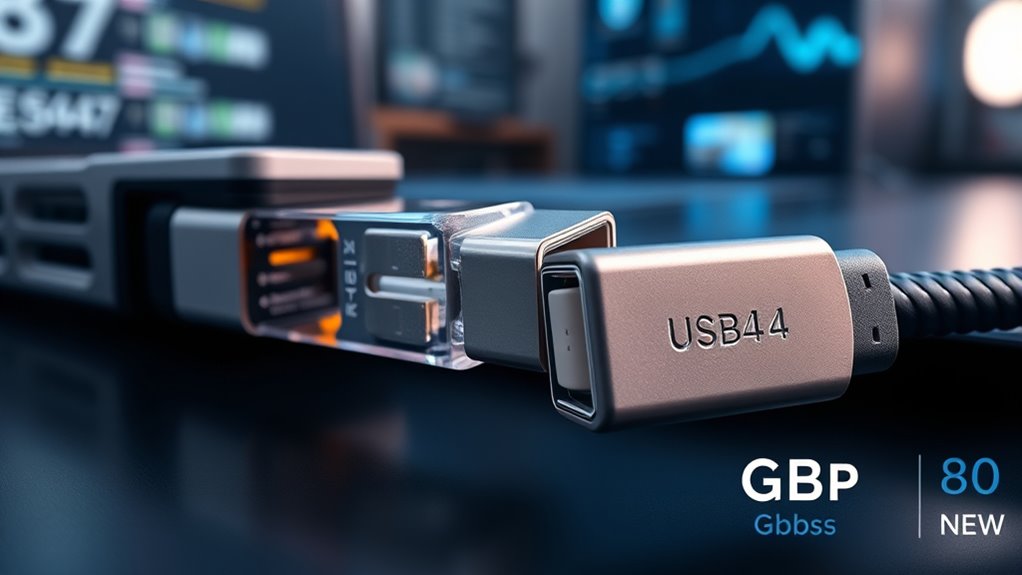
To achieve 80 Gbps data transfer speeds with existing cables, you can use current USB-C passive cables that support PAM3 encoding, which are backward compatible and capable of handling the higher bandwidth. These cables, designed for USB4, can transmit the increased data rates without needing immediate upgrades. However, not all cables are created equal; some may not support PAM3 or the full 80 Gbps speed. It’s crucial to verify cable specifications before use. Additionally, cable compatibility depends on proper implementation of standards like PAM3. Ensuring proper cable quality is essential for maintaining optimal performance and avoiding potential issues. Selecting cables from reputable manufacturers can further enhance reliability and performance. Below is a quick comparison:
| Cable Type | Supports 80 Gbps | Compatibility |
|---|---|---|
| Passive USB-C | Yes (with PAM3) | Backward compatible |
| Active USB-C | Yes (requires new specs) | Full 80 Gbps support |
| Older USB-C | No | Limited to 40 Gbps or less |
Choosing the right cable guarantees maximum performance and compatibility.
Advances in Protocol Tunneling and Multi-Protocol Support

With USB4 Version 2.0, you gain better multi-protocol tunneling that supports USB, PCIe, and DisplayPort simultaneously. This upgrade reduces legacy overhead, freeing up more bandwidth for high-speed data transfer. As a result, your devices can handle complex workflows more efficiently without sacrificing performance.
Enhanced Multi-Protocol Tunneling
Recent advances in protocol tunneling within USB4 Version 2.0 markedly enhance multi-protocol support by enabling simultaneous transmission of USB, PCIe, DisplayPort, and host-to-host traffic over a single connection. This improvement allows you to run multiple high-bandwidth protocols concurrently, maximizing the utility of each cable and port. You no longer need separate connections or complex setups for different data types, as the system dynamically manages traffic flows across protocols with minimal overhead. By reducing protocol overhead and streamlining data pathways, USB4 v2.0 delivers greater effective bandwidth. This means your devices can handle demanding tasks like 8K video, fast storage, and multiple peripherals seamlessly, all through unified tunneling. It simplifies your setups while boosting performance, making your workflows more efficient and versatile.
Reduced Legacy Overhead
Advances in protocol tunneling within USB4 Version 2.0 markedly reduce legacy overhead, allowing more bandwidth to be dedicated to high-speed data transfer. You benefit from streamlined data pathways that diminish the time spent handling older protocols like USB 2.0 and USB 3.2, freeing up bandwidth for faster, more efficient transfer. This is achieved through improved tunneling methods that prioritize modern protocols such as USB 3.2 Gen T and PCIe, which now operate with minimal overhead. As a result, you experience higher throughput and lower latency, especially during simultaneous multi-protocol communication. These enhancements ensure that your high-performance peripherals—such as 8K displays, ultra-fast SSDs, and complex multi-device setups—operate smoothly without legacy protocol bottlenecks, maximizing the full potential of USB4 Version 2.0. Additionally, vetted compatibility with a wide range of cables ensures consistent performance and reduces connection issues. Reduced legacy overhead also contributes to a more efficient overall system performance by minimizing unnecessary protocol translation delays. Incorporating advanced protocol support helps future-proof your setup as new standards continue to evolve, and ongoing innovations in protocol tunneling further optimize data transfer efficiency. Moreover, these improvements facilitate better integration with tuning of high-performance components, ensuring that data transfer capabilities keep pace with emerging technologies.
Power Delivery Upgrades and Power Management Capabilities

USB4 Version 2.0 substantially boosts power delivery capabilities, supporting up to 240W to handle more demanding devices. You’ll also benefit from advanced power management features that optimize energy use and extend battery life. These upgrades make your connected devices more versatile and efficient than ever before. Additionally, the new security protocols incorporated into the standard help safeguard data during transfer, enhancing overall system security. The standard also emphasizes efficient heat dissipation, ensuring that high-power devices operate safely without overheating during extended use. Incorporating energy-efficient materials can further improve thermal management and sustainability. Moreover, the integration of power management systems can help monitor and optimize energy consumption across multiple devices.
Enhanced Power Levels
With the introduction of USB4 Version 2.0, power delivery capabilities have been considerably enhanced, allowing devices to draw up to 240W of power. This upgrade supports more demanding peripherals, including high-performance laptops and docking stations. You can now power multiple devices through a single cable, simplifying setups and reducing clutter. The USB Power Delivery 3.1 update ensures efficient power management, minimizing energy waste. To clarify, here’s a quick comparison:
| Power Level | Device Compatibility |
|---|---|
| 100W | Laptops, smartphones |
| 240W | High-end gaming laptops, docks |
| 60W | Monitors, small peripherals |
This expanded power capacity enables broader device integration and improved energy efficiency, making USB4 v2.0 ideal for future-proof setups. Additionally, understanding power management concepts can help users optimize their device environments for better energy flow and efficiency, especially with the increased power delivery capabilities. Recognizing the importance of power efficiency can further enhance overall device performance and longevity. Incorporating energy-conscious practices can maximize the benefits of these technological advancements and support sustainable device usage.
Advanced Power Management
Have you ever wondered how USB4 Version 2.0 enhances power management? It introduces USB Power Delivery (USB-PD) 3.1, supporting up to 240W, enabling you to power larger devices like laptops and monitors through a single cable. This upgrade means you can charge your device faster and more efficiently without needing multiple power sources. The updated USB Type-C connector remains backward compatible, so your existing cables and accessories continue to work. Power management is now smarter, with improved negotiation protocols that optimize power delivery based on device needs. You also gain better control over power distribution, reducing energy waste. Additionally, these enhancements support power distribution to ensure devices receive optimal power levels during operation. Overall, these enhancements make your setup more streamlined, versatile, and capable of handling higher power demands seamlessly. For safe and reliable power handling, understanding power management is essential to prevent overloads and ensure maximum efficiency.
Implications for Device Manufacturers and Market Adoption

Device manufacturers must adapt quickly to USB4 Version 2.0’s advanced capabilities, as it introduces markedly higher data transfer speeds and enhanced tunneling protocols. You’ll need to redesign or update existing devices to support the new standards, especially for higher bandwidth and power delivery. Compatibility with existing cables remains, but new active cables will be essential for full 80 Gbps support. Certification processes will evolve, requiring rigorous testing to guarantee compliance. Below is a quick comparison to help you understand the key differences:
| Aspect | Previous Version | USB4 v2.0 |
|---|---|---|
| Max Speed | 40 Gbps | 80/120 Gbps |
| Cable Compatibility | Passive cables | Active cables, passive |
| Tunneling Support | Limited | Expanded (USB, PCIe, DisplayPort) |
| Power Delivery | Up to 100W | Up to 240W |
| Market Adoption | Early stages | Launch in 2025 |
Staying ahead requires early investment and innovation to meet new standards. Enhancing cabling technology will be crucial for supporting the increased data rates and power demands.
Future Perspectives on USB4 V2.0 in Consumer Electronics
The adoption of USB4 Version 2.0 is poised to revolutionize consumer electronics by enabling faster data transfer, greater power delivery, and versatile connectivity options. You’ll see devices seamlessly handle 8K video, high-speed storage, and multiple peripherals without extra cables or adapters. Expect smartphones, laptops, displays, and gaming gear to become more integrated, with single cables supporting data, power, and video simultaneously. This standard will push manufacturers to innovate, making devices more compact and efficient. As compatibility broadens, consumers will benefit from more reliable, robust connections and future-proofed technology. Over time, USB4 V2.0 could become the new norm, transforming how you connect, charge, and enjoy your devices, ultimately making your digital experience faster, simpler, and more interconnected.
Frequently Asked Questions
Will Existing USB-C Cables Support 80 Gbps Speeds Reliably?
Yes, existing USB-C passive cables can support 80 Gbps speeds using PAM3 encoding, but only at lower power levels and with some limitations. For full 80 Gbps performance, you’ll need new active cables designed specifically for that speed tier. Make certain to check cable certifications to guarantee compatibility and reliable performance, especially if you’re working with high-bandwidth applications like 8K video or ultra-fast storage.
How Does USB4 V2.0 Ensure Backward Compatibility With Older Devices?
You can trust that USB4 v2.0 guarantees backward compatibility by supporting older standards like USB4 1.0, USB 3.2, USB 2.0, and Thunderbolt 3. It uses adaptable protocols and maintains the USB Type-C connector, so your existing devices and cables still work seamlessly. Plus, passive cables are compatible at lower speeds, allowing you to upgrade gradually without losing functionality or needing new cables immediately.
What Are the New Certification Requirements for 80 Gbps Cables?
Think of certification as the gatekeeper for your high-speed journey. For 80 Gbps cables, you need to meet strict standards that verify speed, power delivery, and compatibility. This involves rigorous testing of signal integrity, connector quality, and adherence to updated specifications. Only cables that pass these checkpoints earn the official badge, ensuring your connection is fast, reliable, and ready to handle the demanding data streams of USB4 v2.0.
How Does USB4 V2.0 Impact Power Delivery and Charging Standards?
USB4 v2.0 enhances power delivery by supporting up to 240W with USB Power Delivery 3.1, allowing faster, more versatile charging. You’ll find that the USB Type-C connector remains the same, ensuring backward compatibility while enabling devices to deliver higher power for laptops, monitors, and other peripherals. This upgrade simplifies your setup by combining data, video, and power through a single cable, making charging more efficient and flexible.
When Will Consumer Devices With USB4 V2.0 Become Widely Available?
You’ll see consumer devices with USB4 v2.0 start arriving in 2025, like new gadgets emerging from the shadows into the light. As tech companies finalize their designs, early adoption will grow, bringing faster data transfer and broader compatibility into your everyday life. Think of this as the dawn of a new era, where your devices seamlessly connect, power, and perform with unprecedented speed, transforming how you work, play, and stay connected.
Conclusion
With USB4 V2.0 pushing boundaries at 80/120 Gbps, you’re on the cusp of a new era in connectivity. As speeds soar and compatibility broadens, imagine the possibilities—faster workflows, richer media, seamless device integration. This upgrade isn’t just technical; it’s a catalyst for innovation, revealing your devices’ true potential. Embrace the future with confidence, because in the race of progress, USB4 V2.0 is your fastest lane to tomorrow.