
NFC and RFID both use wireless radio waves for data transfer, but they serve different purposes. NFC operates at 13.56 MHz and only works within a few centimeters, making it ideal for secure transactions like contactless payments. RFID covers a wider range of frequencies and distances, allowing for tracking large inventories or objects several meters away. If you’re curious about how these technologies differ in security, speed, and application, there’s more to explore below.
Key Takeaways
- NFC operates at 13.56 MHz with a very short range of a few centimeters, while RFID works across multiple frequencies and can reach several meters.
- NFC is designed for secure, close-range transactions like payments and data sharing; RFID is optimized for tracking large quantities over longer distances.
- NFC offers high data transfer speeds suitable for quick exchanges, whereas RFID can scan multiple tags simultaneously for inventory management.
- NFC is embedded in smartphones for personal use, while RFID is widely used in supply chains and warehouse management.
- The key difference lies in range, security, and application: NFC for personal, secure interactions; RFID for large-scale, long-distance tracking.

Have you ever wondered how your smartphone quickly pays for groceries or opens a door? That’s the magic of near-field communication (NFC), a technology that allows devices to communicate wirelessly over very short distances. When you use your digital wallet at checkout or tap your phone to access a secure area, NFC is working behind the scenes, transmitting data instantly and securely. But NFC isn’t the only technology capable of this; radio frequency identification (RFID) also plays a significant role in various applications, especially in inventory tracking and supply chain management. Understanding the differences between NFC and RFID helps you see how each fits into the modern landscape of wireless communication.
NFC and RFID enable quick, secure wireless communication for payments, access, and inventory management.
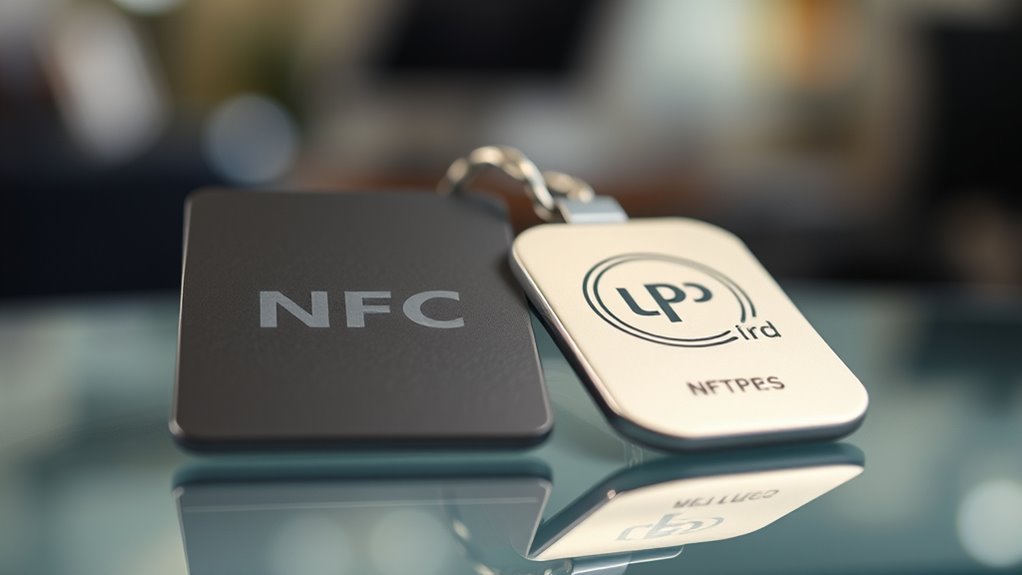
NFC is a subset of RFID, designed specifically for close-range interactions. It operates at a frequency of 13.56 MHz and can communicate across just a few centimeters. Because of this limited range, NFC is ideal for secure transactions like contactless payments, access control, and sharing small amounts of data between devices. It’s built with security in mind, making it suitable for sensitive operations involving digital wallets, where protection against fraud is critical. NFC’s short distance also means it’s less susceptible to interference, enhancing reliability during transactions. The technology’s ease of use and quick setup are why many smartphones come equipped with NFC chips—enabling you to pay, share files, or verify identity with just a tap. Additionally, the high data transfer speeds of NFC support seamless and rapid communication between devices.
RFID, on the other hand, covers a broader spectrum of applications and operates at multiple frequencies—low frequency (125-134 kHz), high frequency (13.56 MHz), and ultra-high frequency (860-960 MHz). This versatility makes RFID especially valuable for inventory tracking in warehouses and retail stores. RFID tags can be read from several meters away, allowing for rapid scanning of many items simultaneously, streamlining stock management, and reducing errors. Unlike NFC, RFID doesn’t require a direct line of sight, which simplifies tracking large quantities of goods in complex environments. RFID’s ability to scan multiple tags at once boosts efficiency and helps organizations keep accurate, real-time inventory data.
While NFC is optimized for personal, close-range interactions, RFID excels in large-scale, long-distance identification tasks. Both use radio waves but differ greatly in range, security, and application scope. Your digital wallet depends on NFC for quick, secure payments, while RFID’s strength lies in managing vast inventories effortlessly. Recognizing these differences helps you appreciate the unique roles each technology plays in everyday life and business. Whether you’re tapping your phone at checkout or a company tracking thousands of products, NFC and RFID are essential tools that make modern interactions faster, safer, and more efficient.
Frequently Asked Questions
Can NFC or RFID Be Hacked Easily?
NFC and RFID can be hacked, but their security vulnerabilities depend on implementation. You’re less likely to face hacking if strong encryption and secure protocols are in place. To prevent hacking, use devices with updated firmware and enable features like two-factor authentication. Be cautious with sensitive data, and avoid sharing your contactless info in insecure environments. Regularly monitoring your devices helps catch any suspicious activity early, enhancing your security.
What Industries Use NFC and RFID Most?
You’ll find NFC and RFID most often used in retail tracking and asset management. Retailers rely on RFID to monitor inventory in real-time, reducing stock errors and theft. Meanwhile, industries use NFC for secure asset management, like tracking high-value equipment or managing access control. These technologies streamline operations, improve accuracy, and boost security, making them essential tools across various sectors.
Are There Any Health Risks Associated With NFC or RFID?
You don’t need to worry much about health concerns with NFC or RFID, as both use very low levels of radiation exposure. The radio waves emitted are non-ionizing, meaning they don’t damage your cells or DNA. Studies show there’s no significant risk linked to regular contact with NFC or RFID devices. So, the technology is safe for everyday use, and health risks are minimal.
How Do NFC and RFID Compare in Cost?
They say “you get what you pay for,” and regarding cost comparison, NFC tags are generally more affordable than RFID tags, especially for small-scale applications. RFID systems tend to have higher setup costs due to their advanced technology and longer read ranges. When doing an affordability analysis, consider how your specific needs align with these costs, since RFID’s higher expense may be justified for larger or more complex projects.
Can NFC or RFID Work Underwater or in Extreme Conditions?
You’ll find that RFID tags, especially those designed for industrial use, often have better underwater durability and extreme environment resilience compared to NFC. RFID systems can be built to withstand harsh conditions like water immersion, extreme temperatures, and chemicals. NFC, on the other hand, is generally more sensitive to environmental factors, making it less suitable for underwater or extreme environment applications unless specially designed for those conditions.
Conclusion
Think of NFC and RFID like different tools in your toolbox—both are essential but suited for different tasks. I once used RFID tags to track inventory across a warehouse, while NFC helped me quickly share contact info at a meetup. Just like choosing a screwdriver or wrench, knowing the difference guarantees you pick the right tech for your needs. Ultimately, understanding when to use each will make your tech interactions smoother and more efficient.