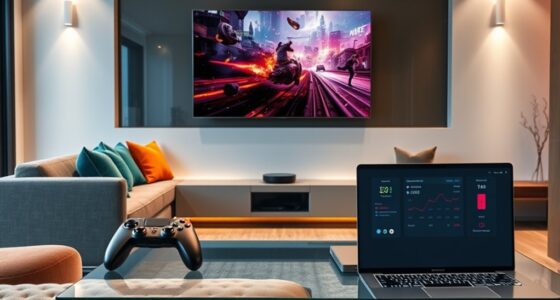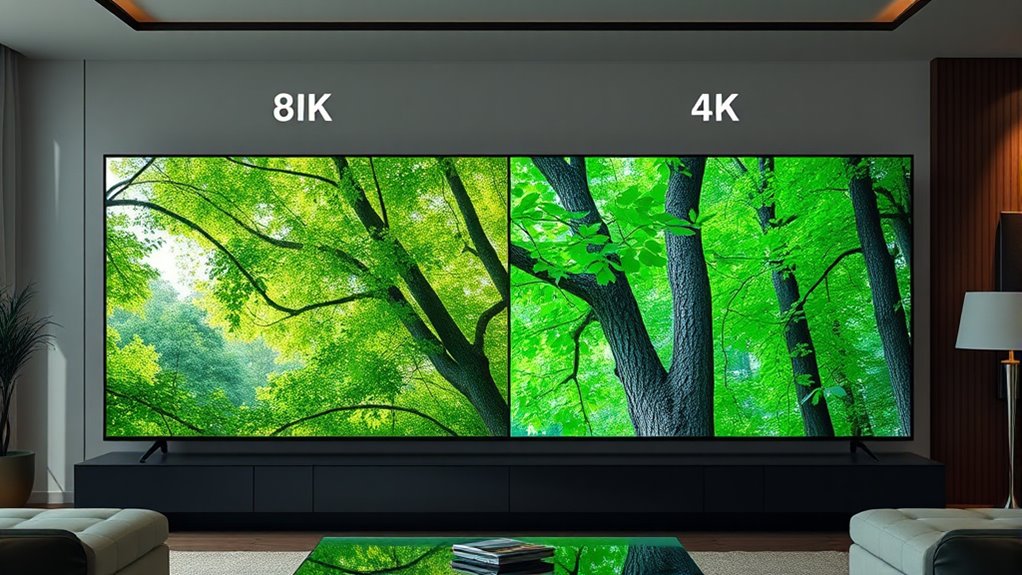

Currently, whether you choose an 8K or 4K TV depends more on HDR support and refresh rates than resolution alone. While 8K offers higher detail, content options are limited, and smaller screens often don’t show much difference. Better HDR and faster refresh rates improve picture quality today. If you want to make a smart choice now, consider these factors—more details on what to look for come next.
Key Takeaways
- HDR quality and refresh rates impact picture quality more than resolution currently does.
- Limited 8K content makes the practical benefits of higher resolution minimal today.
- Smaller screens often don’t show significant differences between 4K and 8K resolutions.
- Advanced HDR formats and higher refresh rates enhance viewing experience more than just resolution.
- 8K TVs are better future-proofed as content and technology adoption increase.
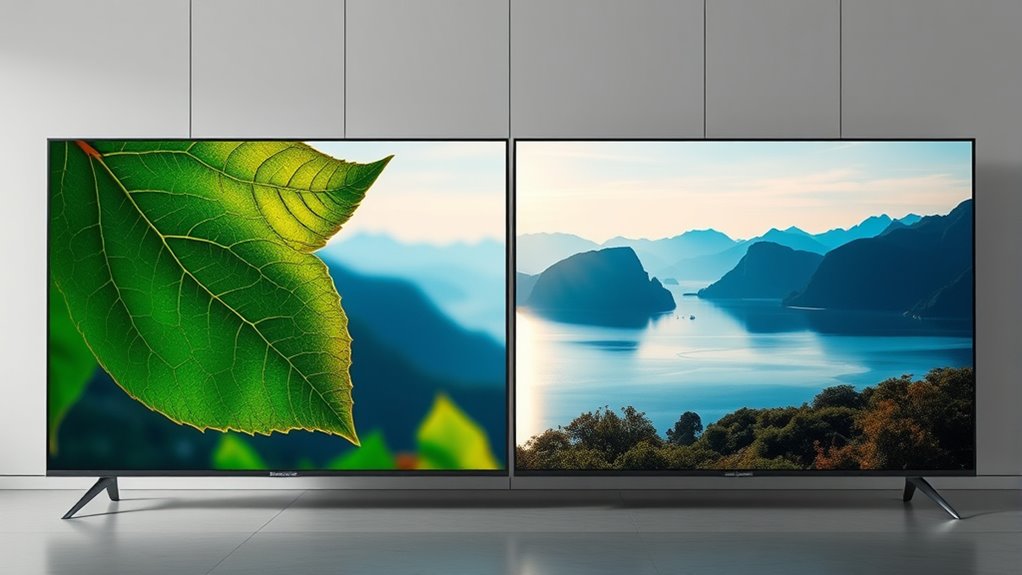
As technology advances, choosing between 8K and 4K TVs can seem confusing, but understanding the key differences helps you make an informed decision. One of the most important factors to consider is HDR technology, which substantially impacts picture quality. High Dynamic Range (HDR) enhances contrast and color, making images look more vibrant and realistic. Both 4K and 8K TVs support HDR, but the implementation and quality can vary. Many 8K models feature advanced HDR formats like Dolby Vision or HDR10+, which offer richer colors and better contrast than standard HDR. However, since 8K content is still limited, having a TV with excellent HDR capabilities is more vital than the resolution itself. If you mainly watch HDR-encoded content, prioritize models with superior HDR support regardless of resolution.
Another key difference lies in refresh rate options, which influence how smooth motion appears on screen. Refresh rate differences are noticeable during fast-paced scenes like sports or gaming. Most 4K TVs offer refresh rates of 60Hz or 120Hz, providing decent motion clarity for everyday use. In contrast, some 8K models come with higher refresh rates, like 120Hz or even 240Hz, which can deliver ultra-smooth motion. If you’re into gaming or binge-watching action-packed content, a higher refresh rate can enhance your viewing experience by reducing motion blur and judder. Keep in mind, though, that higher refresh rates require compatible content and hardware, so check if your devices support these features before investing.
Additionally, the availability of 8K content is still quite limited, which affects the practical benefits of higher resolution. While these technical differences matter, they’re only part of the equation. For most consumers, the availability of 8K content is still sparse, and the benefits of higher resolution aren’t immediately apparent on smaller screens. Instead, HDR technology and refresh rate differences play a more pivotal role in everyday viewing. If you’re choosing a TV now, it’s better to focus on models that excel in HDR and offer higher refresh rates rather than just chasing 8K resolution, which might not make a noticeable difference for most viewers. As content providers gradually adopt 8K, these features will become even more important, but today, understanding how HDR and refresh rates impact your picture quality will help you pick the right TV for your needs.

Hisense 43" E6 Cinema Series Hi-QLED 4K UHD Smart Fire TV (43E6QF, 2025 Model) – AI Light Sensor, Dolby Vision · Atmos, Voice Remote with Alexa, Motion Rate 120, HDR 10+ Adaptive, Game Mode Plus
Hi-QLED Color: Experience a visual treat with Hi-QLED Color. Every frame is rich, vibrant, and true-to-life, ensuring that…
As an affiliate, we earn on qualifying purchases.
As an affiliate, we earn on qualifying purchases.
Frequently Asked Questions
Can 8K TVS Display True 8K Content Now?
Yes, 8K TVs can display true 8K content now, but availability is limited. You’ll notice increased resolution clarity and sharper images, especially on larger screens. However, most content is still upscaled from lower resolutions, so color accuracy and resolution benefits might not be fully realized yet. For the best experience, make certain your source content is native 8K to truly enjoy the detailed visuals and vibrant colors.
How Much More Expensive Are 8K TVS Compared to 4K?
Think of 8K TVs as luxury cars, substantially pricier than 4K models. You’ll find that 8K TVs are generally 2 to 3 times more expensive, depending on brand variations and features. High-end brands like Samsung or Sony command premium prices, while budget options are rarer. If you’re after a cost-effective upgrade, 4K TVs still offer excellent quality without the hefty price tag.
Is There Enough 8K Content Available to Justify an Upgrade?
You probably won’t find enough 8K content available to justify an upgrade right now. Most streaming platforms and broadcasters still focus on 4K or lower resolutions, so content availability for 8K is limited. Unless you’re an early adopter who values future-proofing and has a budget for the upgrade necessity, sticking with a 4K TV makes more sense until 8K content becomes more widespread.
Do 8K TVS Require More Powerful Hardware or Internet Speeds?
Yes, 8K TVs do require more powerful hardware and internet bandwidth. To stream 8K content smoothly, you’ll need a compatible device with higher processing power and a robust internet connection, typically at least 25 Mbps or more. These hardware requirements guarantee high-quality visuals without lag, while faster internet speeds help handle the large data streams. Upgrading might mean checking your hardware and internet plan to fully enjoy 8K content.
Will 8K TVS Become the Standard in the Near Future?
8K TVs are unlikely to become the standard soon because of future adoption challenges and technological hurdles. You’ll find that content availability, hardware requirements, and internet speeds still lag behind, making widespread adoption difficult. While manufacturers push 8K, it’ll take time for these TVs to become mainstream as improvements in technology and content creation overcome current limitations. So, don’t expect 8K to dominate your viewing experience just yet.
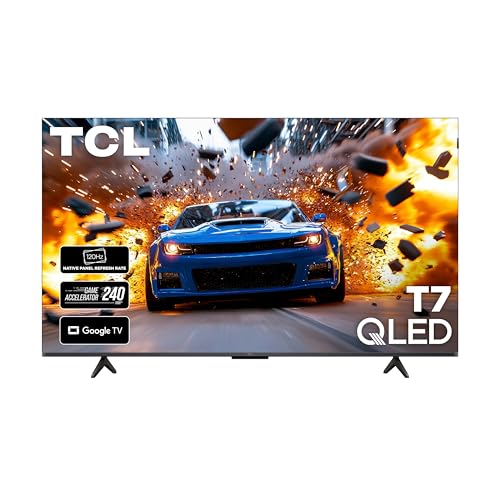
TCL 55 Inch Class T7 Series | 4K QLED HDR | 55T7, 2025 Model | 120HZ Refresh Rate High Brightness Smart Google TV Dolby Atmos Audio | Voice Remote Alexa Gaming Streaming Television
4K UltraHD Resolution: Experience incredible detail with 4X the resolution of 1080p Full HDTVs
As an affiliate, we earn on qualifying purchases.
As an affiliate, we earn on qualifying purchases.
Conclusion
So, while 8K TVs offer incredible resolution, the truth is that most viewers won’t notice a real difference yet, especially on smaller screens. The theory that 8K will soon transform your viewing experience assumes content and technology will catch up, but for now, 4K remains the practical choice. As technology evolves, 8K might become more relevant, yet for most, investing in a high-quality 4K TV still makes the most sense today.
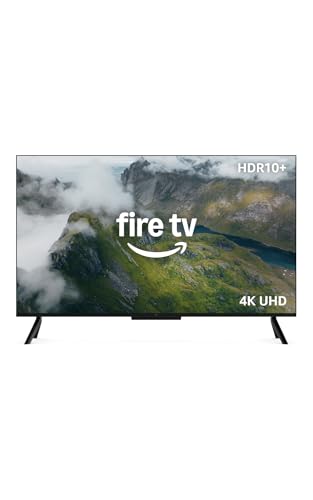
Amazon Fire TV 50" 4-Series (newest model), 4K Ultra HD smart TV with Alexa Remote, HDR10+, fast processor, Dolby Audio, Ambient Experience, free and live TV, find shows faster with Alexa+
Get more from your TV – With 4K Ultra HD, enhanced brightness, and clear audio, the Fire TV…
As an affiliate, we earn on qualifying purchases.
As an affiliate, we earn on qualifying purchases.
TCL 55 Inch Class T7 Series | 4K QLED HDR | 55T7, 2025 Model | 120HZ Refresh Rate High Brightness Smart Google TV Dolby Atmos Audio | Voice Remote Alexa Gaming Streaming Television
4K UltraHD Resolution: Experience incredible detail with 4X the resolution of 1080p Full HDTVs
As an affiliate, we earn on qualifying purchases.
As an affiliate, we earn on qualifying purchases.