Mixed reality blends digital and physical worlds, transforming how you work and play by creating immersive environments. You can collaborate remotely in shared virtual spaces, manipulate 3D models, and brainstorm naturally, making teamwork more engaging. In gaming and entertainment, you achieve higher immersion by interacting with lifelike virtual worlds that respond to your movements. This technology is evolving rapidly, offering even richer experiences that seamlessly combine work and leisure—discover how this innovation can enhance your daily activities.
Key Takeaways
- Mixed reality enhances remote collaboration by creating shared virtual spaces for seamless teamwork and digital model manipulation.
- It immerses users in interactive gaming environments that respond to physical movements, increasing engagement and realism.
- Merges work and entertainment, allowing users to switch effortlessly between professional tasks and leisure activities within immersive environments.
- Continuous hardware advancements improve accessibility, realism, and interaction, broadening mixed reality’s applications for daily use.
- Facilitates innovative ways to connect, learn, and entertain by breaking traditional digital interface limitations and fostering natural interactions.
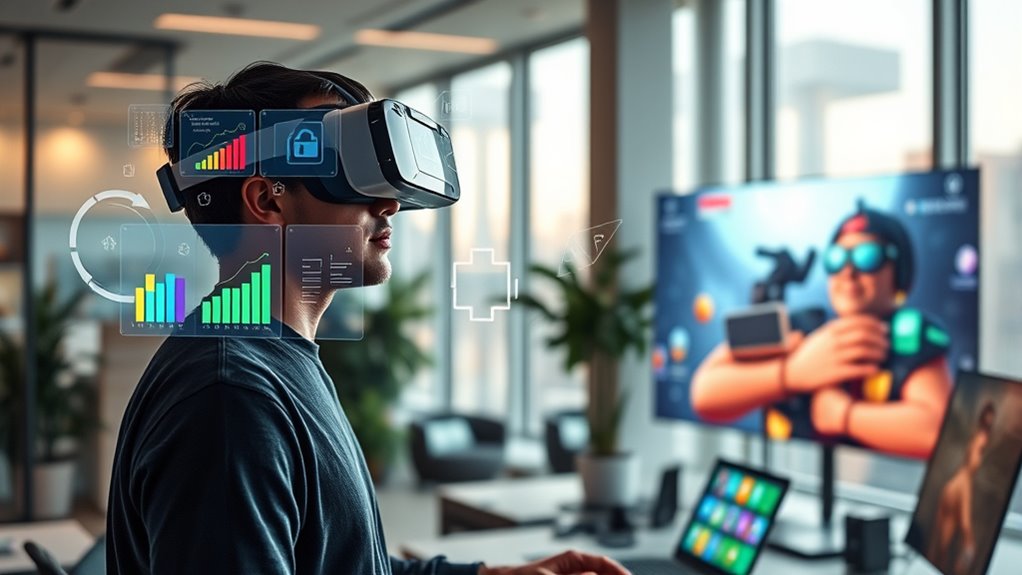
Mixed reality is transforming how we work and play by seamlessly blending the physical and digital worlds. With this technology, you’re no longer confined to screens or specific locations. Instead, you can step into environments where digital elements interact naturally with your surroundings. This shift opens up exciting possibilities for virtual collaboration, making remote teamwork more engaging and effective. Imagine sitting in a conference room, yet feeling like you’re sharing a space with colleagues from across the globe. You can manipulate 3D models, brainstorm ideas, or review documents together, all within a shared virtual space. Such immersive collaboration reduces misunderstandings and accelerates decision-making, creating a more dynamic and productive work environment. It’s like bringing the office to your living room, but with added layers of interaction and realism. Additionally, advancements in mixed reality hardware continue to expand the accessibility and realism of these experiences, making them more practical for everyday use.
At the same time, mixed reality elevates your gaming experience through immersive gaming. Instead of just watching or controlling characters on a screen, you become part of a three-dimensional world that reacts to your movements. Whether you’re battling enemies, exploring new worlds, or solving puzzles, the digital elements respond in real-time, making every session feel authentic and engaging. This immersion transforms gaming from passive entertainment to active adventure, where your physical actions influence the virtual environment. Plus, with mixed reality, multiplayer games become more social and interactive because you and your friends can see and manipulate shared virtual objects within your real-world space. This makes gameplay more intuitive and exciting, as you physically reach out to grab items or dodge obstacles, blurring the lines between game and reality.
As you adopt mixed reality for work and play, you’ll notice that virtual collaboration tools become more intuitive, fostering teamwork that feels natural despite physical distance. The technology encourages spontaneous interactions that mimic real-world conversations, boosting creativity and innovation. Meanwhile, immersive gaming becomes more lifelike, drawing you deeper into stories and challenges that feel tangibly real. You no longer have to choose between work and leisure — mixed reality seamlessly integrates both into your daily life, making tasks more efficient and entertainment more mesmerizing. This convergence is reshaping how you connect, learn, and have fun, all while breaking down the barriers of traditional digital interfaces. With each new advancement, mixed reality invites you to explore new levels of interaction, making your experiences richer, more engaging, and ultimately more satisfying.

Meta Quest 3 512GB | VR Headset — Thirty Percent Sharper Resolution — 2X Graphical Processing Power — Virtual Reality Without Wires — Access to 40+ Games with a 3-Month Trial of Meta Horizon+ Included
NEARLY 30% LEAP IN RESOLUTION — Experience every thrill in breathtaking detail with sharp graphics and stunning 4K…
As an affiliate, we earn on qualifying purchases.
As an affiliate, we earn on qualifying purchases.
Frequently Asked Questions
What Are the Main Technical Challenges in Developing Mixed Reality Devices?
You face several technical challenges developing mixed reality devices. Hardware limitations, like battery life, processing power, and display quality, restrict performance and comfort. Building an intuitive user interface is tough, as it must seamlessly blend virtual and real worlds while remaining user-friendly. Achieving precise tracking and minimizing latency also pose hurdles, ensuring smooth, immersive experiences without causing discomfort or disorientation for users.
How Does Mixed Reality Impact User Privacy and Data Security?
You should be aware that mixed reality raises significant privacy concerns and data protection challenges. As you use these devices, your personal data, including environment scans and behavior patterns, could be collected and potentially misused if not properly secured. Developers must implement robust security measures to safeguard your information, but always stay vigilant about permissions and data sharing settings to protect your privacy in mixed reality environments.
What Industries Are Most Likely to Benefit From Mixed Reality Integration?
Imagine stepping into a future where healthcare innovation blossoms and architectural visualization becomes a vivid dream. You’ll find industries like healthcare, where mixed reality enhances patient care and training, and architecture, where it brings blueprints to life with immersive clarity. These sectors benefit most, as they harness mixed reality’s power to improve precision, collaboration, and creativity. You’ll see how this technology transforms ideas into tangible realities, shaping tomorrow’s world today.
How Affordable Are Mixed Reality Solutions for Everyday Consumers?
Mixed reality solutions are becoming more affordable for everyday consumers, thanks to advancements in technology and increased competition. A thorough cost analysis shows prices are dropping, making devices more accessible. Your chances of consumer adoption grow as costs decrease and features improve. While high-end options still exist, budget-friendly mixed reality headsets are now available, allowing you to enjoy immersive experiences without breaking the bank.
What Are the Future Advancements Expected in Mixed Reality Technology?
In the future, you can expect advancements in mixed reality technology that make wearable interfaces more seamless and comfortable, enhancing your experience. Developers will create more immersive environments that feel incredibly real, improving both work and entertainment. These improvements will likely include better spatial mapping, higher resolution displays, and more intuitive controls, making mixed reality more accessible and engaging for everyday use.

Facmogu Voice Changer with Multi Sound Effects, Portable USB 3.0/ Type-C to 3.5mm Jack Game Voice Changer, Virtual 7.1 Surround Sound Voice Disguiser Device for PS4/ PS5/ Windows、MacOS PC/Laptop/Phone
Voice Changer & Noise Reduction — Transform your voice with 7 modes (original, male, female, cute, quirky voices…
As an affiliate, we earn on qualifying purchases.
As an affiliate, we earn on qualifying purchases.
Conclusion
So, now you’re basically living in a sci-fi movie, juggling work meetings and game nights in the same virtual universe. You might forget what’s real and what’s not—just don’t try to grab that floating coffee cup during a meeting! As mixed reality blurs lines, one thing’s clear: soon, your boss might be a hologram, and your favorite game could be a tap away. Welcome to the future—where reality is just a suggestion.

RayNeo Air 4 Pro AR/XR Glasses – 201" HDR10 Video Display, Vision 4000 Chip, Audio by Bang & Olufsen, 3D Movies & Gaming Smart Glasses for iPhone 17,16,15/Android/Switch 2/Mac/PS4/5-4 Pro
World’s First HDR10 AR Display – Experience over 10 billion colors and ultra-deep contrast on a massive 201-inch…
As an affiliate, we earn on qualifying purchases.
As an affiliate, we earn on qualifying purchases.

Razer BlackShark V2 X Xbox Gaming Headset: 50mm Drivers – Cardioid Mic – Lightweight – Comfortable, Noise Isolating Earcups – for Xbox Series X, Series S, PS5, PC, Switch via 3.5mm Audio Jack – Black
TRIFORCE TITANIUM 50 MM DRIVERS — Our cutting-edge proprietary design divides the driver into 3 parts for the…
As an affiliate, we earn on qualifying purchases.
As an affiliate, we earn on qualifying purchases.